Konica Big Mini: models, prices, how to use it and common faults
The short answer
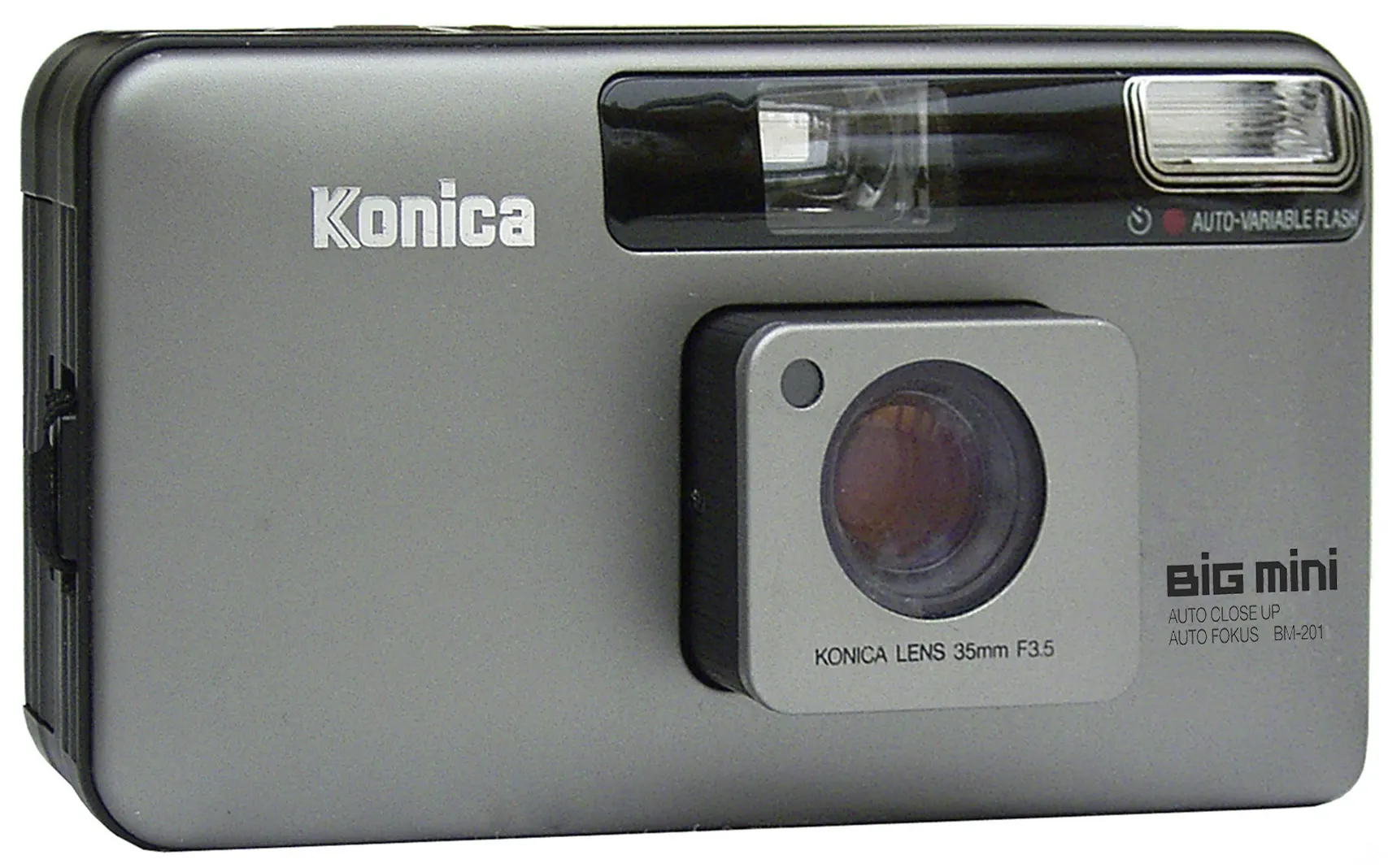
The Konica Big Mini is a pocket 35mm point-and-shoot, first sold as the BM-201 in 1990, and owners rate its 35mm f/3.5 lens and image quality positively in 25 of 30 comments, with none negative.
The catch is reliability: 10 of 14 comments on it are negative, mostly about dead rear displays and stiff shutter buttons, so buy a tested copy. Working BM-201s ran about $150 to $200 in 2025, and Brooklyn Film Camera listed a refurbished BM-301 with a 3-month warranty at $500 in October 2026, though it was out of stock that day.
- Lens
- 35mm f/3.5, 4 elements
- Battery
- One CR123A (3V lithium)
- Weight
- 188 g (BM-201, no battery)
- Released
- 1990 (BM-201)
Built from 131 opinions from 28 pages and videos. Not yet tested by Camera Dojo. Updated .
The short version
Across 131 opinions from 23 blogs, review sites and YouTube channels, the lens is the strongest topic: 13 of 17 comments are positive and none are negative, and Japan Camera Hunter calls it very sharp with excellent contrast. All 9 comments on size are positive, 10 of 12 praise the bright viewfinder and quick autofocus, and Matt Loves Cameras points out that exposure compensation is rare on compacts outside the high end.
Reliability is the weak spot. Owners describe dead rear LCDs, overlapping frames and one camera that lasted a single roll, and Japan Camera Hunter blames the ribbon cable behind the back panel. The BM-201's shutter button is the other common complaint: Analog.Cafe missed 2 to 5 shots per roll trying to make it fire. Price splits owners evenly, because the film revival turned a once-cheap compact into a $150-plus purchase.
Good fit if
- You want a sharp 35mm lens in a smooth, flat body that slips into a pocket
- You like fully automatic shooting but still want +1.5 or -1.5 EV exposure compensation for backlit scenes
- You shoot DX-coded film from ISO 25 up to ISO 3200, including fast black and white
- You can buy a tested copy with a warranty, or accept the risk on a cheaper one
- You want a pocket compact for a fraction of what a Contax T2 or Minolta TC-1 costs
Think twice if
- You need a camera that keeps working for years; owners say Big Minis die and parts are scarce
- You shoot quiet candids: Casual Photophile ranks the BM-201's motor among the noisiest point-and-shoots it has used
- You bulk-load film without DX codes, which the camera rates at ISO 25
- You dislike fiddly controls; the rear buttons are tiny rubber domes some owners press with a pencil
- You want fast glass for dim light without flash; f/3.5 is slower than the f/2.8 or faster lenses on many compacts
What owners and reviewers say, topic by topic
We sorted 131 opinions about the Big Mini from 28 pages and videos on 23 websites and channels. Each row shows how many people raised a topic and how many of them were positive. Open a row to read short quotes, each linked to its source.
Owner voices come mainly from long-form blogs (Matt Loves Cameras, Michael Fil, Film Advance, 35mmc, Shoot With Personality), editorial reviews (Analog.Cafe, Casual Photophile, EMULSIVE), reader comments and five YouTube reviews, two of which cover the earlier Konica A4. Reddit, Photrio and photo.net could not be read, so forum voices are thin, and 14 of the 15 Analog.Cafe opinions come from one author (the 15th is a reader comment).
Lenses76% positiveof 17
The strongest topic, with no negative comments: owners call the 35mm f/3.5 sharp corner to corner with good contrast. The 4 mixed notes say f/3.5 is slow, the Big Mini F flares in direct light, EMULSIVE saw no sharpness edge over an Olympus Mju II, and one BM-20 owner found his frames softer than expected.
“All things being equal, the lens is pretty darn sharp”
Amanda Raney, Shoot With Personality 2014-01Owner
“It has a 35mm f/3.5 four-element lens that delivers nice, sharp results.”
Gary, Film Advance 2015-05Owner
“The lens on this camera is very sharp and has excellent contrast rendering.”
Bellamy, Japan Camera Hunter 2012-05Owner
“that these images were not as sharp as expected”
ImagingPixelOwner
Controls and features53% positiveof 15
Owners value the exposure compensation and the short list of buttons, but 5 complain that the tiny rubber rear buttons are hard to press or that the BM-21 gives no focus feedback in the viewfinder.
“The buttons on the back are unfortunately also hard to press, they are tiny and mushy.”
Thang Nguyen, 35mmc 2020-07Owner
“The ability to alter exposure with these modes is a feature not usually seen on point and shoots other than high end models.”
Matt Murray, Matt Loves Cameras 2025-08Owner
“That's why it's appreciated that it has a built-in exposure compensation system”
Jorge, Dusty GrainHands-on review
“It's one of those tiny rubberized ones that you have to press "just so" to get it to do its thing”
Gary, Film Advance 2015-05Owner
Reliability today14% positiveof 14
The weakest topic: 10 of 14 comments are negative, citing dead rear LCDs, a failing ribbon cable, overlapping frames and a camera that died after one roll. Two owners report copies that kept working.
“Rest in piece my Big Mini. Only lasted one roll of film.”
Ray, EMULSIVE (reader comment) 2019-09Owner
“Mine is on its last legs, and the display on the back has gone”
darren, Japan Camera Hunter (reader comment) 2012-12Owner
“Perhaps more than any other compact camera, it has a reputation for dying”
Matt Murray, Matt Loves Cameras 2025-08Owner
“Big Minis are known to occasionally break down though they don't carry a reputation as bad as some other '90s point-and-shoots”
Dmitri, Analog.Cafe 2022-06Owner
Image results92% positiveof 13
12 of 13 comments are positive: owners describe sharp, well-exposed, colorful negatives, and Casual Photophile notes slightly lower contrast and pastel colors. The one mixed view calls the BM-21's results good but nothing special.
“When it's good, it's VERY good”
Amanda Raney, Shoot With Personality 2014-01Owner
“In every photo the subject was in focus and actually quite sharp.”
Nicole LD, Beau Photo Supplies blog 2018-01Owner
“The images were sharp, well exposed. Colors were nice and bright.”
Sunkenrat, 35mmc 2016-09Owner
“The images look sharp, are well exposed, and have fantastic colour and contrast.”
Matt Murray, Matt Loves Cameras 2025-08Owner
Viewfinder and focusing83% positiveof 12
10 of 12 comments praise the bright viewfinder and fast, accurate autofocus. The 2 complaints are close-range misses on the BM-21 and one beach scene where 35mmc's camera could not lock on.
“The Konica Big Mini really struggled to find my subject even when I was giving it a reasonably sized thing to lock on to”
Hamish Gill, 35mmc 2013-07Owner
“The autofocus action on Big Mini F is remarkably fast.”
Dmitri, Analog.Cafe 2023-06Owner
“The camera is also quick to focus and has minimal shutter lag.”
Gary, Film Advance 2015-05Owner
“It has a nice bright viewfinder and I found it a pleasure to compose images with.”
Matt Murray, Matt Loves Cameras 2025-08Owner
Ease of use64% positiveof 11
Most owners find it simple to point and shoot, and Analog.Cafe would hand the Big Mini F to someone who has never shot film. The 4 complaints are about the BM-201's stiff shutter button and its loud motor.
“It takes a bit of a push to get it to fire and has no definitive click to its action”
Hamish Gill, 35mmc 2013-07Owner
“having a point and shoot is convenient at times”
Tom, Being and Formulating 2024-06Owner
“This is the kind of camera you can hand to someone who's never shot film”
Dmitri, Analog.Cafe 2023-06Owner
“I actually enjoyed learning to use the Big Mini and will continue to do so.”
Amanda Raney, Shoot With Personality 2014-01Owner
Build quality55% positiveof 11
Most owners find it solid, with a premium-feeling metal front. The negatives are the missing lens cover, a loud film winder and one owner who found the Big Mini F flimsier than older models.
“I'm a bit scared of the lack of a lens cover.”
Amanda Raney, Shoot With Personality 2014-01Owner
“Unlike most similar cameras, the Big Mini lacks a lens cover.”
Gary, Film Advance 2015-05Owner
“my BM-302 feels like a well-built camera that can last a while”
Dmitri, Analog.Cafe 2022-06Owner
“Big Mini F is a well-made camera; it features higher-quality components than its predecessors.”
Dmitri, Analog.Cafe 2023-06Owner
Price and value40% positiveof 10
Opinion is split: some say a clean copy at a fair price is worth it and far cheaper than a Minolta TC-1, while others say the film revival pushed prices too high, especially for the Big Mini F.
“A film photography renaissance has inflated prices for these cameras beyond what many deem reasonable.”
Michael Fil blogOwner
“Nowadays, it's impossible to find one for under $350 in good condition, and you will have to source one from Japan.”
Thang Nguyen, 35mmc 2020-07Owner
“BM-201 today sells for less than a fifth of what Minolta TC-1 goes for”
Dmitri, Analog.Cafe 2022-06Owner
“If you can pick up a nice looking model at a decent price, it's worth buying.”
Matt Murray, Matt Loves Cameras 2025-08Owner
Size and weight100% positiveof 9
All 9 comments are positive: the flat, smooth body slips into a pocket and makes the Big Mini an easy everyday carry.
“its compact size makes it an easy everyday carry”
Michael Fil blogOwner
“it is compact and light, and is just about right for the palm of your hand”
ImagingPixelOwner
“I also love how this camera has virtually no bumps or pieces sticking out from its sleek shell. It's very pocketable.”
Dmitri, Analog.Cafe 2022-06Owner
“The camera is so small, it's a joy manoeuvring it around your hand to go from landscape to portrait in a sudden movement.”
Sunkenrat, 35mmc 2016-09Owner
Light meter and exposure50% positiveof 8
Opinion is split: 4 comments trust the meter and like the easy exposure compensation, while 3 say it is easily fooled or leans toward underexposure, so backlit scenes need +1.5 EV.
“I wish the camera didn't err on the side of underexposure”
Dmitri, Analog.Cafe 2022-06Owner
“I haven't gotten many well exposed shots because the meter isn't that great”
Urban Hafner, 35mmc (reader comment) 2013-09Owner
“It's got an accurate meter with easy exp. comp setting.”
Aaron, Japan Camera Hunter (reader comment) 2012-05Owner
“Need to compensate for backlighting? The EV button's right there, and you can actually trust this meter.”
Josh Solomon, Casual Photophile 2017-05Hands-on review
Repairs and servicing29% positiveof 7
Mostly negative: the shutter button is proprietary, the back-panel ribbon is the weak spot and an electronic fault can end the camera. On the plus side, cleaning dust from behind the front filter takes two screws.
“Now the lens doesn't slide in and out so smoothly.”
João Peixoto, 35mmc (reader comment) 2015-05Owner
“these cameras have been around for decades and are difficult to service”
Michael Fil blogOwner
“The main problem seems to be the ribbon that connects the control panel on the back of the camera.”
Bellamy, Japan Camera Hunter 2012-05Owner
“since Relics restores their cameras, I felt confident that the camera worked”
Tom, Being and Formulating 2024-06Owner
PositiveMixedNegative
Konica Big Mini models: BM-201, BM-301, BM-302 and Big Mini F
Big Mini is a family name, not one camera. The BM-201 arrived in 1990 after the 1989 Konica A4, and the BM-201, BM-301 and BM-302 all use a 35mm f/3.5 four-element lens. The 1997 Big Mini F was the only model in the BM series with an f/2.8 lens.
Analog.Cafe, which used both, prefers the BM-302 to the BM-201 for its much quieter motor and a shutter button that gave no trouble, though the reviewer admits he may have been lucky. Dusty Grain calls the Big Mini F probably the best model in the line and the last with a fixed lens.
You will also see the BM-20 (sold as the Big Mini Jr.), the BM-21 and the Big Mini Ex. Owner reviews of these are scarce: ImagingPixel's BM-20 had a plastic body and a dead LCD, and davidde.com found the BM-21 gives no focus or exposure feedback in the viewfinder.
| Model | Lens | What sets it apart |
|---|---|---|
| Konica A4 (1989) | 35mm f/3.5 | The predecessor; Matt Gabriel's video review says it needs a second battery for the rear LCD |
| BM-201 (1990) and BM-202 | 35mm f/3.5, 4 elements | Square lens housing; the 201 has a date back and the 202 does not; loud motor and a shutter button known for needing several presses |
| BM-301 and BM-302 | 35mm f/3.5, 4 elements | Round lens housing; the 301 has a date back and the 302 does not; Analog.Cafe found the 302's motor much quieter than the BM-201's |
| Big Mini F (1997) | 35mm f/2.8 | The only f/2.8 model, with a 4 s to 1/450 s shutter; Dusty Grain calls it probably the best Big Mini |
| BM-310Z, 311Z, 411Z, 510Z, 610Z | Zoom | Zoom models, less sought after than the fixed-lens cameras |
Sources: mattlovescameras.substack.com, analog.cafe, analog.cafe, japancamerahunter.com, filmadvance.com, dustygrain.com, forum.mflenses.com, imagingpixel.com, davidde.com, youtube.com
How to use a Konica Big Mini: battery, film and the mode button
The Big Mini sets focus, exposure and film speed for you, so using it well comes down to a fresh battery, DX-coded film and knowing what the mode button does.
- 1
Fit a CR123A battery
It takes one 3V lithium CR123A, also sold as DL123A, EL123A or CR17345, and filmphotography.eu puts battery life at about 840 shots. Our film camera battery finder covers other cameras.
- 2
Load DX-coded film
Drop the cassette in and close the back; the camera advances the film to the first frame by itself. It reads DX codes from ISO 25 to 3200, and film without a code is rated ISO 25. Our film loading guide covers the basics.
- 3
Pick a mode
The mode button cycles through auto flash, flash on, flash off, flash off +1.5 EV and flash off -1.5 EV. Everything resets to auto flash when you switch off, so 35mmc's reviewer carried the camera switched on. On the BM-302 you can set the mode while the camera is off and it holds when you power up.
- 4
Press the small buttons with a pencil tip
The rear buttons are tiny rubber domes. Analog.Cafe's reviewer presses them with a pencil on his BM-201.
- 5
Half-press to focus and check the lights
Put the center of the frame on your subject and half-press: a green light beside the viewfinder means focus is locked, and a blinking one means it could not focus. Keep the half-press to recompose. An orange light means the flash will fire; if it blinks, the flash is still charging or the subject is beyond about 3.8 m (12 ft 5 in).
- 6
Use infinity mode for landscapes
For landscapes and horizons, use the infinity (mountain) mode, because the infrared autofocus can struggle with far subjects. Up close, the camera focuses from 0.35 to 0.6 m (about 14 to 24 in) when the close-up indicator is lit, with a little less sharpness.
- 7
Let it rewind
The camera rewinds by itself at the end of the roll, and it will not power off or retract the lens until you open the back and take the cassette out.
Sources: filmphotography.eu, batteryjunction.com, mattlovescameras.substack.com, 35mmc.com, analog.cafe, analog.cafe
Best film for the Konica Big Mini
 Ultramax 400
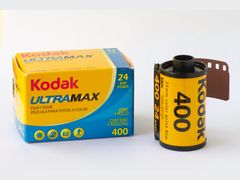
ISO 400 color negative is the easy default. Analog.Cafe says the f/3.5 lens is not fast enough for slow film in dim light without flash, and filmphotography.eu suggests Kodak Ultramax 400. Brooklyn Film Camera's Big Mini starter kit offers Portra 400 or Ilford HP5.
Because the camera reads DX codes up to ISO 3200, fast film such as Ilford Delta 3200 works, which Michael Fil points out many compacts cannot handle. Analog.Cafe adds that the meter's lean toward underexposure hurts color negative in contrasty light but can suit black and white and some slide films such as Ektachrome E100, and Michael Fil got acceptable results on slide film.
Skip film without a DX code. The camera rates it at ISO 25, so an ISO 400 roll gets four stops too much light (25 to 50 to 100 to 200 to 400). Our film ISO explainer covers what that does to negatives.
There is no way to set ISO by hand: a cassette with no DX code is always metered as ISO 25.
Sources: analog.cafe, filmphotography.eu, brooklynfilmcamera.com, michaelfil.com, mattlovescameras.substack.com
Getting good exposures: the meter, +1.5 EV and the flash
The meter splits owners. Casual Photophile trusts it and likes having the EV button right there for backlit scenes, while Analog.Cafe found it errs toward underexposure, and Amanda Raney at Shoot With Personality often needed +1.5 EV during her first two rolls. Dusty Grain saw the Big Mini F underexpose only in very specific situations.
The rule these reviewers settle on: for backlit subjects, switch to flash off +1.5 EV before you shoot. Because the camera falls back to auto flash when it is switched off (the BM-302 holds a mode set while it is off), check the mode after each switch-on.
The flash covers 0.35 to 3.8 m at ISO 100 and recycles in about 3 seconds. Michael Fil found it strong up close and weak for distant subjects, and it fires on its own in dim light while the camera is in auto flash.
Exposure compensation only works with the flash off, so you cannot combine +1.5 EV with fill flash.
Sources: casualphotophile.com, analog.cafe, shootwithpersonality.com, dustygrain.com, filmphotography.eu, michaelfil.com, 35mmc.com
What to check before buying a used Konica Big Mini
Big Minis have a reputation for dying, so how the seller tested the camera matters more than how it looks. These checks come from owners who bought duds and the shops that refurbish them; our guide to buying and testing used film cameras covers the general routine.
- 1
Ask how it was tested
Matt Murray's first eBay Big Mini was sold as in perfect working condition, but the flash modes did not work and the shutter was very hard to press, and he sent it back. Analog.Cafe's advice is to ask the seller how the camera was tested before you buy.
- 2
Make the shutter fire repeatedly
If you can handle the camera, press the shutter many times with it switched on. A button that needs several firm presses is the BM-201's best-known fault and has no easy fix.
- 3
Cycle every mode and look at the LCD
Step through all five flash and exposure modes and confirm the rear display shows each one, along with the frame counter. Online, ask for a photo of the lit LCD: Japan Camera Hunter names the ribbon behind the back panel as the main weak spot.
- 4
Inspect the front glass
There is no lens cover, so check the clear front filter for scratches and dust. Dusty Grain passes on any copy whose ring around the lens is heavily faded and yellowed.
- 5
Prefer a warranty
Brooklyn Film Camera says it verifies the electronics and LCD, cleans the optics and tests autofocus, flash modes and film transport on the Big Minis it sells, with a 3-month warranty. Michael Fil's rule: buy a well-maintained camera or have somewhere to get it serviced.
- 6
Weigh repair against replacement
Brooklyn Film Camera says that for many cameras under about $200, repair costs more than a tested, warrantied replacement, and Casual Photophile expects a shutter button repair to cost more than the camera is worth.
Sources: mattlovescameras.substack.com, analog.cafe, casualphotophile.com, japancamerahunter.com, dustygrain.com, brooklynfilmcamera.com, michaelfil.com, brooklynfilmcamera.com
Known problems and what fixing them costs
These are the faults owners and reviewers report most. No US shop publishes a Big Mini repair price, so the costs below are general rates published by US repairers in October 2026, and a real quote comes only after an inspection.
Stiff or unresponsive shutter button
Raised in 5 opinions
- How you notice
- The shutter needs several firm presses before it fires; Matt Murray had to press his four or five times, and Analog.Cafe missed 2 to 5 shots per roll. It is mostly reported on the BM-201; Analog.Cafe's BM-302 had no such trouble, though the reviewer says he may have been lucky.
- Fix
- There is no known user fix. Casual Photophile says the button is proprietary and finding the part would be a wild goose chase, so test it before you buy and favor a seller who tested it.
- Typical cost
- Casual Photophile expects the repair to cost more than the camera is worth. For scale, Brooklyn Film Camera (Brooklyn, NY) lists specific repairs such as a stuck shutter at $80-120 with no warranty, but its repair menu does not name the Big Mini.
Sources: mattlovescameras.substack.com, analog.cafe, analog.cafe, casualphotophile.com, brooklynfilmcamera.com
Dead or fading rear LCD (broken ribbon cable)
Raised in 4 opinions
- How you notice
- The display on the back goes blank, taking the frame counter and mode display with it. A Japan Camera Hunter reader's camera lost its display, ImagingPixel's BM-20 had a dead LCD panel, and KingJvpes says the ribbon cable commonly fails.
- Fix
- Japan Camera Hunter names the ribbon that connects the back control panel as the main weak spot. A video tutorial shows how to replace the BM-201's LCD flex cable; otherwise, buy only a copy with a working display.
- Typical cost
- No US shop quote for a Big Mini found. Photecnica, which calls itself a Konica specialist, bills $180 an hour in half-hour steps and charges a $45 minimum diagnostic fee if a camera cannot be fixed; Brooklyn Film Camera charges a $50 inspection fee that is credited to the repair.
Sources: japancamerahunter.com, imagingpixel.com, kuzmiakkamil.com, photecnica.com, brooklynfilmcamera.com
Flash modes or exposure compensation not working
- How you notice
- The mode button does nothing or the flash modes do not change. Matt Murray's first copy, sold as in perfect working condition, had dead flash modes and an exposure compensation he suspected also did not work.
- Fix
- Step through every mode before you buy, or ask the seller to confirm each one works. Matt Murray sent his copy back.
- Typical cost
- No published Big Mini price; expect an inspection fee such as Brooklyn Film Camera's $50 before any quote.
Sources: mattlovescameras.substack.com, brooklynfilmcamera.com
Overlapping or skipped frames
Raised in 2 opinions
- How you notice
- Frames land on top of each other while everything else seems to work; one Flickr owner spoiled three rolls this way on a BM-201. A 35mmc reader reported skipped frames, especially after removing the battery.
- Fix
- A Flickr group member says an infrared LED and sensor near the film sprocket count the holes, and a dying or dirty one causes this; gentle cleaning is worth a try. If it is an electronic fault, the same member calls it probably a death sentence for the camera.
- Typical cost
- Nothing to try cleaning; beyond that, see the inspection fees above.
Sources: flickr.com, 35mmc.com
Dust or fluff behind the front filter
Raised in 2 opinions
- How you notice
- Specks and fluff collect behind the clear filter in front of the lens, which has no cover.
- Fix
- On his Big Mini, 35mmc's Hamish Gill removed two screws, one on each side of the extended lens, pulled the front part off, blew and wiped out the dust and put it back. A reader who followed the steps found his BM-201's lens moved less smoothly afterward, so go gently.
- Typical cost
- Nothing if you do it yourself. Brooklyn Film Camera's lens CLAs start at $125. The shop does not say whether it takes Big Mini lenses.
Sources: 35mmc.com, brooklynfilmcamera.com
Underexposed negatives in backlit or mixed light
Raised in 4 opinions
- How you notice
- Several reviewers find the meter leans toward underexposure, and Amanda Raney found it easily fooled over two rolls.
- Fix
- Set flash off +1.5 EV for backlit scenes, or use ISO 400 film for more margin.
- Typical cost
- None; it is technique.
Sources: analog.cafe, analog.cafe, shootwithpersonality.com, dustygrain.com
Exposed front glass
Raised in 2 opinions
- How you notice
- Unlike most similar cameras, the Big Mini has no lens cover, so the clear front filter picks up fingerprints and pocket grime and can scratch.
- Fix
- Wipe the filter with a clean cloth and keep the camera in a pocket on its own, as Analog.Cafe's reviewer does, or in a case.
- Typical cost
- None; it is care.
Sources: filmadvance.com, analog.cafe
Photos taken with a Konica Big Mini
A photo taken with a Konica Big Mini by a Wikimedia Commons contributor; free-license samples from this camera are scarce.

Saint-Malo, France, March 2012, shot on expired Kodak Portra 400VCPhoto: laurent gauthier from Rennes, France, CC BY 2.0
What a Konica Big Mini costs today
Few US shops had a Big Mini in stock on October 28, 2026. Brooklyn Film Camera listed a refurbished BM-301 at $500 with a 3-month warranty, out of stock that day, and Kamerastore listed a certified BM-302 at $327 (now sold out). Editorial estimates are older: Matt Loves Cameras put working BM-201s at about $150 to $200 in August 2025, and Analog.Cafe saw $150 to $350 in June 2022.
Brooklyn Film Camera (Brooklyn, NY)
Refurbished, 3-month warranty (out of stock), BM-301, camera only
$500.00
See listingKamerastore (Finland, prices in USD)
Certified (sold out), BM-302, camera only
$327.00
See listing
Prices checked on October 28, 2026. They move every week, so treat them as a range, not a quote. In Europe, filmphotography.eu tracked an average of 162.19 euros across 31 offers on October 19, 2026. The Big Mini F costs more: Dusty Grain saw $150 to $700 in February 2023. Analog.Cafe says most Big Minis for sale come from Japan. eBay and KEH pages could not be checked by our scripts, and MPB and B&H showed no Big Mini, so no marketplace prices are listed here.
Video reviews worth your time

Konica Big Mini F Film Camera Review + Photos
The Konica Big Mini F is a high-quality 35mm point-and-shoot camera featuring a sharp f/2.8 lens, automatic functions, and simple overall operation.

Konica Big Mini (A4) | Review
The Konica A4 is an underrated, high-value point-and-shoot film camera offering identical lens quality and close-focus performance to pricier Big Mini models.

Konica Big Mini / A4 Review
The Konica A4 is a stylish, highly pocketable point-and-shoot camera featuring a quiet shutter and sharp lens, though sticky lens cover flaps and a dual-battery requirement are minor downsides.

THE KONICA BIG MINI! (IN YOSEMITE)
The Konica Big Mini is a compact, highly pocketable point-and-shoot camera featuring a sharp 35mm lens and reliable metering, making it a great travel option despite occasional shutter lag and common rear LCD ribbon cable issues.

POINT & SHOOT FILM CAMERA - shooting my beloved Konica Big Mini - reupload
The Konica Big Mini is a lightweight and simple point-and-shoot camera that yields impressive photos, though its high price tag and risk of failure are drawbacks.
Specifications
Lens and exposure
- Shutter (BM-201)
- 3.6 s to 1/500 s, electronic, stepless
- Shutter, other figures
- Kamerastore lists 7.5 s to 1/360 s for the BM-302; Brooklyn Film Camera lists 2 s to 1/300 s for its BM-301
- Shutter (Big Mini F)
- 4 s to 1/450 s
- Exposure compensation
- +1.5 or -1.5 EV, with the flash off only
- Manual controls
- None
Focus, flash and power
- Close-up range
- 0.35 to 0.6 m with the close-up indicator lit
- Flash (BM-201)
- Built in, 0.35 to 3.8 m at ISO 100, about 3 s recycle
Body and history
- Size and weight (BM-201)
- 115 x 63 x 34 mm, 188 g without battery
- Size and weight (BM-302)
- 115 x 63 x 32 mm, 174 g without battery
- Construction
- Metal front, plastic back
- Construction, other view
- Dusty Grain's comparison table lists the BM-201 as full plastic, with only the Big Mini F getting an aluminum front
- Lens protection
- No lens cover; fixed clear filter in front
- Launched (BM-201)
- 1990
- Launched (Big Mini F)
- 1997
- Price new
- About $130
Questions people ask about the Big Mini
Is the Konica Big Mini a good camera?
For pictures, yes: owners and reviewers rate its 35mm f/3.5 lens and image quality positively in 25 of 30 comments, with none negative, and EMULSIVE found it reasonably quick to use with very good results. The weak point is age. Matt Loves Cameras says it has a reputation for dying, perhaps more than any other compact, so a tested copy matters more than which model you buy.
Sources: mattlovescameras.substack.com, emulsive.org
When was the Konica Big Mini BM-201 released?
In 1990, according to Matt Loves Cameras and Analog.Cafe. It followed the Konica A4 of 1989 and sold for about $130 new. The f/2.8 Big Mini F followed in 1997.
Sources: mattlovescameras.substack.com, analog.cafe, dustygrain.com
What battery does the Konica Big Mini take?
One CR123A, a 3V lithium cell also sold as DL123A, EL123A or CR17345; filmphotography.eu puts its life at about 840 shots. Rechargeable RCR123A or 16340 cells are the same size but run at about 3.6V, so a standard 3V lithium cell is the safer choice. The older Konica A4 also needs a second battery for its rear LCD, according to Matt Gabriel's video review.
Sources: filmphotography.eu, batteryjunction.com, en.wikipedia.org, youtube.com
What is the Konica Big Mini BM-301, and how is it different from the BM-302?
The BM-301 and BM-302 are the 300-series Big Minis, with a round lens housing instead of the BM-201's square one and the same 35mm f/3.5 lens. The 301 has a date back and the 302 does not, per Japan Camera Hunter. Film Advance found the BM-302 quick to focus with minimal shutter lag, and Analog.Cafe found it much quieter than the BM-201.
Sources: mattlovescameras.substack.com, japancamerahunter.com, filmadvance.com, analog.cafe
How much does a Konica Big Mini cost?
Working BM-201s ran about $150 to $200 in 2025, according to Matt Loves Cameras, and Brooklyn Film Camera listed a refurbished BM-301 with a 3-month warranty at $500 in October 2026, out of stock that day. The f/2.8 Big Mini F costs more; Dusty Grain saw prices from $150 to $700 in February 2023. New, the Big Mini sold for about $130.
Sources: mattlovescameras.substack.com, brooklynfilmcamera.com, dustygrain.com
Are old Minolta cameras worth anything?
It depends on the model, and a Minolta TC-1 is the clear example of one worth far more than a Big Mini. Analog.Cafe says a BM-201 sells for less than a fifth of what a TC-1 goes for, so the TC-1 costs more than five times as much. It is a compact launched in 1996 that Analog.Cafe counts among the smallest and most capable point-and-shoots ever made.
Sources: analog.cafe
What ISO does the Konica Big Mini use if the film has no DX code?
ISO 25. The camera reads DX codes from ISO 25 to 3200 and rates any cassette without a code at ISO 25, so an ISO 400 roll would get four stops too much light. Analog.Cafe says the Big Mini F behaves the same way, so stick to DX-coded film.
Sources: michaelfil.com, analog.cafe
Is the Konica Big Mini F worth the extra money?
Only if you want its f/2.8 lens. Thang Nguyen at 35mmc likes the sharp, contrasty lens and fast infrared autofocus but warns it flares badly in direct light, and in 2020 he said a good one cost at least $350 and usually had to come from Japan. A reader on EMULSIVE who owned two found the F noticeably sharper than the f/3.5 models but flimsier.
Sources: 35mmc.com, emulsive.org
What people compare it with
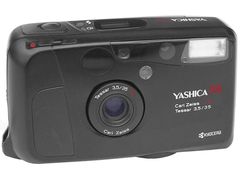
The clamshell rival with a faster f/2.8 lens; EMULSIVE compared the two lenses and saw no difference in sharpness.
Often compared with the Big Mini; a 35mmc reader with a BM-300 rates the T4's optics higher but finds the Konica far more responsive.
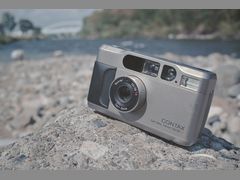
The titanium premium step: Brooklyn Film Camera lists one at $2,300, against $500 for its refurbished Big Mini.
Minolta TC-1
A premium compact launched in 1996 that Analog.Cafe counts among the smallest ever made; it says a BM-201 sells for less than a fifth of a TC-1's price.
Every source behind this page
Read them yourself. How we pick and count them is in our methodology.
Show all 37 sources
Independent blogs 16
- Matt Loves Cameras: Konica Big Mini: fun but fragile
- Michael Fil blog: Part II: Shooting the Konica Big Mini BM
- davidde.com: Review: The Konica Big Mini 21
- Film Advance: Favourite Cameras: Konica Big Mini BM
- Being and Formulating: Long Beach with My Konica Big Mini
- Japan Camera Hunter: Camera Geekery
- 35mmc: Konica Big Mini Review
- 35mmc: Konica Big Mini F Review
- 35mmc: Cleaning the dust out of a Konica Big Mini Lens
- Shoot With Personality: {Two Rolls In} Konica Big Mini
- Dusty Grain: Konica Big Mini F Review: A Bigger Camera Than You Think
- Beau Photo Supplies blog: Camera Speed Dating - Konica Big Mini
- 35mmc: 35mm Compact Camera Photographer #21 - Luis Diaz
- ImagingPixel: Konica Big Mini Jr. BM
- BKSPicture blog: Konica Big mini HG (BM
- 135compact.com: Konica Big Mini Ex
Manuals and references 9
- brooklynfilmcamera.com: Film Camera Repair Cost
- brooklynfilmcamera.com: Camera Repair NYC: Film Camera Repair in Brooklyn + Mail
- brooklynfilmcamera.com: Konica Big Mini 35mm Point and Shoot, Tested + Warranty
- en.wikipedia.org: List of battery sizes
- filmphotography.eu: Konica Big Mini BM-201
- kamerastore.com: Konica Big Mini BM-302 - Camera
- kuzmiakkamil.com: Konica Big Mini BM
- photecnica.com: Vintage camera repair service - Konica specialist
- batteryjunction.com: Energizer 3V ELCR123A Batteries - Bulk
Editorial reviews 5
Video reviews 5
Forums 2
Keep reading
Film cameras
The best point-and-shoot film camera for most people is the Olympus Mju II, about $250-$600 used. Eight picks from $34.99 to $2,000, prices checked Oct. 2026.
Film cameras
Olympus Mju II (Stylus Epic) guide: what 110 owner and reviewer opinions say, $399.99-$814 dealer listings in Oct 2026, common faults, film and battery tips.
Film cameras
What 145 owner and reviewer opinions say about the Yashica T4: its Zeiss lens, $449.95-$1,100 used prices at US shops in 2026, common faults and fixes.
Film cameras
Where to buy film cameras used in the US: KEH, MPB, B&H, local shops, eBay and thrift, with warranties, October 2026 prices and a checklist to test one.
Film stocks
Kodak Ultramax 400 is a 35mm ISO 400 color film, $8.69 to $11.50 a 36-exposure roll. What 121 opinions say about its color, grain, latitude and low light.