Free download
Film Camera Battery Finder: Which Battery Does Your Camera Take?
The short answer
Which film camera battery you need depends on the model: many 1970s and 1980s SLRs run on one or two SR44 button cells (1.55V silver oxide) or a single 6V 4LR44, while autofocus point-and-shoots and Canon EOS bodies use 3V CR123A or CR2 or 6V 2CR5 lithium cells.
Many 1960s and 1970s cameras were built for a 1.35V PX625 mercury cell, now banned or restricted nearly worldwide, and a few, like the Olympus Trip 35, need no battery at all. Find your model in the charts below and confirm it in a free finder; in October 2026 an SR44 cost $2.08 at Micro Battery and a Wein Cell mercury replacement $8.99 at Freestyle and Adorama.
- Classic SLR button cell
- SR44 or LR44, 11.6 x 5.4 mmen.wikipedia.org
- Canon AE-1 and A-series
- One 6V 4LR44global.canon
- Point-and-shoot lithium
- CR123A or CR2 (3V), 2CR5 (6V)photoethnography.com
- Mercury cell
- PX625, 1.35V, banned or restrictedcamera-wiki.org
- No battery needed
- Olympus Trip 35en.wikipedia.org
- SR44 price, Oct 2026
- $2.08 (Energizer 357/303)microbattery.com
Film camera battery chart: SLRs and rangefinders
Find your camera below. The battery column gives the type the maker or a solid camera reference lists, and the notes say what still works with no battery, because a dead cell stops some cameras completely and only switches off the meter on others.
Where a manual lists both LR44 and SR44, either fits. Photoethnography says to buy the silver oxide SR44 and not the alkaline LR44, and Ausgeknipst says to use an SR44 whenever the camera's instructions call for one.
| Camera | Battery | Notes |
|---|---|---|
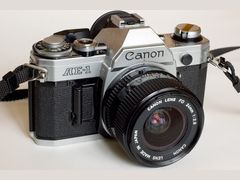 Canon AE-1 | One 6V 4LR44 (Energizer A544, PX28A); Canon's original spec also lists the 4G-13 | Does not work at all without it: every shutter speed is electronic. Full guide: Canon AE-1 battery |
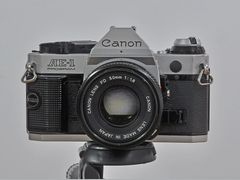 Canon AE-1 Program | One 6V cell: 4LR44/A544 alkaline, 4SR44/PX28 silver oxide or PX28L lithium | Will not function when power is insufficient |
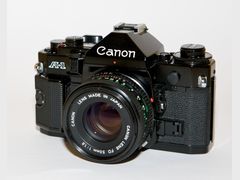 Canon A-1 | One 6V 4LR44 (or the original 4G-13) | All shutter speeds are electronic; battery check with a blinking LED |
| Canon AT-1 and AV-1 | Same 6V 4G-13 or 4LR44 as the AE-1 | On the AT-1, the overexposure warning doubles as the battery check |
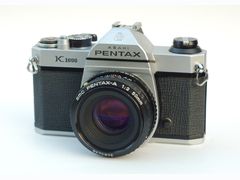 Pentax K1000 | One LR44 or SR44 (also sold as A76, S76, 357/303) | Fully usable with no battery; the cell runs the meter only. See the Pentax K1000 guide |
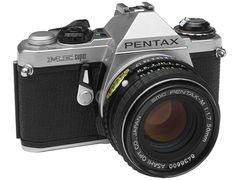 Pentax ME Super | Two SR44 (the manual says two 1.5V silver oxide cells); LR44 also fits | Without batteries only 1/125 (125X) and B work |
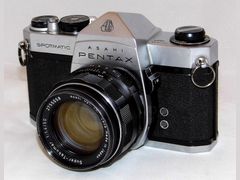 Pentax Spotmatic (SP, SP II) | Built for a 1.35V PX400 mercury cell; today a 1.55V silver oxide 387, which the bridge circuit handles | Shoots with no battery at all. The Spotmatic F takes a PX625-size cell instead. See the Spotmatic guide |
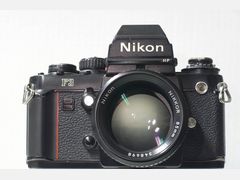 Nikon F3 | Two SR44 (Nikon's spec), or two LR44 or one CR-1/3N | Mechanical 1/60 backup through the release lever; the DB-2 holder takes two AA cells in the cold |
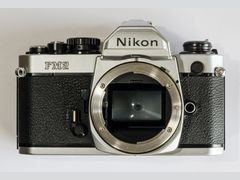 Nikon FM2 | Two SR44 or LR44, or one CR-1/3N lithium | Batteries run only the meter; every speed from 1 s to 1/4000 fires without them |
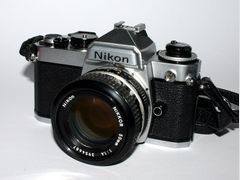 Nikon FE | Two SR44 or LR44 (S76, A76), or one 3V 1/3N lithium | Only M90 (1/90) and B work without batteries |
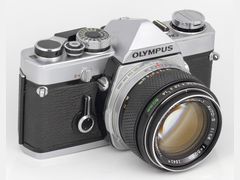 Olympus OM-1 | Built for one 1.35V PX625 mercury cell (also called EPX625 or MR9) | Everything except the meter works without a battery. See the OM-1 guide |
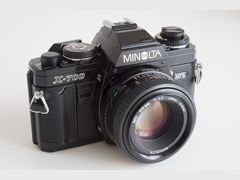 Minolta X-700 | Two LR44 (A76) or SR44 (S76/357), or one CR-1/3N | Needs batteries at every setting, including B; the manual says never to use 1.35V mercury cells |
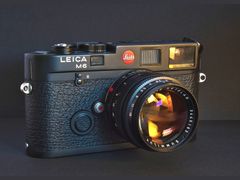 Leica M6 | Two SR44 or one 1/3N 3V lithium (the same for the 2022 M6) | Batteries run only the meter; the shutter is fully mechanical. See the Leica M6 guide |
| Canon F-1, Minolta SRT, Nikkormat F | PX625 mercury size | All three are on Freestyle's compatibility list for the 1.35V Wein Cell MRB-625 |
| Canon EOS 1V and EOS 3 | One 6V 2CR5 lithium | Entry-level EOS film bodies are the best-known CR2 users; Ausgeknipst's Canon list shows EOS models split across 2CR5, CR2 and CR123A |
One online battery guide lists the Olympus Trip 35 as an LR44 camera and the Nikon L35AF as a CR123A camera. Camera references say the Trip 35 needs no battery and the L35AF takes two AA cells.
Sources: global.canon, en.wikipedia.org, canonclassics.com, global.canon, global.canon, global.canon, en.wikipedia.org, filmtypes.com, 35mmc.com, camera-wiki.org, blog.jimgrey.net, imaging.nikon.com, thecamerasite.lauro.fi, brooklynfilmcamera.com, mir.com.my, mir.com.my, mir.com.my, mir.com.my, mir.com.my, en.wikipedia.org, camera-wiki.org, leica-camera.com, freestylephoto.com, photoethnography.com, dustygrain.com, ausgeknipst.de, kfconcept.com
Point-and-shoot and medium format camera batteries
Autofocus compacts run on lithium photo cells or AA batteries, and the electronic ones stop entirely when the cell dies: the Contax T2's meter, shutter, focus, flash and film transport all need power.
Medium format bodies split the other way. The Mamiya RB67 and Hasselblad 500C/M bodies are fully mechanical, and only metered prisms or motorized accessories take a battery.
| Camera | Battery | Notes |
|---|---|---|
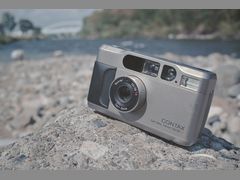 Contax T2 | One 3V CR123A | Meter, shutter, focus, flash and film transport are all electronic. See the Contax T2 guide |
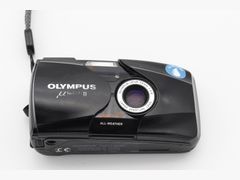 Olympus Mju II (Stylus Epic) | One 3V CR123A | Same cell as the Contax T2, Yashica T4 and Konica Big Mini |
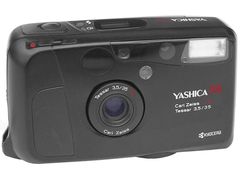 Yashica T4 | One 3V CR123A | About 20 rolls of 24 per cell with flash on about half the shots, per Lapse of the Shutter |
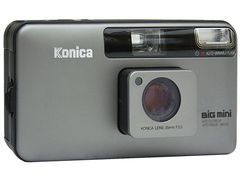 Konica Big Mini | One 3V CR123A | About 840 shots per cell, per filmphotography.eu |
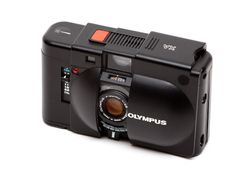 Olympus XA | Two SR44 (EPX-76) | The electronic shutter will not fire without batteries; a US repairer prefers SR44 over LR44 for steadier voltage |
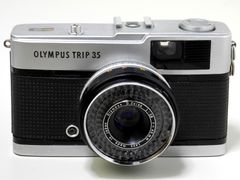 Olympus Trip 35 | None | The selenium meter is powered by light. See the Trip 35 guide |
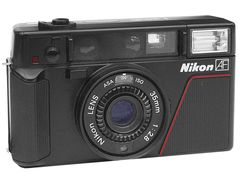 Nikon L35AF | Two AA alkaline | About 100 rolls of 24 per pair, per Casual Photophile; flash use shortens that |
| Canon Sure Shot (AF35M) and Sure Shot Owl | Two AA | On the AF35M, the AA cells run both the camera and the built-in flash |
| Later Canon Sure Shots | Supreme, Tele, Ace, Zoom XL: one 6V 2CR5. Max, Telemax, A-1, Sleek, 60 Zoom, 80 Tele: one CR123A. Classic 120: two CR2. 80u: one CR2 | Check the exact model name before you buy: the family spans AA, CR123A, CR2 and 2CR5 cells |
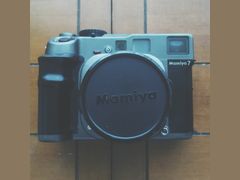 Mamiya 7 II | One 6V 4LR44, per Kamerastore's listing | The same 6V size as the Canon AE-1 cell |
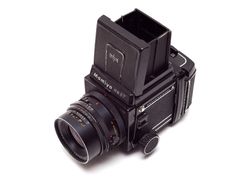 Mamiya RB67 | None in the body | Fully mechanical; only some accessories, such as motorized backs and auto-exposure finders, use batteries |
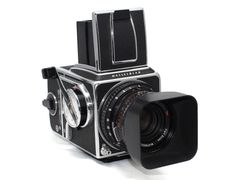 Hasselblad 500C/M | None in the body | Metered prisms do: the PME (1981 to 1988) takes a 6V PX28, the PME-45 a CR2, the PME-90 a CR123A, and the original 52051 meter prism a 1.5V PX625A |
Sources: camera-wiki.org, cute.camera, camera-wiki.org, camerawest.com, lapseoftheshutter.com, filmphotography.eu, en.wikipedia.org, xa2.cam, rangefinder-cameras.com, en.wikipedia.org, camera-wiki.org, casualphotophile.com, global.canon, global.canon, global.canon, global.canon, global.canon, global.canon, global.canon, global.canon, global.canon, global.canon, global.canon, global.canon, global.canon, global.canon, kamerastore.com, en.wikipedia.org, shootitwithfilm.com, photoethnography.com, kamerastore.com
How to read a film camera battery code (LR44 vs SR44 and more)
The letters before the number give the chemistry, and chemistry matters more than size. High 5 Cameras sums it up: L and LR mean alkaline, SR and SG mean silver oxide, and AG means alkaline. An LR44 and an SR44 are the same 11.6 mm by 5.4 mm button, but they behave differently in a light meter.
Ausgeknipst says an LR44 starts at 1.5V and falls toward 1.0V, while an SR44 stays near 1.55V for most of its life. Rob Miles found that LR44 cells made his Olympus OM-2N meter less accurate as they drained, and SR44 cells fixed it. Mercury types such as the PX625 and PX400 are a separate case, covered in the mercury section.
| Code | Also sold as | Chemistry and voltage | Used in |
|---|---|---|---|
| SR44 | 357, 303, S76, EPX76 | Silver oxide, 1.55V | Pentax K1000, Nikon FM2, FE and F3, Leica M6, Minolta X-700, Olympus XA |
| LR44 | A76, AG13, LR1154 | Alkaline, 1.5V, same size as the SR44 | The same cameras, where the manual allows alkaline |
| 4LR44 | A544, PX28A | Alkaline, 6V (four LR44 in series), 13.0 x 25.2 mm; silver oxide version 4SR44/PX28 | Canon AE-1, AE-1 Program, A-1, AT-1 and AV-1; Mamiya 7 II; Hasselblad PME prism |
| PX28L | 2CR1/3N, L544, 2CR11108 | Lithium, 6V | The same cameras as the 4LR44 |
| CR 1/3N | DL1/3N | Lithium, 3V, the size of two stacked SR44 | Leica M6, M6 TTL, M7 and MP; Nikon FE; an option in the FM2, F3 and X-700 |
| CR123A | CR17345, Energizer 123 | Lithium, 3V | Contax T2, Olympus Mju II, Yashica T4, Konica Big Mini, many Canon Sure Shots |
| CR2 | CR2N, CR15270 | Lithium, 3V | Entry-level Canon EOS film bodies, Canon Sure Shot 80u, Hasselblad PME-45 |
| 2CR5 | EL2CR5, DL245, KL2CR5 | Lithium, 6V, two CR123-size cells in one keyed pack, 34 x 17 x 45 mm | Canon EOS 1V and EOS 3, Canon Sure Shot Supreme and Tele |
| PX625 | PX13, MR9, EPX625, 1124MP | Mercury, 1.35V, 15.6 x 6.05 mm; banned or restricted | Olympus OM-1, Pentax Spotmatic F, Canon F-1, Minolta SRT, Nikkormat F |
| PX400 | RM-400-R | Mercury, 1.35V; banned or restricted | Pentax Spotmatic SP and SP II |
| PX625A | LR9, V625U, Energizer E625G | Alkaline, 1.5V, PX625 size | Hasselblad 52051 meter prism; a 1.5V stand-in in PX625 cameras |
Read the voltage on the pack, not just the shape: iFixit warns that cells the size of the 6V 4LR44 also come in other voltages, such as 3V or 12V.
Sources: high5cameras.com, en.wikipedia.org, ausgeknipst.de, robmiles.com, photoethnography.com, data.energizer.com, data.energizer.com, data.energizer.com, data.energizer.com, data.energizer.com, en.wikipedia.org, dustygrain.com, camera-wiki.org, kamerastore.com, ifixit.com
How to find the right battery for any film camera
This works for any camera, including ones missing from the charts above.
- 1
Get the exact model name
Check the top plate, the front of the body and the battery compartment. Many cameras from the 1960s and 1970s were sold under store brand names with no maker name on the body, so pin down the real model first.
- 2
Read the old cell or the manual
The code printed on the old battery, or the battery line in the manual, is the best evidence. Butkus.org hosts more than 6,500 film camera, flash and light meter manuals.
- 3
Look it up in two places
Use a model-first finder (Ausgeknipst lists 2,650 cameras) and a battery-first chart (Photoethnography or Dusty Grain), and compare. If the model is missing, search the word battery plus the model name, as Ausgeknipst suggests.
- 4
Read the prefix, not just the number
LR means alkaline and SR means silver oxide. They share sizes but not voltage curves, so buy the SR version, as Photoethnography advises, unless the manual says otherwise.
- 5
Check for a mercury code
PX625, PX13, PX675, PX400, PX640 and PX32 are mercury types. If you see one, read the mercury section below before buying, because some cameras built for these sizes regulate voltage and work fine on modern cells.
- 6
Match the chemistry to the camera
Silver oxide for button-cell meters, lithium for CR 1/3N, CR123A, CR2 and 2CR5 cameras, and alkaline only where the manual or spec lists it.
- 7
Check the meter against a second meter
Compare readings with a handheld meter or a camera you trust. If the error is steady, correct it with the film speed dial, the fix Digital Camera World describes for an OM-1 on a 1.55V cell.
Sources: ausgeknipst.de, butkus.org, ausgeknipst.de, photoethnography.com, high5cameras.com, camera-wiki.org, digitalcameraworld.com
Do film cameras need batteries?
Not always, and the answer decides how much a dead battery matters. Discover Cameras sorts film cameras into meter-only, shutter-assist and fully electronic designs, and says a dead battery can disable a fully electronic camera.
Meter only: the Pentax K1000, Nikon FM2, Olympus OM-1, Leica M6 and Pentax Spotmatic shoot at every speed with no battery; you lose only the light meter. Partly mechanical: the Nikon FE keeps M90 and B, the Pentax ME Super keeps 1/125 and B, and the Nikon F3 has a mechanical 1/60. Fully electronic: the Canon AE-1, AE-1 Program and A-1, the Minolta X-700 (even on B) and compacts like the Contax T2 and Olympus XA stop dead.
No battery at all: the Olympus Trip 35 uses a selenium meter powered by light, and the Mamiya RB67 and Hasselblad 500C/M bodies are fully mechanical. With a meter-only camera and no cell, you can still expose by the Sunny 16 rule or with a handheld meter, two of the non-battery routes High 5 Cameras lists.
Sources: discovercameras.com, en.wikipedia.org, brooklynfilmcamera.com, mir.com.my, emulsive.org, blog.jimgrey.net, mir.com.my, 35mmc.com, imaging.nikon.com, en.wikipedia.org, canonclassics.com, global.canon, en.wikipedia.org, cute.camera, rangefinder-cameras.com, en.wikipedia.org, en.wikipedia.org, shootitwithfilm.com, high5cameras.com
What replaced the PX625 mercury battery?
Nothing replaced it exactly. Mercury cells gave a steady 1.35V for most of their life, which let makers skip voltage regulation in simple meters, and Camera-wiki.org says they are now banned or restricted nearly worldwide.
Owners now pick one of four routes: a 1.35V zinc-air cell such as the Wein Cell, an adapter that steps a silver oxide cell down to 1.35V (CRIS's MR-9), a smaller 675 zinc-air hearing aid cell with a spacer, or a plain 1.5V cell with exposure compensation. A fifth option is a repair: an Emulsive reviewer had a CLA calibrate his OM-1 for a standard 1.5V cell, and Camtech's John Hermanson adapted Jim Grey's OM-1 to a 1.55V SR44 during a 2022 CLA.
Check first whether your camera needs 1.35V at all. Camera-wiki.org says some cameras made for 625, 675 or 400 cells have voltage regulation, and the Pentax Spotmatic SP's bridge circuit reads correctly on a 1.55V silver oxide cell. Sources are not fully consistent on which Spotmatics have the circuit: Jim Grey wrote in 2017 that only the Spotmatic F did, and in 2022 that all of them do.
Sources: photoethnography.com, camera-wiki.org, epa.gov, gossen-photo.de, high5cameras.com, shop.criscam.com, emulsive.org, blog.jimgrey.net, camera-wiki.org, blog.jimgrey.net
PX625 replacements compared: Wein Cell vs MR-9 adapter vs hearing aid cells
| Wein Cell MRB-625 (zinc-air) | CRIS MR-9 adapter + 386 cell | 675 hearing aid cell | Plain 1.5V cell | |
|---|---|---|---|---|
| Voltage | 1.35V | Steps a silver oxide 386 down to 1.35V | Rated 1.45V, settling to 1.4 to 1.35V under load, per Ausgeknipst | 1.5V alkaline (Energizer E625G) or 1.55V silver oxide |
| US price, Oct 2026 | $8.99 each at Freestyle and Adorama | $39.99 adapter only, $42.74 with a 386 cell | $2.55 for six Rayovac Extra Advanced at Micro Battery | Not priced here |
| How long it lasts | About 3 months (High 5 Cameras) to 6 to 12 months (buhla.de); it drains from the moment the tab comes off | The adapter stays; you replace only the 386 cell | 2 to 3 months at most, per High 5 Cameras | Not covered by these sources |
| Fit | Drop-in for PX625 and PX13 | Replaces PX13 and PX625; CRIS's list says how many adapters each camera needs | Smaller: needs an adapter or a wrap | Same size as the PX625 (E625G) |
| Meter accuracy | Freestyle says no camera or meter adjustment is needed | Matches the original 1.35V | Close to 1.35V once settled | 1 to 2 stops off in many cameras, up to 4 light values in some; fine in bridge-circuit cameras |
| Best for | Regular shooters who want the exact voltage with nothing to fit | Owners tired of buying zinc-air cells | The cheapest stand-in, per High 5 Cameras | Negative film, which Jim Grey says tolerates the error |
Pick the Wein Cell MRB-625 (zinc-air) if
- You shoot often enough to use up a cell within a few months
- You want the original voltage with no adapter to fit
Pick the CRIS MR-9 adapter + 386 cell if
- You want a fix you keep, instead of buying zinc-air cells every few months
- Your camera is on CRIS's MR-9 equipment list
Sources: freestylephoto.com, adorama.com, shop.criscam.com, microbattery.com, ausgeknipst.de, high5cameras.com, buhla.de, data.energizer.com, gossen-photo.de, buhla.de, criscam.com
Can you use a 1.5V battery in a camera built for 1.35V?
Sometimes, and sources disagree on how much it matters. Gossen, which makes light meters, says same-size 1.5V alkaline and 1.55V silver oxide cells are not suitable replacements for its meters. Jim Grey takes the opposite view: he uses whatever battery fits because he shoots mostly negative film, which has wide exposure latitude.
The size of the error depends on the camera. Ausgeknipst puts it at roughly one to 1.5 stops of underexposure in many cameras, High 5 Cameras at 1.5 to 2 stops, and Flynn Graphics found a Canon F-1 overestimating the light by one full stop on a 625G alkaline cell. According to Frans de Gruijter's guide, a Konica TC can be off by up to 4 light values, while a Pentax Spotmatic with its bridge circuit does fine.
If you go this route, measure the error once and correct for it. Digital Camera World says a 1.55V 386 silver oxide cell works in an OM-1 if you set the film speed two stops slower than the box speed.
Slide film is the case to avoid: Jim Grey uses it only in cameras with bridge circuitry, because it needs precise exposure.
Sources: gossen-photo.de, blog.jimgrey.net, ausgeknipst.de, high5cameras.com, flynngraphics.ca, buhla.de, digitalcameraworld.com
Free film camera battery finders and charts
Camera Dojo has not tested these tools or batteries. Each entry says what the resource is, who runs it, what it costs and how to use it. Apart from Energizer, every source in this list is a shop, a hobbyist site or a volunteer wiki, and the shops sell what they recommend.
- 01
Ausgeknipst battery finder
Looking up a camera by brand and model
Free to use
A free model-by-model list of 2,650 cameras on the site of Ausgeknipst, a German online shop that ships worldwide. Pick the brand, then find your model; each row gives the battery, for example 4LR44 for the Canon AE-1 and AE-1 Program. If your camera is missing, the finder takes requests.
Watch out: It sells the batteries and adapters it writes about, and shipping to the US costs EUR 36.90 to 64.90 with 9 to 21 days delivery, so use it for the answer and buy in the US.
Sources: ausgeknipst.de, ausgeknipst.de, ausgeknipst.de
- 02
Photoethnography: Camera Batteries, a complete chart
Decoding a battery code you already have
Free
Part of Karen Nakamura's Classic Camera DB, this page describes each battery type with its dimensions, voltage and the cameras that use it, including discontinued mercury types and their replacements. Search the page for your code (PX625, SR44, 2CR5) to see the aliases.
Watch out: It is an archive not updated since 2013, its price checks are old, and it is one long page, so use your browser's find tool to search it.
Sources: photoethnography.com
- 03
Dusty Grain: What kind of batteries do film cameras use?
Scanning lists of cameras grouped by battery
Free
A film photography blog post that groups cameras by battery type: an LR44 list (Canon A-1, Nikon FM2, Minolta X-700, Pentax K1000 and others), a long list of PX625 mercury-cell cameras, and notes on CR123A, CR2 and 2CR5. Scroll to the list that matches your old cell.
Watch out: It lists SR44 and other codes as equivalent to LR44 without separating alkaline from silver oxide, and it earns affiliate commission on its product links.
Sources: dustygrain.com
- 04
Camera-wiki.org: Mercury cells
Identifying a mercury cell and its modern names
Free (GNU Free Documentation License)
A volunteer wiki page with a size table (the PX625 is also MR9, PX13, EPX625 and 1124MP, 15.6 mm by 6.05 mm), a list of devices that required mercury cells and a replacements section. It notes that most cameras, finders and meters were designed for the PX625.
Watch out: It is a community wiki, so use it to identify the cell and confirm the replacement with a repair-minded source.
Sources: camera-wiki.org
- 05
Butkus.org (Orphan Cameras manual library)
The maker's own battery spec
No price shown on the home page
Michael Butkus Jr.'s site, described on its home page as more than 6,500 film camera, flash and light meter manuals. Find the manual for your model and read the battery line: it is the original specification.
Watch out: The home page is a personal site; open the manuals library from there.
Sources: butkus.org
- 06
Energizer Specialty Battery Finder and datasheets
Cross-referencing a cell number to a current battery
Free
Energizer's finder maps other brands' button cell numbers to Energizer replacements: choose the brand of the cell you already have first. Its PDF datasheets give the chemistry, voltage and IEC name, for example the 357/303 as a 1.55V silver oxide SR44 and the A544 as a 6.0V 4LR44.
Watch out: It lists no cameras, so you need the battery code first.
Sources: energizer.com, data.energizer.com, data.energizer.com, data.energizer.com
- 07
Mike Eckman: Miranda Camera Battery List
Miranda owners
Free
A per-model list giving the battery type, where the cell sits in the camera and a note on the original chemistry.
Watch out: It covers Miranda cameras only.
Sources: mikeeckman.com
- 08
Wikipedia: Button cell
Making sense of IEC names like LR1154
Free
The naming section shows that the cell IEC calls LR1154 is sold as AG13, LR44, A76 and other names depending on the maker, and gives the 11.6 mm by 5.4 mm size.
Watch out: It is a general reference, not camera specific.
Sources: en.wikipedia.org
Guides and adapters for mercury-battery cameras
These explain the 1.35V problem in depth. Gossen is a manufacturer; the rest are shops, a repair supplier and hobbyists, and they disagree with each other on substitutes.
- 01
High 5 Cameras: a guide to classic film camera batteries
Seeing every option side by side
Free to read
A UK used-camera shop lays out eight options for mercury-cell cameras, from dropping the meter (exposure compensation, Sunny 16 or a handheld meter) to Wein cells, MR-9 adapters and hearing aid cells, and explains the L, LR, SR, SG and AG prefixes.
Watch out: Prices are in pounds, physical orders ship inside the UK only, and it is a shop's view.
Sources: high5cameras.com
- 02
Frans de Gruijter: The mercury cell problem and its solutions (PDF)
The technical detail, plus a camera list
Free download
A 14-page guide hosted at buhla.de, which calls it very good and technically detailed. According to its index, page 3 covers options for replacing 625 cells, pages 8 and 9 list cameras that use PX13, PX625 and MR9 cells, and page 11 has ordering information for ready-made adapters.
Watch out: Ready-made adapters and parts can be bought from him, and the PDF is dense reading.
- 03
Gossen: Replacing mercury batteries V625PX
A meter maker's view
Free to read; the adapter is sold in Gossen's web shop
The German light meter maker says 1.5V and 1.55V cells are not suitable for its meters, names the 1.35V Wein/Exell MRB625 zinc-air cell as a drop-in and the smaller MRB675 with a mechanical adapter, and sells its own V207A adapter, which takes two SR43 silver oxide cells.
Watch out: It is written for Gossen meters, and some camera owners, such as Jim Grey, disagree with its no-1.5V rule for negative film.
Sources: gossen-photo.de
- 04
Jim Grey: Go ahead and use alkaline or silver-oxide batteries in your old film cameras
The pragmatic counterpoint
Free
A post on Jim Grey's Down the Road blog arguing that you can use whatever battery fits when you shoot negative film, with the caveat that slide film belongs in cameras with bridge circuits.
Watch out: The approach relies on negative film's latitude; Gossen and High 5 Cameras expect a real meter error from a 1.5V cell.
Sources: blog.jimgrey.net
- 05
CRIS MR-9 adapter and compatibility list
A US-made adapter route
$39.99 adapter only, $42.74 with a 386 cell (Oct 2026)
C.R.I.S. Camera Services sells the MR-9, which holds a silver oxide 386 cell and steps it down to 1.35V to replace PX13 and PX625 cells. Its free PDF, Photo Equipment Products that need MR-9 Adapters, gives how many adapters each model needs (one for the Canon F-1, two for the Canon EF).
Watch out: It is a seller's list, and its H-B and HM-4N adapters ($36.99) showed sold out in October 2026.
Sources: shop.criscam.com, shop.criscam.com, criscam.com
- 06
buhla.de: Mercury oxide battery problem
Konica owners and zinc-air details
Free
A Konica camera site that explains the mercury cell types and the fixes, and hosts the de Gruijter PDF. It also gives figures for zinc-air cell life and warm-up time.
Watch out: Its focus is Konica cameras.
Sources: buhla.de
Where to buy film camera batteries in the US
| Seller | Item | Price | Note |
|---|---|---|---|
| Micro Battery (Miami, FL) | Energizer 357/303 (SR44) silver oxide, 1 cell | $2.08 | Duracell 303/357, 3 cells, was $5.15 |
| Micro Battery | Maxell LR44 alkaline, pack of 10 | $3.30 | Alkaline; use where the manual allows LR44 |
| Camera Mall (Ann Arbor, MI) | Energizer A544 (4LR44, PX28A) 6V alkaline | $4.49 | Canon AE-1, AE-1 Program, A-1 |
| Green Mountain Camera (South Burlington, VT) | Energizer A544 6V alkaline | $7.29 | Same cell, higher price |
| CRIS webstore | PX28 6V battery | $6.90 | |
| Shell Lumber and Hardware | Duracell 28L (PX28L) 6V lithium, 1 pack | $11.99 | Lithium version of the 6V cell; 4 in stock for store pickup on October 28, 2026 |
| Micro Battery | Duracell 1/3N 3V lithium | $5.95 | Leica M6; option in the Nikon FE, FM2 and F3 |
| Micro Battery | Panasonic CR123A 3V lithium, 1-cell retail pack | $2.50 | On special at $2.40; Duracell's CR123A was $8.75 |
| Micro Battery | Panasonic CR2 lithium, 1-cell retail pack | $3.95 | |
| Micro Battery | Panasonic 2CR5 6V lithium | $5.50 | Canon EOS 1V and EOS 3, several Sure Shots |
| Freestyle Photo & Imaging | Wein Cell MRB-625 1.35V zinc-air | $8.99 | PX625/PX13 replacement; Freestyle also stocks the MRB-400 and MRB-675 |
| Adorama | Wein Cell PX625/PX13 1.35V zinc-air | $8.99 | 12-pack $107.88, which is still $8.99 each |
| Micro Battery | Rayovac Extra Advanced size 675 zinc-air, 6 cells | $2.55 | Hearing aid size; needs an adapter or spacer in a PX625 camera |
| CRIS webstore | MR-9 mercury battery adapter | $39.99 | $42.74 with a 386 cell |
Prices checked October 2026. They change often.
New battery, but the camera or meter still won't work
Discover Cameras lists the usual suspects: dirty or corroded contacts, the wrong battery type and aged internals. Clean the contacts first, then check the cell is in the right way round; on a Canon AE-1, a meter needle that doesn't move at all can mean the battery is in backwards, according to iFixit's troubleshooting page.
A fresh cell can still read wrong. An alkaline LR44 drifts as it drains, which Rob Miles traced in his OM-2N meter. A new zinc-air cell needs time after the tab comes off: Ausgeknipst says about 5 minutes, Freestyle and Glazer's say at least 30 minutes, and buhla.de says half an hour to an hour, with wrong meter readings until it settles.
On electronic cameras, iFixit notes that an almost dead battery often causes a shutter that won't cycle, and that corroded terminals can stop power reaching the camera. The Canon AE-1 battery guide walks through those checks for the A-series.
Sources: discovercameras.com, ifixit.com, robmiles.com, ausgeknipst.de, freestylephoto.com, glazerscamera.com, buhla.de
How to store and fly with film camera batteries
Take the battery out before a camera sits on a shelf for months; Ausgeknipst warns that cells can leak over decades and damage the camera. Some meters never switch off: the Pentax K1000's meter is live whenever light comes through the lens, so keep the lens cap on, the Olympus OM-1 drains its cell whenever the meter switch is left on, and Ausgeknipst says certain Rollei 35 meters are always active.
For flights, TSA says spare lithium metal and lithium ion batteries for cameras go in carry-on bags only, and non-rechargeable lithium metal batteries are limited to 2 grams of lithium each. That rule covers spare CR123A, CR2, 2CR5 and CR 1/3N cells.
At home, the EPA says button cells can be a swallowing hazard and should be stored out of reach of young children.
Sources: ausgeknipst.de, cute.camera, mir.com.my, tsa.gov, epa.gov
Questions people ask
Can I use an LR44 instead of an SR44?
It fits, and some specs list both, as references for the Pentax K1000 and Nikon FM2 do. Photoethnography says to buy the silver oxide SR44 and not the alkaline LR44, and Ausgeknipst says to use an SR44 where the instructions call for one. An SR44 holds near 1.55V for most of its life, while an alkaline LR44 sags as it drains, which can make a meter read less accurately.
Sources: photoethnography.com, ausgeknipst.de, en.wikipedia.org, brooklynfilmcamera.com
Are LR44, SR44, 357, 303, A76 and AG13 the same battery?
They are the same size, 11.6 mm by 5.4 mm, but not the same chemistry. LR44, A76 and AG13 are 1.5V alkaline cells; Energizer sells its silver oxide SR44 as the 357/303, rated 1.55V according to its datasheet. Any of them fits the compartment, but the silver oxide cells hold their voltage better in a meter.
Sources: en.wikipedia.org, photoethnography.com, data.energizer.com
Can I use a single CR123A in place of a 2CR5?
No. According to Energizer's datasheets, the 2CR5 is a 6.0V battery and the 123 is 3.0V, so one CR123A gives half the voltage. The 2CR5 is built from two CR123-size cells in one keyed package that fits its compartment only one way.
Sources: data.energizer.com, data.energizer.com, dustygrain.com, en.wikipedia.org
How long does a Wein Cell last?
Reports vary a lot. High 5 Cameras says around 3 months; buhla.de says about 6 to 12 months for Wein cells, which have fewer air holes, against 2 to 3 months for ordinary hearing aid cells. Every zinc-air cell starts discharging once its tab comes off, whether you shoot or not.
Sources: high5cameras.com, buhla.de
Are mercury camera batteries still sold?
Not legally in most places: Camera-wiki.org says mercury batteries are banned or restricted nearly worldwide. Sources give different US dates: Photoethnography says they were outlawed in the 1980s, while the EPA cites the federal Mercury-Containing and Rechargeable Battery Management Act (Public Law 104-142), enacted to phase them out. In the EU, Gossen says V625PX and PX13 production and sale have been banned since January 1, 2000.
Sources: camera-wiki.org, photoethnography.com, epa.gov, gossen-photo.de
Can I take spare camera batteries on a plane?
Yes, in your carry-on. TSA says spare lithium metal and lithium ion batteries for cameras must go in carry-on baggage only, and lithium metal batteries are limited to 2 grams of lithium per battery.
Sources: tsa.gov
Can I use rechargeable batteries in a film camera?
The sources here barely cover it. Ausgeknipst lists a Varta V80H NiMH rechargeable, at 1.25 to 1.30V in operation, as one of its PX625 replacement options; that is a seller's suggestion, not a test. Check the voltage against what your camera expects before trying one.
Sources: ausgeknipst.de
What battery does a Canon AE-1 take?
One 6V 4LR44, sold as the Energizer A544 or PX28A; Canon's original spec also lists the 4G-13. In October 2026 an Energizer A544 cost $4.49 at Camera Mall and $7.29 at Green Mountain Camera. Without it the AE-1 does not work at all, and the [Canon AE-1 battery guide](/cameras/canon-ae-1-battery/) shows how to change it.
Sources: global.canon, en.wikipedia.org, cameramall.com, gmcamera.com
Sources
Every fact on this page comes from one of these. How we choose and check sources is in our methodology.
Show all 109 sources
official 30
- Energizer: Specialty Battery Finder
- Energizer: 357/303 datasheet (PDF)
- Energizer: A544 datasheet (PDF)
- Energizer: L544 datasheet (PDF)
- Energizer: 123 datasheet (PDF)
- Energizer: 2CR5 datasheet (PDF)
- Energizer: E625G datasheet (PDF)
- Gossen: Replacing mercury batteries V625PX
- Canon Camera Museum: AE-1
- Canon Camera Museum: A-1
- Canon Camera Museum: AT-1
- Canon Camera Museum: AV-1
- Canon Camera Museum: Sure Shot AF35M
- Canon Camera Museum: Sure Shot Owl
- Canon Camera Museum: Sure Shot Supreme
- Canon Camera Museum: Sure Shot Tele
- Canon Camera Museum: Sure Shot Ace
- Canon Camera Museum: Sure Shot Zoom XL
- Canon Camera Museum: Sure Shot Max
- Canon Camera Museum: Sure Shot Telemax
- Canon Camera Museum: Sure Shot A-1
- Canon Camera Museum: Sure Shot Sleek
- Canon Camera Museum: Sure Shot 60 Zoom
- Canon Camera Museum: Sure Shot 80 Tele
- Canon Camera Museum: Sure Shot Classic 120
- Canon Camera Museum: Sure Shot 80u
- Nikon: The history of the F3
- Leica: M6 technical specs
- US EPA: Used household batteries
- TSA: Lithium batteries with 100 watt hours or less in a device
retailer 29
- Ausgeknipst: Battery finder (all batteries sorted by camera brands)
- Ausgeknipst: Batteries for Canon cameras
- Ausgeknipst: Film camera battery guide
- Ausgeknipst: Battery type SR44
- Ausgeknipst: International shipping
- High 5 Cameras: Whose got the power? A guide to classic film camera batteries
- Cute Camera: Pentax K1000
- Glazer's Camera: Wein MRB400
- Brooklyn Film Camera: Nikon FM2
- Cute Camera: Contax T2
- Camera West: Yashica T4 Super
- Kamerastore: Mamiya 7 II
- Kamerastore: Hasselblad meter prism finder 52051
- CRIS webstore: MR-9 mercury battery adapter
- CRIS webstore: Mercury battery adapters
- CRIS webstore: Batteries
- CRIS: Photo Equipment Products that need MR-9 Adapters (PDF)
- Freestyle Photo & Imaging: Wein Cell MRB-625
- Adorama: Shop Wein products
- Micro Battery: 357 batteries
- Micro Battery: LR44 batteries
- Micro Battery: CR123A batteries
- Micro Battery: CR2 batteries
- Micro Battery: 2CR5 batteries
- Micro Battery: CR 1/3N batteries
- Micro Battery: Size 675 hearing aid batteries
- Camera Mall: Energizer A544
- Green Mountain Camera: Energizer A544
- Shell Lumber and Hardware: Duracell 28L lithium camera battery
Manuals and references 28
- Photoethnography: Camera Batteries, a complete chart
- Photoethnography: Hasselblad finders
- Camera-wiki.org: Mercury cells
- Butkus.org: Orphan Cameras manual library
- Wikipedia: Button cell
- Wikipedia: List of battery sizes
- Canon Classics: Canon AE-1 Program
- Wikipedia: Canon AE-1
- iFixit: Canon AE-1 troubleshooting
- Wikipedia: Pentax K1000
- Filmtypes: Pentax ME Super
- Camera-wiki.org: Asahi Pentax Spotmatic
- The Camera Site: Nikon F3
- mir.com.my: Nikon FE specifications
- mir.com.my: Nikon FE technical notes
- mir.com.my: Olympus OM-1 manual
- mir.com.my: Olympus OM-1 manual, battery page
- mir.com.my: Minolta X-700 specifications
- mir.com.my: Minolta X-700 manual
- Wikipedia: Minolta X-700
- Camera-wiki.org: Leica M6
- Camera-wiki.org: Contax T2
- Camera-wiki.org: Olympus mju II
- filmphotography.eu: Konica Big Mini
- Wikipedia: Olympus XA
- Wikipedia: Olympus Trip 35
- Camera-wiki.org: Nikon L35AF
- Wikipedia: Mamiya RB67
Independent blogs 15
- Dusty Grain: What kind of batteries do film cameras use?
- Mike Eckman: Miranda camera battery list
- Frans de Gruijter: The mercury cell problem and its solutions (PDF)
- buhla.de: Mercury oxide battery problem
- Down the Road (Jim Grey): Go ahead and use alkaline or silver-oxide batteries in your old film cameras
- Down the Road (Jim Grey): Pentax Spotmatic SP II
- Down the Road (Jim Grey): My Olympus OM-1 is back from repair and CLA
- Flynn Graphics: The 625 mercury cell
- robmiles.com: Camera battery complications
- Discover Cameras: Film camera battery not working
- K&F Concept: What type of batteries do cameras use?
- Lapse of the Shutter: Yashica T4 review
- xa2.cam: Repairs
- Rangefinder Cameras: Olympus XA
- Down the Road (Jim Grey): Pentax Spotmatic F
Editorial reviews 6
Forums 1
Keep reading
Film cameras
The Canon AE-1 takes one 6V 4LR44 battery (PX28, A544 and PX28L fit too). How to open the front door, fit it the right way and check that it works.
Film cameras
Where to buy film cameras used in the US: KEH, MPB, B&H, local shops, eBay and thrift, with warranties, October 2026 prices and a checklist to test one.
Techniques and editing
The sunny 16 rule: f/16 at 1/ISO in clear sun, wider for clouds and shade. Chart by ISO, backlight fixes, zone focusing presets and how to meter film.
Film cameras
The Olympus OM-1 is a small all-mechanical 1972 SLR with a huge 0.92x finder. What 111 opinions say, used prices from $275, battery fixes and what to check.
Film cameras
The best point-and-shoot film camera for most people is the Olympus Mju II, about $250-$600 used. Eight picks from $34.99 to $2,000, prices checked Oct. 2026.
Film cameras
The Pentax K1000 is a fully mechanical 35mm SLR made 1976-1997. What 150-plus owners and reviewers say, plus used prices ($250-$400), lenses and problems.