Olympus OM-1: what owners say, prices and what to check
The short answer
The Olympus OM-1 is an all-mechanical 35mm SLR that Olympus made from 1972 to 1988, and owners still praise it as an easy manual SLR to carry, thanks to a compact body, a huge 0.92x viewfinder and sharp Zuiko lenses.
The catches are manual-only exposure, a meter designed for a banned 1.35V mercury battery, and old foam and lubricants that often need service. On October 28, 2026, Cute Camera Co. listed restored copies with a 50mm lens at $349.99 and $379.99 (its $439.99 best grade was sold out), and Victory Camera listed a Good OM-1n MD with a 35-70mm zoom for $275.
- Made
- 1972-1988, Japan
- Shutter
- 1 s to 1/1000 s + B
- Viewfinder
- 0.92x, 97% coverage
- Meter battery
- 1.35V PX625 (meter only)
Built from 111 opinions from 27 pages and videos. Not yet tested by Camera Dojo. Updated .
The short version
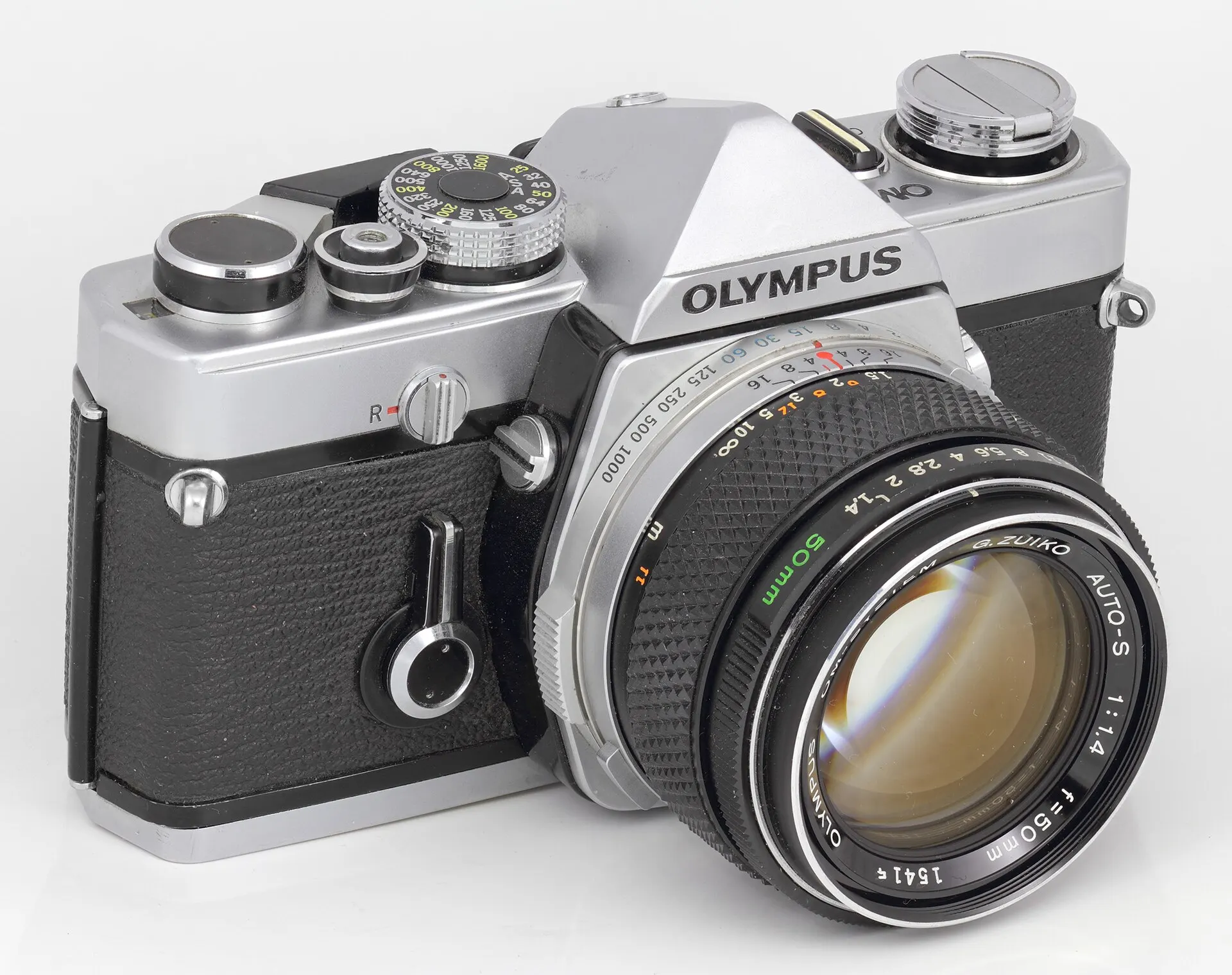
It is a camera for people who want to set everything themselves. There is no auto mode: you turn the meter on, set the shutter speed on a ring around the lens mount, then turn the aperture ring until a needle sits between + and -. The finder shows only that needle, not your settings. The battery runs nothing but the meter, so the shutter, advance and self-timer all work with no battery at all.
Buying one today is mostly about age. Every copy is at least 38 years old, and the faults owners report most are prism damage from rotting foam, jammed or sticky shutters, meters that drift several stops, and light leaks. A serviced body avoids most of that; LeZot Camera in Vermont lists a $180 OM-1 service, and Thomas Eisl recommends sending any copy with an unknown history to a specialist.
Good fit if
- You want an SLR you will actually carry: Jim Grey slings his over his shoulder all day and barely notices it.
- You want to learn manual exposure on a camera that works without batteries (only the meter needs one).
- You focus by eye and want a big, bright finder: 0.92x with a 50mm lens and 97% coverage.
- You want compact Zuiko lenses with shared filters: Digital Camera World says the 20mm to 200mm lenses use 49mm threads, although the manual lists 55mm for the f/1.2.
- You shoot close-ups, copy work or astrophotography: the OM-1 has mirror lock-up, which later OM bodies dropped.
Think twice if
- You want auto exposure. The OM-1 is manual only; the OM-2 and OM-2n add aperture-priority auto in a near-identical body.
- You want to see shutter speed and aperture in the finder. It shows only the meter needle.
- You shoot daylight fill flash: X-sync tops out at 1/60 s and flash needs a clip-on accessory shoe.
- You want to drop in any cheap cell and forget it: the meter expects 1.35V, so you need a Wein cell, an adapter or a conversion.
- You don't want to budget for service: single repairs at Brooklyn Film Camera run $80-120.
What owners and reviewers say, topic by topic
We sorted 111 opinions about the OM-1 from 27 pages and videos on 20 websites and channels. Each row shows how many people raised a topic and how many of them were positive. Open a row to read short quotes, each linked to its source.
Most voices are owners writing on blogs and in reader comments, plus reviews from Digital Camera World, Casual Photophile, Kosmo Foto and one YouTube review by Analog Insights. Four popular YouTube reviews titled OM-1 turned out to cover the 2022 OM System OM-1 digital camera and were left out. Photrio, KEH, MPB, B&H and eBay pages could not be read.
Controls and features56% positiveof 18
The shutter ring around the lens mount divides people: fans like having focus, aperture and speed under the left hand, while others need half a roll to readjust. The film advance gets mixed reviews, from smooth and short to sandy, and mirror lock-up is a valued extra.
“the film advanced lever feels horrible compared to other parts of the camera”
“the rest of the controls are all in one easy to see and control spot”
“since i started with the shutter speeds on the front, it felt normal to me”
“flash sync of 1/60s is an advantage and disadvantage at the same time”
Trevor Hong, EMULSIVE 5 Frames 2021-02Owner
Batteries and power43% positiveof 14
Owners like that the camera works with no battery, since only the meter uses one. The split is over the meter cell: the original 1.35V mercury battery is gone, so owners use Wein cells, hearing-aid cells, adapters or a 1.5V conversion.
“we cannot find the 1.35V mercury battery”
“even the light meter was modified to meter correctly on a 1.5v LR44 battery”
Trevor Hong, EMULSIVE 5 Frames 2021-02Owner
“it doesn't need a battery if you're willing to forego the internal light meter”
“today I would recommend a Wein cell battery for the correct voltage for meter accuracy”
Leslie Lazenby, Film Photography Project 2017-07Owner
Viewfinder and focusing64% positiveof 11
The finder is the most praised part of the camera: big, bright and easy to focus. The criticisms are that it shows no shutter speed or aperture and that the needle can be hard to see in bright light.
“it can be difficult to see the light meter reading through the viewfinder in bright light”
“It is big, bright, and crystal clear.”
Paul McKay, Kosmo Foto 2019-06Owner
“Thanks to the large viewfinder, nailing critical focus is quite convenient with this camera.”
“Bright and more importantly, big. In fact, probably the only thing in the camera that is big.”
Photo Thinking 2021-10Owner
Ease of use56% positiveof 9
Most owners find it easy to pick up, and a longtime teacher hands it to students who have never shot film. The complaints are about habits: no auto exposure for beginners, a meter switch that is easy to leave on, and film that has to catch the take-up spool.
“I didn't notice that the rewind knob wasn't rotating, since the frame counter was advancing as usual.”
“I can hand this camera to a student who has never used a film camera”
Leslie Lazenby, Film Photography Project 2017-07Owner
“Bringing the camera up to my eye, my hands intuitively fall into the right place”
“If you're used to traditional SLRs, the OM-1 might take a bit to get used to, I know I struggled at first.”
Alex Luyckx blog 2016-12Owner
Reliability today22% positiveof 9
This is the weakest topic. Most comments describe age-related faults such as prism damage from rotting foam, jammed shutters, meters drifting several stops and back-door light leaks, while well-kept bodies have handled thousands of rolls.
“developed 3 rolls of film and NOTHING was on the film”
“When I checked it late last year, the meter was reading several stops off.”
Down the Road (Jim Grey) 2022-04Owner
“After a bit of internet searching, I discovered this is a common issue with this camera.”
Peggy, Camera Go Camera 2016-01Owner
“Thousands of rolls when through these cameras. Incredible. They were and have been reliable”
Leslie Lazenby, Film Photography Project 2017-07Owner
Light meter and exposure50% positiveof 8
Owners who checked the match-needle meter found it accurate and easy to read, though Casual Photophile calls it decent rather than exceptional. The negatives are the lack of any auto mode and light entering around glasses that can skew readings.
“The only issue I had was when wearing glasses the light would enter from behind and skew the reading”
“It's simple + - metering is easy to use and see in the viewfinder.”
Leslie Lazenby, Film Photography Project 2017-07Owner
“While checking out the meter, I found it was spot on so was confident to let the camera guide me.”
Photo Thinking 2021-10Owner
“Match-needle metering like my OM-1 offers usually feels like a hiccup step in my flow.”
Down the Road (Jim Grey) 2022-04Owner
Build quality75% positiveof 8
Reviewers call it dense, all-metal and long-lived, and a repairer finds the shutters hold accurate speeds after decades. The two complaints are an advance lever that feels less refined than the rest and add-on accessory shoes that crack when tightened.
“they have a tendency to crack easily when locking them in place”
“This camera is a workhorse, I used it for personl and for commercial use.”
Leslie Lazenby, Film Photography Project 2017-07Owner
“these Olympus cameras seem to be pretty great at maintaining accurate shutter speeds over their lives”
“The OM-1 otherwise feels like a luxury item in my hands. Everything about this camera oozes excellence.”
Down the Road (Jim Grey) 2018-11Owner
Lenses86% positiveof 7
Zuiko lenses are a big reason people buy into the OM system, praised for sharpness and easy to find. Casual Photophile warns that its shop sees more fungus and helicoid oil in Zuikos than in rivals of the same age.
“we've seen an inordinate number of Olympus lenses come through our shop suffering much higher rates of fungus and focus helicoid oil seepage”
James Tocchio, Casual Photophile 2016-04Hands-on review
“the lens is crazy sharp at f/16”
Trevor Hong, EMULSIVE 5 Frames 2021-02Owner
“Olympus lenses are widely available and relatively affordable.”
“If there's one thing that Olympus got right, right off the mark is the optics.”
Alex Luyckx blog 2016-12Owner
Size and weight100% positiveof 7
Every opinion on size is positive. Owners carry it all day, fit a body and two lenses in a small bag, and say it stays small even with a motor drive.
“It literally fits in the palm of my hand.”
“Even with a motor drive, the camera is both small and light”
Alex Luyckx blog 2016-12Owner
“it's extremely pocketable and I find myself carrying it everywhere”
“I can sling it over my shoulder all day and barely notice it's there.”
Down the Road (Jim Grey) 2011-09Owner
Price and value50% positiveof 6
Prices have climbed. Owners once paid under $20 for a junk-bin body in Japan and under $200 for a near-mint copy, Kosmo Foto notes steady increases as Zuiko lenses stay in demand, and Jim Grey says OM bodies are not cheap.
“Yes, the OMs are not inexpensive. I would not own one were this pair of bodies (with all those lenses) not gifted to me.”
Down the Road (Jim Grey) 2018-11Owner
“thirdly it was less than $20 (without a lens)”
Peggy, Camera Go Camera 2016-01Owner
“I bought it in near mint condition for under $200.”
“With the reputation of the Zuiko OM lenses undimmed, prices have steadily climbed.”
Stephen Dowling, Kosmo Foto 2022-06
Image results80% positiveof 5
Owners describe sharp, contrasty results, especially from the 50mm f/1.8. One reviewer found Zuiko color a little on the warm side.
“But the rest are so sharp.”
Peggy, Camera Go Camera 2016-01Owner
“I found that images are sharp, crisp”
“The 50mm at f2.8 produces beautiful images with great subject separation.”
“Results were nice and contrasty in all situations, but I did notice the Zuiko colour was a little on the warm side.”
Photo Thinking 2021-10Owner
Repairs and servicing60% positiveof 5
Owners who paid for a CLA say it was worth it and the controls came back smoother. One owner who is learning repair worries that trained OM technicians are getting scarce.
“the previous generation of film camera repair techs are already scarce and they'll only become more rare as time goes on”
“But after CLA, all of the controls were next-level smooth and sure.”
Down the Road (Jim Grey) 2022-04Owner
“I can't recommend getting them overhauled enough and you will have a camera good for another 10-15 years at least.”
“I highly recommend sending a newly bought Olympus OM-1 to an expert if the previous owner cannot specify when the camera was serviced last time”
Thomas Eisl PhotographyHands-on review
Film availability25% positiveof 4
These comments are about film, not the camera: owners say film prices, developing costs or trouble buying and processing film keep their OM-1s on the shelf. One reviewer pointed a reader to HP5 Plus at photo retailers such as B&H.
“The only thing holding me back would be the film and developing costs.”
“I used it for decades, until film became an issue to buy or get processed”
“the pinch on new film prices has had me going through the rolls of long expired mystery film”
“You can usually find them on photography sites (like B&H Photo) for around $5-6 a roll.”
PositiveMixedNegative
How to check a used Olympus OM-1 before you buy
The OM-1 was made from 1972 to 1988, so every copy is at least 38 years old and most faults are about age. These checks take a few minutes; a seller who won't allow them is telling you something. If the service history is unknown, Thomas Eisl recommends sending the camera to a specialist anyway, mainly to replace the prism foam.
- 1
Bring a battery and test the meter
Fit a cell, slide the meter switch to ON and point the camera at bright and dark areas: the needle should swing smoothly. Compare a few readings with a phone light meter app. Jim Grey's well-kept OM-1 had drifted several stops before repair.
- 2
Fire every shutter speed
Run from 1 s to 1/1000 s and listen. Slow speeds such as 1/8 that hang or a shutter that will not fire point to a dirty slow-speed escapement; Camera Go Camera's owner found a jammed shutter is a common fault.
- 3
Look for spots or lines in the finder
Dark spots or a line that do not clean off the mirror or focusing screen usually mean the prism is losing its silvering because the foam around it has rotted. A badly damaged prism can only be replaced from a donor body.
- 4
Check the foam and the battery well
The battery chamber should be free of corrosion, and the black foam around the back door and mirror should not be crumbling or gooey. Sticky foam means light leaks until it is replaced.
- 5
Shine a light through the shutter curtains
In a dark room, lock the mirror up, remove the lens, open the back and shine a bright light at each cloth curtain while looking from the other side. Pinholes show up as points of light.
- 6
Check the lens
Look through it with a flashlight for fungus or haze between elements, then take the lens off and flip the stop-down lever on its back: the aperture should close and open freely, with no creeping motion. Casual Photophile reports more fungus and helicoid oil in Zuikos than in rivals of the same age.
- 7
Confirm which body you are getting
Early OM-1 bodies need a conversion to take a motor drive; look for an MD marking or buy an OM-1n if you want a winder. The code stamped under the film pressure plate gives the factory, year and month of assembly. Real M-1s are collectible and fakes made from OM-1s exist, so buy those only from a trusted seller.
Sources: casualphotophile.com, blog.jimgrey.net, cameragocamera.com, photographic.co.nz, thomaseisl.photography, esif.world-traveller.org, camera-wiki.org, andydiangelis.com
Olympus OM-1 battery: what to use instead of the PX625 mercury cell
The OM-1 meter was built for one 1.35V mercury cell (PX625, EPX625 or MR9 type), which the manual says lasts about a year. Mercury cells have long been outlawed, and modern 1.5V or 1.55V cells of the same size make an unmodified meter read wrong. The battery only powers the meter, so the camera still shoots without one: you can meter with a phone app or the Sunny 16 rule instead.
Owners use one of five fixes. The table lists what each one does; sources disagree on how big the error is with an uncorrected 1.5V cell, so check your meter against a phone app or a second camera before trusting it. Our film camera battery finder covers batteries for other film cameras.
| Option | Voltage | What to know |
|---|---|---|
| Wein MRB625 zinc-air cell | 1.35V | The only exact-voltage drop-in, per Digital Camera World. Zinc-air cells lose voltage as they age, which can make the meter unreliable. |
| 675 hearing-aid cell | 1.3V | Works, but it is slightly smaller and may need wedging in the chamber. Camera Go Camera's owner runs her OM-1n on an A675. |
| MR-9 adapter with an SR43 cell | About 1.35V | The adapter brings a silver-oxide cell down to roughly the original voltage. |
| 386 silver-oxide cell, no adapter | 1.55V | Digital Camera World says set the film speed two stops slower than the box speed; other owners shoot as is and rely on negative film latitude. |
| Meter conversion to SR44 or LR44 | 1.5V to 1.55V | A technician recalibrates the meter, often during a CLA. John Hermanson converted Jim Grey's OM-1 to an SR44 during a CLA, which Grey wrote up in April 2022. |
There is no auto-off: slide the meter lever to OFF after shooting or the cell drains, and clean the battery chamber now and then so a leaking cell can't corrode the contacts.
Sources: mir.com.my, mir.com.my, digitalcameraworld.com, emulsive.org, cameragocamera.wordpress.com, casualphotophile.com, blog.jimgrey.net
How to load and shoot the Olympus OM-1
The OM-1 loads like most manual 35mm SLRs (see our guide to loading film in any camera). The two things that trip people up are the shutter speed ring, which sits around the lens mount instead of on top, and film that never catches the take-up spool.
- 1
Set the film speed
The dial on top sets film speed only: press its lock and turn it to your film's ISO. It runs from 25 to 1600, so a 3200-speed film has to be set at 1600 or metered by hand.
- 2
Load the film
Pull up the rewind knob to open the back, drop in the cartridge and push the knob back down. Put the film leader into a slot in the take-up spool and advance until the sprocket holes on both edges engage, then close the back.
- 3
Make sure the film is catching
As you advance to frame 1, watch the rewind knob: it should turn. If it doesn't, the film isn't winding on and the whole roll will come back blank, even though the frame counter keeps moving.
- 4
Turn the meter on and set the exposure
Slide the meter lever on the left side of the camera to ON. Set the shutter speed with the ring around the lens mount, then turn the aperture ring until the needle in the finder sits between + and -.
- 5
Check your settings before you raise the camera
The finder shows only the meter needle, not the shutter speed or aperture, so glance at both rings first.
- 6
Turn the meter off
There is no auto-off, so slide the lever back to OFF when you put the camera away.
- 7
Rewind at the end of the roll
Turn the rewind release lever about 90 degrees counterclockwise until its red dot lines up with R, fold out the rewind crank and wind in the direction of the arrow until it turns freely, then pull up the crank to open the back.
Sources: camera-wiki.org, mir.com.my, mir.com.my, shootitwithfilm.com, flickr.com, culturedkiwi.com, casualphotophile.com
Best lenses, film and flash for the Olympus OM-1
 HP5 Plus
The usual kit lens is the Zuiko 50mm f/1.8: a 165 g lens with 6 elements in 5 groups, a 45 cm close-focus distance and a 49mm filter thread. Owners rate it highly, and Reijo Lauro says the late made-in-Japan version is the best performer, suspecting the idea that chrome-nose copies are better is an urban legend. For a wide angle, Photo Thinking finds the tiny G.Zuiko 28mm f/3.5 sharp at f/5.6 but prone to flare into the sun. Lens prices from US stores are in the table below.
Older Zuiko names encode the element count (the G in G.Zuiko means 7 elements), and Auto-S, Auto-W and Auto-T mean standard, wide and tele. Third-party OM-mount lenses exist from Vivitar, Kiron, Sigma, Tamron and Tokina, and Casual Photophile says owners of Sony A7 or Fujifilm X cameras can add an adapter and use legacy Zuikos.
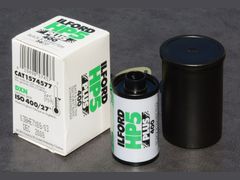
For film, Photo Thinking's reviewer, replying to a reader, suggests Ilford HP5 Plus or Kodak Tri-X for black and white (FP4 Plus in bright light), and Kodak Portra 400 or the cheaper Ultramax 400 for color, plus Kodak Pro Image 100 and Gold 200.
Flash needs a clip-on accessory shoe, since no OM-1 has a fixed hot shoe: the M-1 and OM-1 take Accessory Shoe 1 and the OM-1n takes Shoe 4. Set 1/60 s or slower. With an Olympus T32 or T20 on Shoe 4, an OM-1n shows a ready lamp in the finder. Casual Photophile calls 1/60 s too slow for easy daylight fill flash.
Sources: photothinking.com, thecamerasite.lauro.fi, culturedkiwi.com, casualphotophile.com, esif.world-traveller.org, mir.com.my, digitalcameraworld.com
Olympus OM-1 vs OM-1n: what changed
| OM-1 (and M-1, OM-1MD) | OM-1n | |
|---|---|---|
| Introduced | 1972 as the M-1, OM-1 from February 1973, OM-1MD in 1974 | 1979, made until 1987 |
| Motor drive | Early bodies need a conversion; OM-1MD bodies accept one | Accepts the motor drive |
| Film advance lever | Original design | Redesigned lever |
| Flash | Accessory Shoe 1, no ready lamp | Accessory Shoe 4, ready lamp in the finder with a T32 or T20 |
| Shutter, meter and finder | 1 s to 1/1000 s + B, match-needle meter, 0.92x finder | Same |
Pick the OM-1 (and M-1, OM-1MD) if
- You want an early body and will never use a motor drive or a dedicated Olympus flash.
- You collect M-1s (buy only from a trusted seller, since fakes exist).
Pick the OM-1n if
- You want to add a winder or motor drive without a conversion.
- You use Olympus T32 or T20 flashes and want the ready lamp in the finder.
Sources: en.wikipedia.org, camera-wiki.org, digitalcameraworld.com, esif.world-traveller.org, mir.com.my
Olympus OM-1 history: the M-1, Maitani and the shrinking SLR
Olympus showed the camera at Photokina in Cologne in 1972 as the M-1. Leica asked for a name change to avoid confusion with its M1 rangefinder, and from February 1973 it was sold as the OM-1. How many M-1s were made is disputed: Digital Camera World and camera-wiki put it at roughly 52,000, while an often-repeated figure attributed to Olympus says 5,000.
The design team was led by Yoshihisa Maitani, who had already created the Pen and Pen F. According to Digital Camera World, he wanted size and weight halved compared with the Nikon F; the body target was 600 g and it came in at 510 g, with a shutter meant to last 100,000 cycles, a pro spec at the time.
The system was big from the start: Digital Camera World counts 38 Zuiko lenses at launch, from an 8mm f/2.8 fisheye to a 1000mm f/11 mirror lens (the Film Photography Project says 33). It also says the OM-1 started a rush toward smaller designs, including Pentax's equally compact M series in 1976.
Not the same camera as the OM System OM-1, a high-end digital camera announced on February 15, 2022, that reuses the name to mark the film SLR's 50th anniversary.
Sources: en.wikipedia.org, digitalcameraworld.com, camera-wiki.org, filmphotographyproject.com, en.wikipedia.org
Olympus OM-1 problems and what repairs cost
Most OM-1 faults come from foam, lubricants and a battery standard that are decades old, and each has a known fix. LeZot Camera in Burlington, Vermont, is the one US shop in our research that lists an OM-1 price: $180 for a full service, though it reserves the right to re-estimate.
Prism damage from rotting prism foam
Raised in 2 opinions
- How you notice
- Dark spots or a line in the viewfinder that do not clean off the mirror or focusing screen. Cute Camera Co.'s lowest cosmetic grade mentions lines in the prism.
- Fix
- Have the decaying foam removed before it spreads. A badly damaged prism can only be swapped for a good one from a donor body, which is why Thomas Eisl recommends servicing any copy with an unknown history.
- Typical cost
- No US shop publishes a prism-swap price. Brooklyn Film Camera quotes after a $50 inspection (credited to the repair) and Cute Camera Co. after a $59.99 diagnostic; foam and seal work alone runs $80-120 at Brooklyn Film Camera.
Sources: thomaseisl.photography, andydiangelis.com, cute.camera, cute.camera, brooklynfilmcamera.com
Obsolete 1.35V mercury battery
Raised in 8 opinions
- How you notice
- The meter reads wrong with a 1.5V or 1.55V cell and no correction, and zinc-air cells drift as they age.
- Fix
- Use a 1.35V Wein MRB625, a 675 hearing-aid cell or an MR-9 adapter, or have a technician convert the meter to SR44 or LR44, often during a CLA.
- Typical cost
- Meter calibration and a new battery are included in LeZot Camera's $180 OM-1 service. John Hermanson (Camtech) did an SR44 conversion with a CLA for Jim Grey; the price was not published.
Sources: digitalcameraworld.com, casualphotophile.com, emulsive.org, blog.jimgrey.net, lezotcameras.com
Dead, jumpy or drifting light meter
Raised in 1 opinion
- How you notice
- The needle doesn't move with the switch on, works only some of the time, or reads several stops off.
- Fix
- Try a fresh cell and clean the battery contacts first; turning the ISO dial back and forth can clean its contacts. Corroded battery wires or switch contacts need a technician.
- Typical cost
- Meter calibration is included in LeZot Camera's $180 OM-1 service (8-10 weeks); otherwise expect a quote after inspection, $50 at Brooklyn Film Camera.
Sources: casualphotophile.com, andydiangelis.com, mir.com.my, lezotcameras.com, brooklynfilmcamera.com
Crumbling light seals and mirror foam
Raised in 1 opinion
- How you notice
- Light leaks (streaks or fogged edges) and sticky or crumbling foam around the back door and mirror. High5 Cameras calls the back-door hinge seal a notorious leak point.
- Fix
- Replace the seals and the mirror foam.
- Typical cost
- $80-120 at Brooklyn Film Camera (no warranty; its repair page shows $85-150 sample ranges); Victory Camera calls a seal job a $75 value; included in LeZot Camera's $180 OM-1 service.
Sources: brooklynfilmcamera.com, victorycamera.com, lezotcameras.com, high5cameras.com, brooklynfilmcamera.com
Jammed shutter or sticky slow speeds
Raised in 2 opinions
- How you notice
- The shutter won't fire or stays open, slow speeds such as 1/8 hang, or fast speeds drift (one repairer had to adjust the curtain tension to bring 1/1000 back on target).
- Fix
- Clean and re-lubricate the slow-speed escapement under the mirror box floor and adjust the curtain tension.
- Typical cost
- $80-120 for a stuck shutter at Brooklyn Film Camera (no warranty); full service $180 at LeZot Camera.
Sources: cameragocamera.com, photographic.co.nz, brooklynfilmcamera.com, lezotcameras.com
Rough or gritty film advance
Raised in 4 opinions
- How you notice
- The advance stroke feels sandy or stiff. Some owners say a little roughness is normal for the OM-1.
- Fix
- A CLA cleans and lubricates the film transport; Jim Grey found every control much smoother afterward.
- Typical cost
- $180 OM-1 service at LeZot Camera; $225-325 for a full CLA on a common 35mm SLR at Brooklyn Film Camera.
Sources: casualphotophile.com, culturedkiwi.com, blog.jimgrey.net, lezotcameras.com, brooklynfilmcamera.com
Zuiko lens fungus, haze or oily aperture blades
Raised in 1 opinion
- How you notice
- Fuzzy growths or haze between elements, sticky or slow aperture blades, oil seeping from the focus helicoid.
- Fix
- Inspect with a flashlight before buying. A lens CLA cleans fungus and degreases the blades and helicoid.
- Typical cost
- At Brooklyn Film Camera: lens CLA for 50mm and below $125-165, fungus cleaning $75-165, aperture repair $55-110. LeZot adds a $20 lens polish to its OM-1 service.
Sources: casualphotophile.com, esif.world-traveller.org, brooklynfilmcamera.com, lezotcameras.com
Photos taken with a Olympus OM-1
Photos shot on Olympus OM-1 bodies by Wikimedia Commons contributors, from Guinea-Bissau in 1973 to slide film in Verona in the 1990s.

Landing craft Alfange at Bambadinca, Guinea-Bissau, 1973Photo: João Carvalho, Public domain 
Giardino Giusti, Verona, Italy, 1993-1994, Zuiko 50mm f/1.8 on Kodak Ektachrome Elite 100Photo: Paolo Villa, CC BY-SA 4.0 
Portico of Palazzo Giusti, Verona, 1993-1994, Zuiko 28mm f/2.8 on Kodak Ektachrome Elite 100Photo: Paolo Villa, CC BY-SA 4.0 
Keystone at Palazzo Giusti, Verona, 1993-1994, E.Zuiko 135mm f/3.5 on Kodak Ektachrome Elite 200Photo: Paolo Villa, CC BY-SA 4.0 
Courtyard fountain, Giardino Giusti, Verona, 1993-1994, Zuiko 50mm f/1.8 on Kodak Ektachrome Elite 100Photo: Paolo Villa, CC BY-SA 4.0 
Courtyard entrance, Giardino Giusti, Verona, 1993-1994, Zuiko 50mm f/1.8 on Kodak Ektachrome Elite 100Photo: Paolo Villa, CC BY-SA 4.0
What a Olympus OM-1 costs today
On October 28, 2026, the OM-1 bodies listed at US camera stores we could check were restored, refurbished or re-sealed kits with a lens, from $275 for a Good OM-1n MD with a 35-70mm zoom at Victory Camera to $379.99 for Cute Camera Co.'s Good grade. Cute Camera Co.'s $439.99 best grade and Retrospekt's two $399 kits were sold out, so those rows show where prices have been. KEH, MPB, B&H and eBay could not be read, so their prices are not listed.
Victory Camera (Boulder, CO)
Used, Good, new light seals, dent by the frame counter, OM-1n MD chrome body + Olympus 35-70mm f/4 zoom
$275.00
See listingCute Camera Co. (Austin, TX)
Restored, Average cosmetic grade, 60-day returns, Body + 50mm lens + fresh battery
$349.99
See listingCute Camera Co. (Austin, TX)
Restored, Good cosmetic grade, Body + 50mm lens + fresh battery
$379.99
See listingCute Camera Co. (Austin, TX)
Restored, Very Good cosmetic grade (sold out), Body + 50mm lens + fresh battery
$439.99
See listingRetrospekt (Milwaukee, WI)
Refurbished, full CLA, 90-day warranty (sold out), OM-1 + Zuiko 50mm f/1.4 + 28mm f/3.5, case, caps, hood
$399.00
See listingRetrospekt (Milwaukee, WI)
Refurbished, full CLA, 90-day warranty (sold out), OM-1n + Zuiko 50mm f/3.5 Auto-Macro + 100mm f/2.8
$399.00
See listingVictory Camera (Boulder, CO)
Used, Excellent-, Zuiko MC Auto-S 50mm f/1.4 lens
$125.00
See listingVictory Camera (Boulder, CO)
Used, Excellent+, G.Zuiko Auto-W 28mm f/3.5 lens
$125.00
See listingPacific Rim Camera (Salem, OR)
Used, light haze and some dust, G.Zuiko Auto-W 28mm f/3.5 lens
$55
See listingVictory Camera (Boulder, CO)
Used, Good, E.Zuiko 100mm f/2.8 lens
$165.00
See listing
Prices checked on October 28, 2026. They move every week, so treat them as a range, not a quote. For older context, Digital Camera World put an immaculate OM-1 or OM-1N with a 50mm f/1.8 at $150 or more on eBay in May 2022, with worn bodies for much less. A cheap untested body can still make sense if you budget for LeZot Camera's $180 OM-1 service.
Video reviews worth your time

Olympus OM-1 Review
The Olympus OM-1 is a compact, fully mechanical 35mm SLR renowned for its exceptional viewfinder and portability, though it lacks automated exposure modes and relies on discontinued battery voltages.
Specifications
Camera
- Dimensions
- 136 x 83 x 50 mm, body only
Shutter and exposure
- Film speed range
- ASA 25 to 1600
- Self-timer
- Mechanical lever, about 4 to 12 seconds
Viewfinder and handling
Questions people ask about the OM-1
Does the Olympus OM-1 have a light meter?
Yes. It has a through-the-lens, center-weighted meter with two CdS cells beside the eyepiece, read with a needle between + and - in the finder. The meter is the only part that needs a battery, and it was designed for a 1.35V mercury cell, so today owners use a Wein MRB625, a hearing-aid cell, an adapter or a converted meter.
Sources: mir.com.my, digitalcameraworld.com
What year did the Olympus OM-1 come out?
Olympus showed it at Photokina in 1972 as the M-1 and sold it as the OM-1 from February 1973, after Leica asked for a name change. The OM-1MD followed in 1974 and the OM-1n in 1979. Digital Camera World says the OM-1n stayed in production until 1987; Wikipedia gives 1988 for the series.
Sources: digitalcameraworld.com, en.wikipedia.org
How do I change the shutter speed on an Olympus OM-1?
Turn the ring around the lens mount. Speeds run from 1 s to 1/1000 s plus B. The dial on top of the camera only sets film speed, which confuses people coming from other SLRs.
Sources: camera-wiki.org, mir.com.my
Why won't my Olympus OM-1 turn on?
The OM-1 doesn't really turn on: it is mechanical, and only the meter uses power. If the needle doesn't move, slide the meter lever on the left side of the camera to ON, fit a fresh cell and clean the battery contacts. The shutter fires with no battery at all; if it doesn't, the problem is mechanical, not electrical.
Sources: mir.com.my, culturedkiwi.com, casualphotophile.com
Can I use a 1.5V battery in an Olympus OM-1?
Yes, but an unmodified meter won't read correctly. Digital Camera World says a 1.55V 386 silver-oxide cell works if you set the film speed two stops slower than the box speed, while some owners shoot 1.5V cells as is and rely on negative film latitude. The cleaner fixes are a 1.35V Wein MRB625, an MR-9 adapter or having the meter recalibrated for 1.5V during a CLA.
Sources: digitalcameraworld.com, casualphotophile.com, emulsive.org
Is the Olympus OM-1 the same as the OM System OM-1?
No. The OM System OM-1 is a high-end digital camera from OM Digital Solutions, announced on February 15, 2022. It reuses the name to mark the 50th anniversary of the film SLR, so search results and video reviews often mix the two.
Sources: en.wikipedia.org
How much is an Olympus OM-1 worth?
On October 28, 2026, Cute Camera Co. listed restored OM-1 kits with a 50mm lens at $349.99 and $379.99 (a $439.99 grade was sold out), Retrospekt's refurbished $399 kits were sold out, and Victory Camera had a Good OM-1n MD with a zoom for $275. In May 2022, Digital Camera World put an immaculate OM-1 or OM-1N with a 50mm f/1.8 at $150 or more on eBay, with worn bodies for less. Unserviced copies cost less but may need LeZot Camera's $180 service.
Sources: cute.camera, retrospekt.com, victorycamera.com, digitalcameraworld.com, lezotcameras.com
Why did my roll from an Olympus OM-1 come back blank?
A common cause is film that never caught the take-up spool: the frame counter advances anyway, so you shoot a whole roll that never moved. When loading, wind until the leader is firmly on the spool and watch the rewind knob turn as you advance. To check the shutter, open the empty camera, set 1/30 s and fire it while looking through the back.
Sources: flickr.com
What people compare it with
Olympus OM-2 and OM-2n
The same petite body with aperture-priority auto exposure. Digital Camera World says the OM-2 did just about everything better, especially its off-the-film metering.
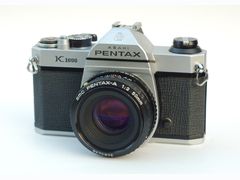
Another all-mechanical manual SLR. Thomas Eisl compares the OM-1 with the FM2n and finds the Olympus more premium thanks to its all-metal exterior.
Another popular manual SLR. The Film Photography Project's reviewer tells readers weighing the K1000, Nikon FM or Canon AT not to forget the OM-1n.
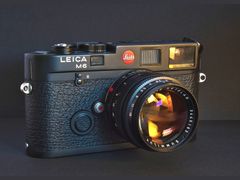
Thomas Eisl compares the OM-1's minimalist, needle-only design with the M6: both are compact professional cameras with no extra functions, though the M6 is a rangefinder, not an SLR.
Every source behind this page
Read them yourself. How we pick and count them is in our methodology.
Show all 48 sources
Independent blogs 21
- Film Photography Project: The Compact, Awesome Olympus OM
- Photo Thinking: Olympus OM-1n
- Cameras By Max blog: Olympus OM-1
- Shoot It With Film: Olympus OM
- Thomas Eisl Photography: Olympus OM
- Cultured Kiwi: Olympus OM-1 Review 2026
- Camera Go Camera: Olympus OM
- Camera Go Camera: Olympus OM1n
- Andrew DiAngelis, Vintage OM Camera Repair Blog: Vintage OM Camera Repair Blog
- Alex Luyckx blog: Camera Review Blog No. 50 - Olympus OM-1n - Alex Luyckx
- Down the Road: Olympus OM-1
- Down the Road: Another Olympus OM-1
- Down the Road: Operation Thin the Herd: Olympus OM-1
- Down the Road: Updated review: Olympus OM-1
- Down the Road: My Olympus OM-1 is back from repair and CLA
- EMULSIVE: Camera review: the Olympus OM-1N
- EMULSIVE 5 Frames: 5 Frames... Of sharp shots on a soft lens with Kodak Portra 400 + flash (35mm Format / EI 400 / Olympus OM-1n + G. Zuiko 55mm f/1.2)
- EMULSIVE 5 Frames: 5 Frames… Of expired FotoStop Colour Print Film 200 (EI 200 / 35mm format / Olympus OM-1) - by Ed Worthington
- Kosmo Foto: ATWI80C 3: Geneva on an Olympus OM-1
- thegashaus: Olympus OM-1n
- High5 Cameras repair guide: Guide to Replacing Light Seals
Manuals and references 21
- esif.world-traveller.org: Olympus OM SLR FAQ, Wed Jun 21 15:04
- photographic.co.nz: Olympus OM1 shutter
- mir.com.my: Olympus OM-1(n)
- mir.com.my: Olympus OM-1(n) - Instruction Manual
- mir.com.my: Olympus OM-1(n) - Instruction Manual
- thecamerasite.lauro.fi: Olympus OM
- brooklynfilmcamera.com: Film Camera Repair Cost
- brooklynfilmcamera.com: Camera Repair NYC: Film Camera Repair in Brooklyn + Mail
- camera-wiki.org: Olympus OM-1/2/3/4 - Camera-wiki.org
- cute.camera: Repairs
- cute.camera: Olympus OM-1
- en.wikipedia.org: OM System OM
- en.wikipedia.org: Olympus OM-1
- retrospekt.com: Olympus OM-1 35mm SLR Film Camera
- retrospekt.com: Olympus OM-1N 35mm SLR Film Camera
- victorycamera.com: Olympus 50mm f1.4 Zuiko MC Auto-S OM Manual Focus Prime Lens [EXC
- victorycamera.com: Olympus G.Zuiko 28mm f3.5 Auto-W OM Wide
- victorycamera.com: Olympus OM 100mm f2.8 E.Zuiko Telephoto Portrait Prime Lens [GOOD]
- victorycamera.com: Olympus OM-1N MD Chrome Film Camera Body w/ 35
- lezotcameras.com: Olympus OM-1 Camera Repair - LeZot Camera | Sales and Camera Repair | Camera Buyers
- pacificrimcamera.com: Pacific Rim Camera Catalog
Editorial reviews 4
Forums 1
Video reviews 1
Keep reading
Film cameras
The Nikon FM2 is a fully mechanical 1982 SLR with a 1/4000 shutter. What 145 owner and reviewer opinions say, 2026 prices, versions and common problems.
Film cameras
The Pentax K1000 is a fully mechanical 35mm SLR made 1976-1997. What 150-plus owners and reviewers say, plus used prices ($250-$400), lenses and problems.
Film cameras
Where to buy film cameras used in the US: KEH, MPB, B&H, local shops, eBay and thrift, with warranties, October 2026 prices and a checklist to test one.
Film cameras
The best film camera for beginners is usually a used Canon AE-1 Program or Pentax K1000. Compare 8 picks, October 2026 US shop prices and what to check first.
Film stocks
Ilford HP5 Plus is an ISO 400 black-and-white film known for latitude and easy pushing. What 112 opinions say, how to shoot it, and US prices from $9.99.