Pentax Spotmatic: what owners say and what to check before buying
The short answer
The Pentax Spotmatic is a fully mechanical 35mm SLR that Asahi built from 1964 until about 1977, and most owners praise its solid build, low prices and M42 Takumar lenses.
Its battery only powers the light meter, and while 50mmF2 says bodies often sell for $50 or less, Retrospekt listed refurbished kits with a lens at $299 to $399 in October 2026 (all sold out when checked).
- Made
- 1964 to about 1977
- Shutter
- Mechanical cloth, 1 s to 1/1000 + B
- Battery
- Meter only: 387/394 (F: 625 size)
- Lens mount
- M42 x 1mm screw
Built from 150 opinions from 36 pages and videos. Not yet tested by Camera Dojo. Updated .
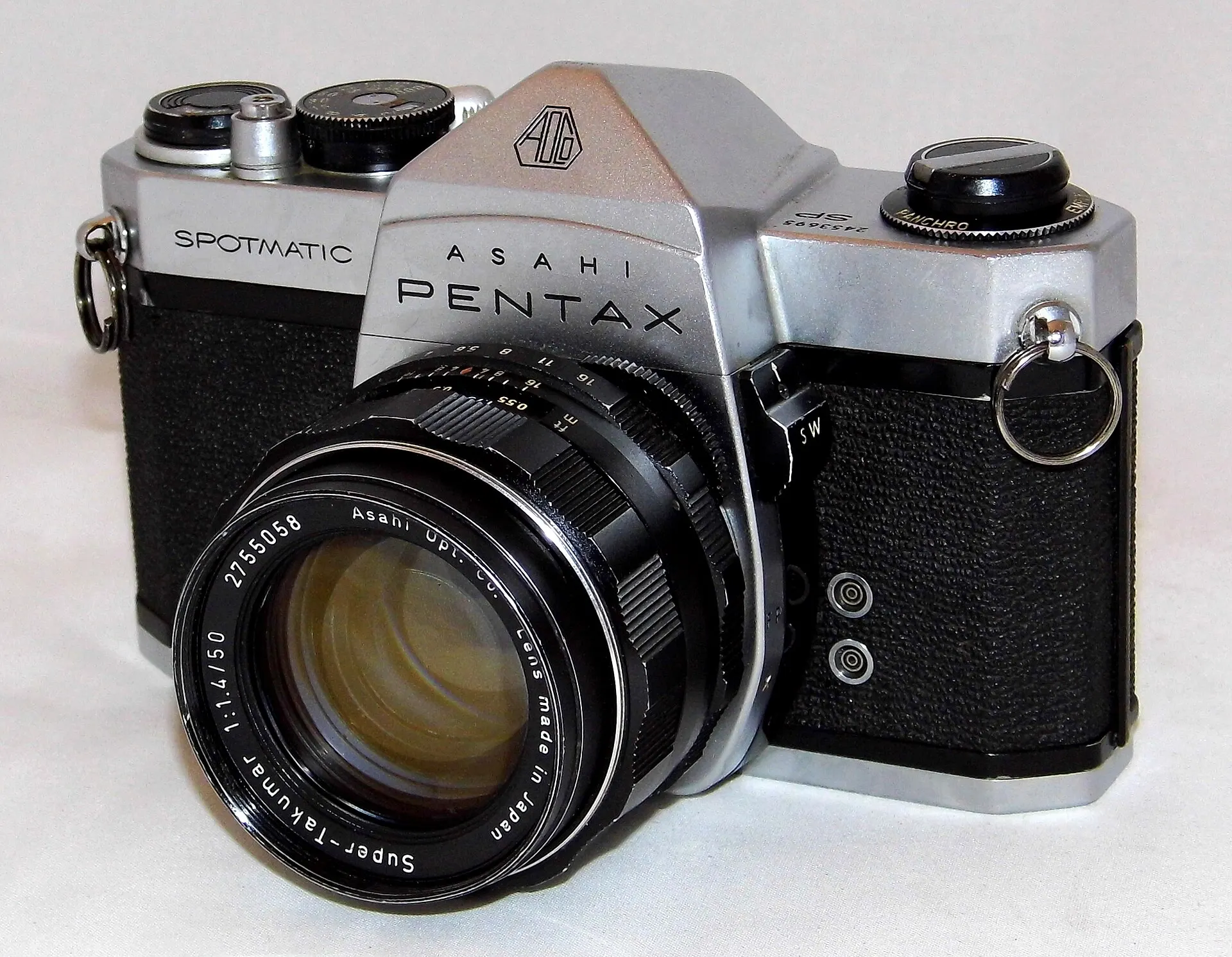
The short version
The main complaint is the metering. On every model except the Spotmatic F with SMC Takumar lenses you push a switch to stop the lens down before the meter reads, which darkens the finder, and owners say the screen is dim with slow lenses. The original mercury battery is no longer made, but owners use 387 or 394 silver-oxide cells, and the camera fires at every speed with no battery at all.
On a camera this old, condition matters more than the model. The usual faults are a mirror that sticks up, which owners often free with a drop of oil, and an aging meter that can read off or quit. Test the stop-down switch and the meter before you pay, or buy one that has had a CLA. For the same chassis with a bayonet mount, see the Pentax K1000.
Good fit if
- You want a fully mechanical SLR that fires at every speed without a battery
- You want cheap, highly rated Takumar lenses and the huge M42 screw-mount catalog
- You shoot at a deliberate pace and don't mind metering in two steps
- You like fixing things: owners report freeing stuck mirrors themselves
Think twice if
- You want automatic exposure, or open-aperture metering without hunting for a Spotmatic F and SMC lenses
- You need a bright screen or a split-image focusing aid for low light or aging eyes
- You want a light SLR: owners and reviewers find it heavier than an Olympus OM body
- You want flash sync faster than 1/60 second
- You change lenses often: screw mounts take longer to swap than bayonets
What owners and reviewers say, topic by topic
We sorted 150 opinions about the Spotmatic from 36 pages and videos on 24 websites and channels. Each row shows how many people raised a topic and how many of them were positive. Open a row to read short quotes, each linked to its source.
Most of the 150 opinions come from owner blogs, a Flickr owners group, editorial reviews and five YouTube reviews. Reddit, Pentax Forums and Cameraderie threads could not be read, so forum voices are thinner than usual.
Light meter and exposure44% positiveof 16
Owners are split. Several call the meter accurate, one even for Kodachrome slides, while others dislike how stop-down metering darkens the finder or report half-century-old meters that read off or quit.
“I just didn't take to the stop-down metering.”
Casual PhotophileOwner
“The inbuilt meter may not be accurate anyway.”
“in the Navy I shot plenty of Kodachrome slide film with my Spotmatic, its meter was dead on everytime”
davidde.comOwner
“The metering is just so precise, which surprised me considering the advancement of metering in the last decades.”
Theo, Photo Thinking 2021-01Owner
Lenses94% positiveof 16
The most praised part of the system: owners call Takumars sharp, smooth-focusing and cheap. The one negative is a third-party M42 lens that would not screw in fully.
“these are very very very good lenses”
Chris Chinnock Photography (Adventures on Film) 2018-01Owner
“Takumars are some of the best lenses ever made!”
“Takumar lenses are still legendary, and for good reason.”
BSmith, The Noisy Shutter 2023-09Owner
“It is a phenominal lens that does not compromise on quality.”
Controls and features69% positiveof 16
Owners like the simple layout and the meter switch beside the mount. A few find that switch stiff, the advance throw long, or the advance lever in the way for left-eyed shooters.
“It's much more solid and purposeful than a lot of cameras”
Everything Vintage 2014-05Owner
“in easy reach of the left thumb when supporting the lens with your hand.”
Why Use Film Cameras? (Frank Lehnen) 2017-10Owner
“controls laid out as if by someone who actually cared about easy operation.”
Daniel J. Schneider (schneidan.com) 2015-06Owner
“The stop-down lever was a little hard to push, but that's nothing a proper CLA couldn't fix.”
Down the Road (Jim Grey) 2013-10Owner
Batteries and power60% positiveof 15
Most owners say a modern 1.5 V cell works and stress that the camera shoots without a battery. The complaints are the discontinued mercury cell, corroded battery covers and the Spotmatic F's always-on meter.
“It was rusted and corroded solid.”
Peggy, Camera Go Camera 2017-03Owner
“fitting a modern 1.5v cell is fine as long as one which physically fits can be found.”
Everything VintageOwner
“I have a mid-60s Spotmatic and I've had pretty good luck finding a battery at wal mart.”
“The meter is powered by a long-discontinued mercury-based 1.35v battery for which there are few suitable substitutes.”
BSmith, The Noisy Shutter 2023-09Owner
Viewfinder and focusing57% positiveof 14
Most owners like the bright, uncluttered finder and its microprism spot, but several say the screen is dim with slow lenses or in low light, and there is no split-image aid.
“Spotmatic focusing screens are not changeable by the owner.”
JR Smith, Fogdog Photography blog 2025-12Owner
“nothing else to clutter the view and get in the way of your eye and the subject”
Chris Chinnock Photography (Adventures on Film) 2018-01Owner
“Even with these drawbacks, Spotmatic viewfinders are my favourite 35mm SLR viewfinders to use.”
50mmF2Owner
“Depending on your point of view, that is either marvellously uncluttered, or lacking in useful information!”
Everything VintageOwner
Build quality82% positiveof 11
No owner calls the build poor: they describe it as tough and precisely machined, though Jim Grey found the controls solid but not luxurious. One commenter finds Canon FT-series and Nikkormat bodies more rugged.
“Despite the lack of heft, the camera feels extremely well made.”
Chris Cushing, Casual Photophile 2017-10Owner
“All the Spotmatics I have handled have been wonderfully built machines.”
BSmith, The Noisy Shutter 2023-09Owner
“This feels like a camera, painstakingly filed out of a solid bloc of steel.”
Why Use Film Cameras? (Frank Lehnen) 2017-10Owner
“Under my fingers the Spotmatic's controls all felt solid but not luxurious.”
Down the Road (Jim Grey) 2013-10Owner
Reliability today36% positiveof 11
Owners say Spotmatics last if looked after, and one fieldwork user says two never failed despite soakings and drops. A mirror that sticks up is the usual failure, and some unserviced bodies arrive with shutter faults.
“when I received it, the shutter proved defective.”
CamerAgX 2017-05Owner
“I have had many Spotmatics and this is the only way they have ever failed.”
“once I replaced the light-seals, it's been a perfect camera”
Gene Wilson, 35mmcOwner
“a problem like that really isn't bad for a camera that is over 50 years old.”
Chris Moore, Adventures of a Photo Nerd (digitalfilmnerd.com) 2018-01Owner
Price and value100% positiveof 11
Every comment on price is positive. Owners report paying from $8 for a flea-market body to $60 for a kit with three lenses, and call the Spotmatic one of the great photo bargains.
“Bought it on e-bay for $40 or so.”
“I picked up the Spotmatic sans lens for $8 at the flea market”
Daniel J. Schneider (schneidan.com) 2015-06Owner
“They have used Spotmatics for a good price and in good condition”
“I recently found an SPII at a flea market for $30, with 50/f2 and a Vivitar zoom.”
Casual PhotophileOwner
Ease of use50% positiveof 10
Most owners find it simple once the stop-down routine becomes a habit. The complaints are that metering step and, for one owner used to auto-loading cameras, getting the film leader to stay in the take-up spool.
“More often than not, it's an ergonomics disaster”
CamerAgX 2017-05Owner
“In operation, this is a simple camera to use.”
Everything Vintage 2014-05Owner
“All the important controls are easy to use and are in no way confusing.”
50mmF2Owner
“I enjoyed using my Spotmatic but for the stopping down.”
Down the Road (Jim Grey) 2013-10Owner
Repairs and servicing80% positiveof 10
Owners say Spotmatics are easy to keep running: a drop of oil often frees a stuck mirror, and Eric Hendrickson at pentaxs.com is the technician they recommend most. One owner found a shutter repair would cost more than the camera.
“Once you include shipping, the cost of the repair is probably in the $100.00 range. Much more than what the camera is worth.”
CamerAgX 2017-05Owner
“Eric had my camera back to me in less than a week.”
JR Smith, Fogdog Photography blog 2025-12Owner
“Great service and fair price. I have had 2 of them done”
Greg, Dead CamerasOwner
“I've done it myself with 3 separate cameras and it has always worked.”
Size and weight33% positiveof 9
Opinion is mixed. Some find it solid but lighter than a Nikon F2; others notice the weight next to an Olympus OM body after a full day.
“The camera is not a light camera. Built like a tank means heavy.”
“Not heavy and bulky like the Nikon F2, another camera that I adore.”
“It's clunky; it's heavy, and yet feels so right to shoot.”
Alex Luyckx blog 2016-12Owner
“a bit on the heavy side compared with later models but still very portable.”
Dead Cameras 2014-05Owner
Image results100% positiveof 6
All six comments on results are positive, and owners give most of the credit to the Takumar lenses for sharp, low-distortion negatives.
“The images that this thing produces are astounding”
Chris Moore, Adventures of a Photo Nerd (digitalfilmnerd.com) 2018-01Owner
“But dig that sharpness. The 55mm f/2 lens is a winner.”
Down the Road (Jim Grey) 2013-10Owner
“The results were spectacular with a couple of the shots quickly becoming favorites of mine.”
“They are both excellent, displaying minimal distortion and virtually no chromatic aberration.”
Daniel J. Schneider (schneidan.com) 2015-06Owner
Film availability40% positiveof 5
Few comments. One owner notes the film speed dial covers today's films; another points out that film costs add up.
“probably won't again as it's a very dear doo”
Chris Chinnock Photography (Adventures on Film) 2018-01Owner
“Yes film is in my opinion not going away.”
“The cheapest b/w I've found is $2.69 a roll and I have to get it mail order.”
Down the Road (Jim Grey) 2013-10Owner
“I just hope film will continue to live for at least another decade”
PositiveMixedNegative
Which Pentax Spotmatic model should you buy?
Every model in the table below shares the same mechanical cloth shutter (1 second to 1/1000 plus B), the M42 screw mount and a center-weighted meter. The name comes from a 1960 Photokina prototype with a true spot meter; production cameras average the scene. The models differ in flash connections, film speed range, how the meter reads and which battery they take.
Jim Grey rates the Spotmatic F above the stop-down models because it meters with the lens wide open when used with Super-Multi-Coated or SMC Takumars, while Casual Photophile calls the original Spotmatic the most challenging to use. Cameras imported by Honeywell for the US market say Honeywell Pentax, with an H on the prism; mechanically they are the same cameras.
Asahi also made the Pentax SL (1968), a Spotmatic without a meter, and the Electro-Spotmatic (1971), the first aperture-priority electronic SLR, sold only in Japan and followed by the ES and ES II.
| Model | Introduced | What's different | Battery today |
|---|---|---|---|
 Spotmatic (SP) | 1964 | Stop-down metering, ASA 20-1600 (10-800 on the earliest bodies), FP and X flash sockets but no hot shoe, self-timer | 387 or 394 silver oxide (PX400 size) |
| Spotmatic II (SP II) | 1971 | Hot shoe with an FP/X switch, film speeds up to ASA 3200 | 387 or 394 (PX400 size) |
| Spotmatic IIa | US only, Honeywell | SP II with an electronic interface for Honeywell Strobonar flashes | 387 or 394 (PX400 size) |
| SP500 | 1971 | Budget SP with no self-timer; an unmarked 1/1000 stop sits past 1/500 on the dial | 387 or 394 (PX400 size) |
| SP1000 | 1974 | Budget SP with no self-timer | 387 or 394 (PX400 size) |
| Spotmatic F | 1973 | Open-aperture metering with SMC Takumars, shutter-release lock, X-only hot shoe, no meter on/off switch | 625 size |
The Spotmatic F's meter stays on whenever light reaches it and only shuts off at EV 2 or below, so keep the lens cap on between shots.
Sources: camera-wiki.org, en.wikipedia.org, butkus.org, blog.jimgrey.net, casualphotophile.com, 35mmc.com
How to load and meter a Pentax Spotmatic
These steps follow the Pentax manual for the SP family. For loading in general, see how to load film.
- 1
Set the film speed
Lift the outer ring of the shutter speed dial and turn it until your film's ASA sits at the red index. The meter reads from this setting, so don't skip it. The SP dial runs from ASA 20 to 1600; the SP II goes to 3200.
- 2
Load the roll
Pull the rewind knob up until the back pops open, drop the cassette in, push the knob back down and tuck the leader into the take-up spool slot. Wind and fire until both sprockets engage; if the film is loaded right, the rewind knob turns counter-clockwise as you advance.
- 3
Advance to frame 1
Close the back and fire two blank frames. The counter resets to 1 on its own.
- 4
Focus wide open, then meter
Focus and compose with the lens wide open. Push the switch beside the lens mount up (a red window shows it is on) and turn the aperture ring or speed dial until the needle on the right of the finder sits in the middle. Near + means overexposed, near - means underexposed. The finder darkens while you meter, so owners compose first and meter second.
- 5
Shoot
Firing the shutter switches the meter off and reopens the lens, so you only re-meter when the light changes. There is no exposure compensation dial: bias the needle a little high for backlit subjects and a little low for dark ones.
- 6
Rewind
Press the rewind release button on the bottom plate, then turn the crank until the tension drops as the leader leaves the take-up spool.
Sources: butkus.org, casualphotophile.com, camera-wiki.org, thenoisyshutter.com
Which battery does the Pentax Spotmatic take?
The SP, SP II, IIa, SP500 and SP1000 were designed for a 1.35 V PX400 (Mallory RM-400-R) mercury cell, according to the manual and camera-wiki. Mercury cells are banned today, so owners commonly use a 1.55 V silver-oxide 387 or 394, which is the same size; Jim Grey notes a 387 is simply a 394 in a removable plastic ring.
The Spotmatic F takes a larger PX625-size cell. The Noisy Shutter found its F meter matched trusted meters on a modern 1.5 V cell. Glazer's Camera in Seattle sells an Exell A625PX alkaline for $7.25 and a 1.35 V Exell MRB625 zinc-air cell for $15.95.
Sources disagree on whether the higher voltage throws the meter off. Camera-wiki and Jim Grey's 2022 SP II review say a bridge circuit absorbs the difference; Jim Grey's 2017 review says only the F has one, and a 35mmc commenter says SP and SP II meters are voltage-sensitive. For the original 1.35 V, the WeinCell MRB-400 zinc-air cell costs $8.75 at Glazer's, though camera-wiki notes zinc-air cells have a short life once activated. Either way, check a few readings against a phone meter app, as several owners do. The film camera battery finder lists equivalents.
- Per the SP manual, open the bottom-plate compartment with a coin and insert the cell with the + side facing up, toward the top of the camera.
- Battery test from the manual: set the shutter to B and the film speed to ASA 100, push the meter switch up, and the needle should drop quickly.
- On the SP family, push the meter switch back down when you are done; on the F, cap the lens. For long storage, take the battery out.
- Pull the tab on a WeinCell MRB-400 at least 30 minutes before use, as Glazer's advises.
The battery only runs the meter: a Spotmatic with a dead cell still fires at every speed, and the Sunny 16 rule covers exposure.
Sources: butkus.org, camera-wiki.org, blog.jimgrey.net, blog.jimgrey.net, blog.jimgrey.net, 35mmc.com, thenoisyshutter.com, glazerscamera.com, glazerscamera.com, glazerscamera.com
Which lenses fit the Pentax Spotmatic?
Any M42 x 1mm screw-mount lens fits. Pentax's own Takumar line ran from an 18mm ultra-wide to a 1000mm telephoto, and Casual Photophile points to a database of nearly 1,600 M42 lenses from makers such as Zeiss, Schneider and Voigtlander. Takumars are the most praised part of the system in owner reviews, and Frank Lehnen notes they are among the cheapest lenses for any camera system.
The usual starting point is a 50mm or 55mm. A 2023 reader comment on Adventures of a Photo Nerd puts the 55mm f/1.8 Super-Takumar at around $25 plus shipping on auction sites. The Super-Takumar 50mm f/1.4 came in four versions: the first (1964-1966) has eight elements, Pentax switched to seven in 1966, and the last two are Super-Multi-Coated or SMC.
The Spotmatic's mirror box was designed around that 50mm f/1.4's deep rear element, so it clears more M42 lenses than most screw-mount bodies, but not every one: Photo Thinking could not screw a Carl Zeiss Jena Flektogon 35mm in fully or focus it to infinity.
- Set Super-Takumars to A for the automatic diaphragm (focus wide open, stops down at the shot); M stops the lens down for depth-of-field preview.
- Switch the meter off before mounting a Super-Takumar: with it on, the lens's diaphragm pin can hit the body's release plate and get damaged, according to the manual.
- Only the Spotmatic F (and the ES and ES II) use the SMC lenses' pin for open-aperture metering; on an SP or SP II, SMC lenses still meter stopped down.
- Casual Photophile says the Super-Multi-Coated 50mm lenses use thorium that can cause yellowing; a reader on Jim Grey's blog blames the early Takumars and thinks the later SMC lenses were exempt. UV light or long exposure to sunlight reduces the tint, and that reader says it does not affect black-and-white film.
- Standard lenses take 49mm filters.
Sources: butkus.org, casualphotophile.com, casualphotophile.com, digitalfilmnerd.com, photothinking.com, blog.jimgrey.net, blog.jimgrey.net, blog.jimgrey.net
What to check before buying a used Pentax Spotmatic
Jim Grey, who has owned the SP, SP II and F, says any Spotmatic in good condition is worth buying. Unserviced bodies sell cheaply because many need work, so check these five things. For sellers and return policies, see where to buy used film cameras.
- 1
Fire it and look through the finder
If the finder stays black after a shot, the mirror is stuck up, the fault owners report most. 50mmF2 says it is usually dried lubricant in the gears under the bottom plate, and cleaning them often cures it; a full CLA is the lasting fix.
- 2
Work the stop-down switch
The lever beside the lens mount gets the most use, and 35mmc calls it a weak point. It should move freely and click into place; Jim Grey expects a CLA to free a stiff one.
- 3
Open the battery cover
Camera Go Camera's junk-bin Spotmatic had a cover corroded shut, and Flickr owners suggest swapping in the bottom plate from a parts camera when contacts break. With a fresh cell, run the manual's needle test before you pay.
- 4
Check the seals and the lens
Gummy or missing foam around the back door means old light seals. Jim Grey's SP II had missing or gummy seals and didn't leak, but replacing them is the safe call. On the lens, look for a yellow tint and, on the 50mm f/1.4, scratches on the deep rear element.
- 5
Budget for a service
Brooklyn Film Camera's sample ranges, across all cameras, run $85-150 for light seals, $90-150 to unjam and $325-850 for a full CLA, after a $50 inspection credited to the repair. Eric Hendrickson at pentaxs.com lists a 2026 estimate of $110 for the K1000, which shares the Spotmatic chassis, but Spotmatics are not on his visible list, so email him before shipping one.
Sources: blog.jimgrey.net, 50mmf2.com, 35mmc.com, blog.jimgrey.net, cameragocamera.com, flickr.com, butkus.org, casualphotophile.com, brooklynfilmcamera.com, pentaxs.com
Pentax Spotmatic vs Pentax K1000
| Pentax Spotmatic | 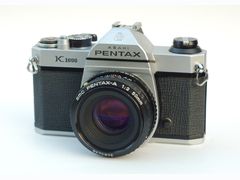 Pentax K1000 | |
|---|---|---|
| Made | 1964 to about 1977 | 1976 to 1997 |
| Lens mount | M42 screw | Pentax K bayonet |
| Metering | Stop-down; open aperture on the F with SMC Takumars | Open aperture, like the Spotmatic F |
| Meter switch | Lever beside the mount, off after each shot (F: none) | None; keep the lens cap on |
| Self-timer | SP, SP II and F (5-13 s) | None |
| Battery | 387 or 394 silver oxide (F: 625 size) | LR44/SR44, A76 or 357 |
Pick the Pentax Spotmatic if
- You want Takumar lenses and the wide range of third-party M42 glass
- You like a meter that switches itself off when you fire
- You prefer a smoother, quieter feel: Casual Photophile calls the K1000 clattery by comparison, and Jim Grey likes the Spotmatics slightly better
Pick the Pentax K1000 if
- You want open-aperture metering without hunting for an F and SMC Takumars
- You want a common LR44/SR44 battery
- You are new to film: Alex Luyckx calls a K1000 or KM the better starter camera, and adapters let Takumars go on K-mount bodies
Sources: blog.jimgrey.net, en.wikipedia.org, en.wikipedia.org, camera-wiki.org, butkus.org, casualphotophile.com, blog.jimgrey.net, alexluyckx.com
Known problems and what fixing them costs
Most Spotmatic problems come from more than 50 years of drying lubricant, aging meter circuits and crumbling foam, not from the design.
Mirror stays up after the shutter fires
Raised in 8 opinions
- How you notice
- The viewfinder goes black after a shot because the mirror doesn't return; often why bodies are sold as defective. One Flickr member reported it sticking at slow speeds, below 1/60, both times in cold weather.
- Fix
- Usually dried lubricant in a gear train under the bottom plate: cleaning and lightly oiling it often cures the fault, and owners report doing it themselves. A full CLA is the lasting fix. 50mmF2 warns against grinding parts off, as some online advice suggests.
- Typical cost
- DIY $0; Brooklyn Film Camera quotes $90-150 to unjam a camera (sample range across cameras, after a $50 inspection); an older Flickr post estimated $100 to $150 for a service covering seals, mirror bumper and shutter
Sources: thenoisyshutter.com, 50mmf2.com, brooklynfilmcamera.com, flickr.com, flickr.com
Stiff or worn stop-down switch
Raised in 3 opinions
- How you notice
- The lever beside the lens mount is hard to push up, won't click into place, or doesn't drop back after a shot.
- Fix
- Test it before buying. Jim Grey expects a CLA to free a stiff one.
- Typical cost
- Part of a CLA: Eric Hendrickson lists the K1000, which shares the Spotmatic chassis, at $110 for 2026 but doesn't list Spotmatics, so ask first; Brooklyn Film Camera's full CLA range is $325-850
Sources: 35mmc.com, blog.jimgrey.net, pentaxs.com, brooklynfilmcamera.com
Dead or erratic light meter
Raised in 6 opinions
- How you notice
- The needle doesn't move, reads a stop or two off, or works one day and not the next; battery covers are sometimes corroded.
- Fix
- Fit a fresh cell of the right size, clean the contacts and run the manual's needle test. If it still fails, the meter circuit needs a technician. Meanwhile the camera shoots fine with a handheld meter, a phone app or Sunny 16.
- Typical cost
- Battery $8.75 (WeinCell MRB-400 at Glazer's); meter repairs are quoted after inspection, which costs $50 at Brooklyn Film Camera and $39.99 at Austin Camera
Sources: blog.jimgrey.net, butkus.org, glazerscamera.com, brooklynfilmcamera.com, austincamera.com
Battery drains overnight
Raised in 1 opinion
- How you notice
- The cell is dead after the stop-down switch was left up overnight (Jim Grey); Pentax's manual warns against leaving it up for long. On the Spotmatic F the meter is live whenever light reaches it.
- Fix
- On the SP, SP II, SP500 and SP1000, push the switch back down after metering (firing the shutter also turns it off). On the F, keep the lens cap on or store it in the dark. Remove the battery for long storage.
- Typical cost
- $0; replacement cells cost $7.25 to $15.95 at Glazer's
Sources: blog.jimgrey.net, 35mmc.com, camera-wiki.org, butkus.org
Shutter curtains out of sync
Raised in 2 opinions
- How you notice
- Shutter speeds that sound or run off. Photo Thinking's technician found unsynchronized curtains on a market-find SP, and a YouTube reviewer says older units may have slightly off speeds.
- Fix
- Shutter cleaning and adjustment as part of a full service; Eric Hendrickson's service includes calibrating speeds.
- Typical cost
- Brooklyn Film Camera's full CLA range is $325-850; Eric Hendrickson's 2026 estimates run $110 (K1000) to $125 (MX), and he doesn't list Spotmatics, so ask first
Sources: photothinking.com, pentaxs.com, brooklynfilmcamera.com
Gummy or missing light seals and mirror foam
Raised in 1 opinion
- How you notice
- Gummy or missing light seals, and a mirror bumper that can turn to sticky black goo (a Flickr member's account); possible light leaks on film.
- Fix
- Replace the seals and the mirror bumper. Jim Grey's SP II didn't leak despite bad seals because the door channels are deep, but replacing them is the safe call.
- Typical cost
- $85-150 for light seals at Brooklyn Film Camera (sample range); included in Eric Hendrickson's standard service
Sources: blog.jimgrey.net, brooklynfilmcamera.com, pentaxs.com
Yellowed Takumar lens
- How you notice
- Color photos come out warm or yellow and the glass looks tea-colored. Casual Photophile links it to thorium in some elements of the Super-Multi-Coated 50mm lenses; a reader on Jim Grey's blog says the early Takumars are the ones affected.
- Fix
- Expose the lens to UV light; Casual Photophile says long exposure to sunlight also reduces the tint. The same reader says it does not affect black-and-white film.
- Typical cost
- $0 with sunlight
Sources: casualphotophile.com, blog.jimgrey.net
Damaged lens aperture pin or scratched rear element
- How you notice
- The lens no longer stops down automatically, or the deep rear element of the 50mm f/1.4 is scratched.
- Fix
- Pentax's manual says to switch the meter off before mounting or removing a Super-Takumar, and never to rest the 50mm f/1.4 on its rear end without a cap.
- Typical cost
- Lens CLA $150-250 at Brooklyn Film Camera (sample range) if the diaphragm needs work
Sources: butkus.org, brooklynfilmcamera.com
Photos taken with a Pentax Spotmatic
These photos were taken with Pentax Spotmatic cameras by Wikimedia Commons contributors, from a flight over Tasmania around 1975 to black-and-white film in New York in 2019.

New York City, 2019, Super-Takumar 135mm f/3.5 on Kosmo Foto Mono 100Photo: Colin Poellot, CC BY-SA 2.0 
Grand Hotel, Mackinac Island, Michigan, 2008Photo: Mnanian, CC BY-SA 4.0 
Mackinac Bridge, Michigan, 1994Photo: Mnanian, CC BY-SA 4.0 
Mount Huxley and Queenstown, Tasmania, from a light plane, about 1975Photo: JarrahTree, CC BY 2.5 au
What a Pentax Spotmatic costs today
In October 2026, Retrospekt listed refurbished Spotmatics with a lens for $299 to $399 (the $299 ones with a full CLA), and F Stop Cameras listed a boxed new-old-stock body at $300. Every one of those listings was sold out when checked. Unserviced bodies sell for far less, as owner reports and editorial guides show.
Retrospekt (Milwaukee, WI)
Refurbished, full CLA; sold out, Spotmatic SP with 50mm f/1.4 Super-Takumar
$299
See listingRetrospekt (Milwaukee, WI)
Refurbished, full CLA; sold out, Spotmatic II with 50mm f/1.8 SMC Takumar
$299
See listingRetrospekt (Milwaukee, WI)
Refurbished, full CLA; sold out, Honeywell Spotmatic F with 50mm f/1.4 SMC Takumar
$299
See listingRetrospekt (Milwaukee, WI)
Refurbished; sold out, Honeywell Spotmatic with 50mm f/1.4 Super-Takumar
$349
See listingRetrospekt (Milwaukee, WI)
Refurbished; sold out, Honeywell Spotmatic SP II kit: 55mm f/2 Super-Takumar, 135mm f/3.5 SMC Takumar, case
$399
See listingF Stop Cameras (Casual Photophile's shop)
New old stock, boxed; sold out, Spotmatic SP body with cap, manuals and packaging
$300
See listing
Prices checked on October 28, 2026. They move every week, so treat them as a range, not a quote. KEH, Adorama and eBay pages blocked automated price checks, so marketplace prices are not listed. 50mmF2 (2022) says Spotmatics often sell for $50 or less and sometimes above $100; Film Still Photography expects $80 to $120 for a good Spotmatic II with a lens.
Video reviews worth your time

Asahi Pentax Spotmatic F Overview/Review
The reviewer highlights the Pentax Spotmatic F as a reliable, nicely weighted fully mechanical SLR that is well-suited for manual photography.

The best, most underrated film camera for beginners and pros | Pentax Spotmatic review
The Pentax Spotmatic is a highly durable, affordable, and easy-to-use 35mm SLR camera that offers great lens options for both beginners and experienced photographers.

Pentax Spotmatic History & Review - My Everyday Camera!
The reviewer considers the Pentax Spotmatic a reliable, satisfying, and affordable 35mm SLR camera that offers access to a massive library of M42 lenses.

Pentax Spotmatic & K1000 - Review & Comparison
The reviewer prefers the Pentax Spotmatic over the K1000 due to its classic design, historical significance, M42 lens options, and convenient light meter switch.

Pentax Pinnacles - Pentax Spotmatic F and ES II Review
The Pentax Spotmatic F and ES II are reliable, well-built M42 mount SLRs that provide great handling and access to the excellent SMC Takumar lens system.
Specifications
Body and shutter
- Shutter design life
- Rated at 100,000 cycles, up from 20,000 on earlier Pentax bodies
Meter and viewfinder
- Spotmatic F metering
- Open aperture with Super-Multi-Coated and SMC Takumar lenses
- Film speed range
- ASA 20 to 1600 on the SP; up to 3200 from the SP II
Lenses and battery
- Lens mount
- M42 x 1mm screw mount
- Filter size
- 49mm on standard lenses
- Original battery
- 1.35 V PX400 mercury cell (SP family); PX625 on the Spotmatic F
Questions people ask about the Spotmatic
Is the Pentax Spotmatic a good camera?
Most owners and reviewers say yes. Casual Photophile's reviewer says every photographer should own one, citing its build and low price. The common complaints are stop-down metering, a dim screen with slow lenses, the discontinued mercury battery and mirrors that stick on unserviced bodies.
Sources: casualphotophile.com, davidde.com, cameragx.com
How old is the Pentax Spotmatic?
The first Spotmatic went on sale in 1964, four years after a prototype was shown at Photokina in 1960, so the oldest are more than 60 years old. Photo Thinking says the original SP was made until 1973. Wikipedia says the family was made between 1964 and 1976, while camera-wiki says the SP II and SP1000 lasted until 1977.
Sources: en.wikipedia.org, camera-wiki.org, photothinking.com
Which Pentax Spotmatic is the best?
Jim Grey rates the Spotmatic F (1973), the only model that meters with the lens wide open, above the stop-down models when it is paired with Super-Multi-Coated or SMC Takumars. The SP II (1971) adds a hot shoe and ASA 3200 to the original design, and Casual Photophile calls the original Spotmatic the most challenging to use. Jim Grey's broader advice is that any Spotmatic in good condition is worth buying.
Sources: blog.jimgrey.net, blog.jimgrey.net, camera-wiki.org, casualphotophile.com
What is a Pentax Spotmatic worth?
50mmF2 wrote in 2022 that Spotmatics often sell for $50 or less, sometimes with a lens, and occasionally above $100; Film Still Photography expects $80 to $120 for a good Spotmatic II with a lens. Refurbished cameras cost more: Retrospekt listed Spotmatics with a lens at $299 to $399 in October 2026 (the $299 ones with a full CLA), all sold out when checked. Cheap unserviced bodies often need a mirror or meter repair, so factor that in.
Sources: 50mmf2.com, filmstillphotography.com, retrospekt.com
What Pentax did Paul McCartney use?
No source we found names the Pentax model Paul McCartney used. Wikipedia lists the Beatles, most notably Ringo Starr, among noted Spotmatic users, and Photo Thinking says Ringo used one in A Hard Day's Night. A commenter there points out that the film was produced in March and April 1964, before the Spotmatic's July 1964 release, so Ringo probably used an earlier Pentax.
Sources: en.wikipedia.org, photothinking.com
My Pentax Spotmatic isn't turning on. What could be the problem?
There is nothing to turn on: the shutter, mirror and film advance are mechanical, and the battery only runs the light meter. If the needle doesn't move, check that the cell is the right size (PX400 size on the SP family, 625 on the F), that its + side faces up (per the SP manual), and that the battery cover isn't corroded. Then run the manual's test: shutter on B, ASA 100, meter switch up, and the needle should drop quickly.
Sources: deadcameras.com, butkus.org, cameragocamera.com
Why is my Spotmatic's viewfinder black?
Usually the mirror has stuck in the up position, which two Flickr members who own many Spotmatics call the standard way they fail. On the SP family, a raised meter switch with the lens set to a small aperture can also make the finder very dark. Owners often free a stuck mirror by oiling the gear under the bottom plate; an older Flickr post estimated $100 to $150 for a service covering seals, mirror bumper and shutter.
Sources: flickr.com, flickr.com, digitalfilmnerd.com
What people compare it with
Built on the Spotmatic chassis with the K bayonet mount; Jim Grey calls the Spotmatic F essentially the same camera. It meters wide open with K-mount lenses and takes a common LR44 cell, but has no self-timer and no meter switch.
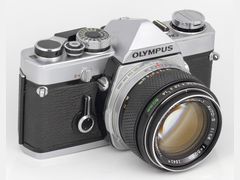
A smaller, lighter SLR of the same period. Casual Photophile says the Spotmatic is heavier than an OM-1, and that the OM-1 is the only one of his old SLRs quieter than the Spotmatic, though it feels far less sturdy.
Canon FTb
Canon's FTb arrived in 1971 with match-needle metering that works at full aperture with FD lenses, according to Casual Photophile and CameraGX, so there is no stop-down step. Casual Photophile puts the Spotmatic about 70 g lighter, and a commenter who owns both a Spotmatic and Canon FT-series bodies finds the Canons more rugged.
Pentax KM
The direct K-mount successor to the Spotmatic F, according to a 35mmc reader, with the self-timer and depth-of-field preview the K1000 dropped.
Every source behind this page
Read them yourself. How we pick and count them is in our methodology.
Show all 55 sources
Independent blogs 20
- The Noisy Shutter: Classic Camera Review
- Photo Thinking: Pentax Spotmatic SP
- Dead Cameras: The Asahi Pentax Spotmatic II
- Daniel J. Schneider: Pentax Spotmatic SP: The all
- 50mmF2: Asahi Pentax Spotmatic SPII Film Camera Review
- Film Still Photography: Pentax Spotmatic IIa
- Adventures of a Photo Nerd: Review: Pentax Spotmatic
- davidde.com: Review: The Asahi Pentax Spotmatic SP
- CamerAgX: Pentax Spotmatic SP
- Chris Chinnock Photography: Pentax Spotmatic F Review
- Everything Vintage: Iconic Pentax Spotmatic SP 35 mm SLR Review
- Everything Vintage: Pentax spotmatic SP1000
- Everything Vintage: Repairing a Pentax spotmatic stuck mirror
- Down the Road: Pentax Spotmatic SP
- Down the Road: Pentax Spotmatic F
- Why Use Film Cameras?: All Curves - The Asahi Pentax Spotmatic
- Why Use Film Cameras?: Simple Pleasures! Praise for the Asahi Pentax Spotmatic!
- Fogdog Photography blog: A Tale of Regret & Renewal: The Pentax Spotmatic
- Camera Go Camera: Pentax Spotmatic SP (Asahi)
- Alex Luyckx blog: CCR Review 51 - Asahi Pentax Spotmatic SPII - Alex Luyckx
Manuals and references 19
- pentaxs.com: Home
- blog.jimgrey.net: Pentax Spotmatic SP II
- brooklynfilmcamera.com: Camera Repair NYC: Film Camera Repair in Brooklyn + Mail
- butkus.org: Pentax Spotmatic instruction manual, Honeywell Pentax SP user guide
- camera-wiki.org: Pentax Spotmatic - Camera-wiki.org
- casualphotophile.com: Pentax Super Takumar 50mm F/1.4 M42 Mount Lens Review
- en.wikipedia.org: Pentax K1000
- en.wikipedia.org: Pentax Spotmatic
- retrospekt.com: Asahi Pentax Spotmatic II 35mm SLR Film Camera
- retrospekt.com: Asahi Pentax Spotmatic SP 35mm SLR Film Camera
- retrospekt.com: Honeywell Pentax Spotmatic 35mm SLR Film Camera
- retrospekt.com: Honeywell Pentax Spotmatic F 35mm SLR Film Camera
- retrospekt.com: Honeywell Pentax Spotmatic SP II 35mm SLR Film Camera
- austincamera.com: Camera Repairs
- flickr.com: Flickr: Discussing snapped battery contact. can i still fix light meter? in Asahi Pentax Spotmatic
- fstopcameras.com: New Old Stock Pentax Spotmatic SP 35mm SLR Film Camera Body with Body Cap, Manuals, Packaging, etc.
- glazerscamera.com: Exell MRB625 1.35V Zinc Air Coin Cell Battery
- glazerscamera.com: Exell A625PX 1.5V Alkaline Battery
- glazerscamera.com: WeinCell MRB-400 1.35V Zinc/Air Mercury Replacement Power Battery for
Forums 9
- Flickr group: Asahi Pentax Spotmatic: Discussing Is my spotmatic broken? in Asahi Pentax ...
- Flickr group: Asahi Pentax Spotmatic: Flickr: Discussing Mirror sticking at slow speeds in Asahi Pentax Spotmatic
- Flickr group: Asahi Pentax Spotmatic: Flickr: Discussing Is my lightmeter dead? in Asahi Pentax Spotmatic
- Flickr group: Asahi Pentax Spotmatic: Flickr: Discussing Price for Asahi Pentax now? in Asahi Pentax Spotmatic
- Flickr group: Asahi Pentax Spotmatic: Flickr: Discussing Easy way to use LR44 batteries in a Spotmatic in Asahi Pentax Spotmatic
- Flickr group: Asahi Pentax Spotmatic: Flickr: Discussing Super Takumar 200mm f/4 won't focus past 2 feet. in Asahi Pentax Spotmatic
- Flickr group: Asahi Pentax Spotmatic: Flickr: Discussing Mirror locks up when Light Meter switch is activated in Asahi Pentax Spotmatic
- Flickr group: Asahi Pentax Spotmatic: Flickr: Discussing New to spot Marci in Asahi Pentax Spotmatic
- Flickr group: Asahi Pentax Spotmatic: Flickr: Discussing How to Get a "Free" Spotmatic in Asahi Pentax Spotmatic
Video reviews 5
- Samsung9alaxy: Asahi Pentax Spotmatic F Overview/Review
- Lotta Milde: The best, most underrated film camera for beginners and pros | Pentax Spotmatic review
- Norbi Whitney: Pentax Spotmatic History & Review - My Everyday Camera!
- tomscameras: Pentax Spotmatic & K1000 - Review & Comparison
- Analog Insights: Pentax Pinnacles - Pentax Spotmatic F and ES II Review
Editorial reviews 2
Keep reading
Film cameras
The Pentax K1000 is a fully mechanical 35mm SLR made 1976-1997. What 150-plus owners and reviewers say, plus used prices ($250-$400), lenses and problems.
Film cameras
The Olympus OM-1 is a small all-mechanical 1972 SLR with a huge 0.92x finder. What 111 opinions say, used prices from $275, battery fixes and what to check.
Film cameras
The best film camera for beginners is usually a used Canon AE-1 Program or Pentax K1000. Compare 8 picks, October 2026 US shop prices and what to check first.
Film cameras
Where to buy film cameras used in the US: KEH, MPB, B&H, local shops, eBay and thrift, with warranties, October 2026 prices and a checklist to test one.
Techniques and editing
The sunny 16 rule: f/16 at 1/ISO in clear sun, wider for clouds and shade. Chart by ISO, backlight fixes, zone focusing presets and how to meter film.