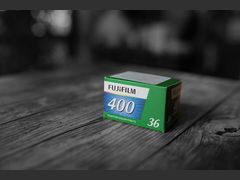
Comparison
Kodak Gold 200 vs UltraMax 400: Best Film for Beginners
The short answer
For most beginners, Kodak UltraMax 400 is the safer pick over Gold 200: it is one stop faster, so it needs half the light, which saves shots in shade, indoors and in fixed-setting reusable cameras.
Pick Gold 200 if you mostly shoot outside in sun and want its warm, yellow look; it is also the cheaper roll, $8.45 to $10 for 36 exposures at US stores in October 2026 versus $9.15 to $11.50 for UltraMax. Grain is nearly the same (Print Grain Index 44 vs 46), and both develop at any C-41 lab.
- Speed
- ISO 200 vs ISO 400 (one stop)i-m-ageplayground.co.uk
- Grain (PGI, 4x6 from 35mm)
- Gold 44, UltraMax 46brooklynfilmcamera.com
- Gold latitude (Kodak)
- 2 stops under, 3 overkodak.com
- Formats
- Gold: 35mm and 120; UltraMax: 35mm onlykodak.com
- 36 exp roll, Oct 2026
- $8.99 vs $9.99 at Film Photography Projectfilmphotographystore.com
- Developing
- Both standard C-41i-m-ageplayground.co.uk
Kodak UltraMax 400 vs Gold 200 side by side
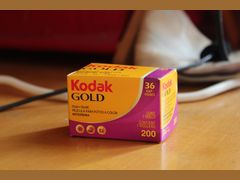 Kodak Gold 200 | 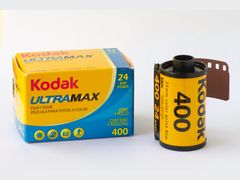 Kodak UltraMax 400 | |
|---|---|---|
| Box speed | ISO 200 | ISO 400, one stop faster |
| Kodak sunny-day exposure (distinct shadows) | 1/250 second at f/11 | 1/500 second at f/11 |
| What Kodak pitches it for | Daylight or electronic flash, people pictures, enlargements and cropping | Indoor, outdoor, low light with flash, action |
| Color | Warm, yellow-amber cast | Punchier, cooler, bluer skies |
| Grain (Print Grain Index, 4x6 from 35mm) | 44 | 46 |
| Exposure latitude | Kodak: 2 stops under, 3 over | No Kodak figure; reviewers say about 1 stop under and 1 to 3 over |
| Flash guide number, 350 BCPS unit (Kodak) | 60 ft (18 m) | 85 ft (26 m) |
| Formats | 35mm (24 and 36 exp) and 120 | 35mm only (24 and 36 exp) |
| Price, 35mm 36 exp (Oct 2026) | $8.45 to $10 | $9.15 to $11.50 |
| Pushing | No Kodak push data; buy UltraMax instead | Shoot at box speed |
| Process | C-41, any color lab | C-41, any color lab |
Pick the Kodak Gold 200 if
- You mostly shoot outdoors in sun: beach days, travel, summer afternoons.
- You want the warm, golden Kodak look straight from the lab.
- You shoot medium format: Gold comes in 120, UltraMax does not.
- Your camera lets you set ISO and you are happy to give the film extra light.
- You want the lowest price per roll.
Pick the Kodak UltraMax 400 if
- You are loading a fixed-setting reusable camera such as the Kodak M35, M38 or Ektar H35.
- You shoot in shade, in the evening or indoors.
- You want one film for days when you don't know what the light will do.
- Your camera has a slow zoom lens, so every stop of film speed helps.
- You rely on a built-in flash and want it to reach farther.
- You were thinking of pushing Gold to ISO 400.
Sources: kodak.com, kodak.com, kodak.com, imaging.kodakalaris.com, kodakprofessional.com, kodakprofessional.com, brooklynfilmcamera.com, digitalcameraworld.com, culturedkiwi.com, i-m-ageplayground.co.uk, filmphotographystore.com, filmphotographystore.com
Which is better for beginners, Gold 200 or UltraMax 400?
Most sources pick UltraMax 400 for a first roll. Bubblesphoto says it would hand a beginner UltraMax "because the extra stop of speed saves shots," and move to Gold once you can read light. Analogue Wonderland says UltraMax is usually the color film it recommends to beginners, and Unique Photo calls it the easiest recommendation for mixed light and compact cameras.
The strongest case for Gold comes from Brooklyn Film Camera, which calls it the best beginner film: about $10 a roll, three stops of overexposure tolerance and developing at any lab. That argument works if you mostly shoot outside in good light. Gold forgives too much light better than too little.
If you don't know what your camera does, or the roll will cover indoors and outdoors, start with UltraMax. For a metered camera and a sunny trip, Gold is the cheaper, warmer pick. Our guide to the best film cameras for beginners covers the camera side.
Sources: bubblesphoto.com, analoguewonderland.co.uk, uniquephoto.com, brooklynfilmcamera.com
Speed: what ISO 200 vs ISO 400 means in practice
UltraMax 400 is one stop faster than Gold 200, so it needs half as much light for the same exposure. Kodak's data sheets make that concrete: for bright sun with distinct shadows, Kodak suggests 1/250 second at f/11 for Gold and 1/500 second at f/11 for UltraMax. In the same light, that stop buys a faster shutter speed to freeze motion and avoid shake, or a smaller aperture for more depth of field.
Kodak Alaris says Gold 200 "loves the sun" and is designed for natural daylight or electronic flash. Kodak pitches UltraMax 400 differently: better low-light performance, longer flash range, better action shots and less camera shake.
Both are daylight-balanced color negative films, so the choice comes down to how much light you will have, not its color temperature. Bright sun suits Gold; deep shade, dusk and rooms suit UltraMax. Overcast days are where sources split: Analog.Cafe says Gold is known to perform well in cool, overcast light as long as you don't underexpose it, while Brooklyn Film Camera calls Gold on a gray day "serviceable, never special."
Rule of thumb from the sources: sun all day, Gold 200; anything less certain, UltraMax 400.
Sources: i-m-ageplayground.co.uk, kodakprofessional.com, kodakprofessional.com, kodak.com, kodak.com, imaging.kodakalaris.com, analog.cafe, brooklynfilmcamera.com
Color: warm yellow Gold vs punchier, cooler UltraMax
 Portra 400
Gold's look is warm. Brooklyn Film Camera describes it as a specific yellow-amber cast that lifts the midtones and can't be fully neutralized in scanning. Digital Camera World says UltraMax doesn't have Gold's "honeyed warmth" but calls it a reliably versatile film in most light.
Side-by-side shooters find UltraMax cooler. In a test where Gold was pushed one stop, Shoot It With Film got punchy UltraMax frames with blue and purple undertones and noticed "everything has a yellow/green hue" on Gold. A Japanese comparison on note.com found UltraMax's daytime blues far stronger, while Gold rendered sunsets with more warmth.
Kodak Alaris recommends Gold for people pictures, and Brooklyn Film Camera says it makes most skin look sun-touched and healthy, "flattering in a snapshot and wrong in a headshot." For neutral skin tones, Brooklyn points to Kodak Portra 400 (now also sold as Ektacolor Pro 400). Scanning matters too: ImagePlayground warns that two labs can produce noticeably different colors from the same roll.
Sources: brooklynfilmcamera.com, digitalcameraworld.com, shootitwithfilm.com, note.com, imaging.kodakalaris.com, en.wikipedia.org, i-m-ageplayground.co.uk
Grain: is UltraMax 400 grainier than Gold 200?
Barely. Brooklyn Film Camera, citing Kodak, puts 35mm Gold at a Print Grain Index of 44 on a 4x6 print, against 46 for UltraMax 400 and 37 for Portra 400. Lower is finer. According to Kodak's data sheets, a change of four units on that scale is a just noticeable difference in graininess for 90 percent of observers, so the two-point gap between Gold and UltraMax falls below it.
Exposure matters more than the box. Brooklyn Film Camera says what people call "grainy Gold" is usually underexposure, and ImagePlayground points out that UltraMax at box speed in dim light can look cleaner than underexposed Gold. If you plan to crop hard or print large from frames shot in good light, Kodak Alaris recommends Gold for enlargements and digital cropping.
Sources: brooklynfilmcamera.com, kodakprofessional.com, kodakprofessional.com, i-m-ageplayground.co.uk, imaging.kodakalaris.com
Exposure latitude: how forgiving each film is
Kodak says Gold 200 tolerates up to two stops of underexposure and three stops of overexposure. That lopsided range is why Brooklyn Film Camera's top tip is to rate Gold at ISO 100 for the whole roll: a full stop of extra light, well inside the three stops Kodak allows.
Kodak's UltraMax page and data sheet give no stops figure; the sheet only promises "better underexposure protection." Reviewers disagree on the rest. Digital Camera World says more than a stop or two over gives harsh highlights and more than a stop under brings color shifts, and Analog.Cafe says you won't get away with overexposing it by three stops. Cultured Kiwi says you can overexpose it up to three stops. Film Photography Project's store listing claims two stops under to three over, a figure that appears nowhere on Kodak's UltraMax page or data sheet.
Analog.Cafe also estimates UltraMax's dynamic range at about 8 stops from Kodak's data, against 12 for Portra 400. The practical reading: with Gold, lean toward more light. With UltraMax, shoot at ISO 400 and let your camera's meter do its job.
Sources: kodak.com, kodak.com, brooklynfilmcamera.com, kodakprofessional.com, digitalcameraworld.com, analog.cafe, culturedkiwi.com, filmphotographystore.com
Which film for your camera: reusable, point-and-shoot or SLR
Fixed-setting reusable cameras. The Kodak M35, M38 and Ektar H35 have one shutter speed and one aperture, and ImagePlayground notes they are designed around ISO 400 film, so UltraMax is usually the better match. Gold 200 can work in these on bright days outside. The Ektar H35 is covered in our half-frame cameras guide.
Automatic point-and-shoots. Most read the DX code on the film canister and set exposure for you, so either film works. If yours has a slow zoom lens, UltraMax's extra stop helps: Cultured Kiwi notes its speed goes well with zoom lenses, where a faster shutter speed cuts shake at the telephoto end.
Manual and semi-auto SLRs. A Canon AE-1, Pentax K1000 or similar handles either film, because you set the ISO and the meter adjusts. Choose Gold for sunny days and UltraMax when the light may drop.
Sources: i-m-ageplayground.co.uk, culturedkiwi.com
Indoors, flash and low light
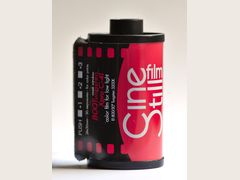 800T
Gold 200 is fine indoors with a flash, since Kodak Alaris says it is designed for natural daylight or electronic flash. Without flash under household bulbs it struggles. Brooklyn Film Camera notes Kodak rates it at EI 50 under 3200 K tungsten with an 80A blue filter; skip the filter and the frames come back orange, which Brooklyn says is not a scanning error.
UltraMax 400 is the better indoor film of the two. Kodak Alaris pitches it for indoor shots, low light with flash and stop-action, and Kodak's data sheets put a number on the flash advantage: with the same 350 BCPS flash unit, the guide number is 85 feet for UltraMax and 60 feet for Gold. Divide the guide number by the aperture to get the reach: at f/8, 85 / 8 is about 10.6 feet, against 60 / 8 = 7.5 feet for Gold.
UltraMax is still an ISO 400 film, so after dark without flash you need lit streets. Our CineStill 800T guide covers shooting film at night.
Sources: imaging.kodakalaris.com, brooklynfilmcamera.com, kodak.com, kodakprofessional.com, kodakprofessional.com
Can you push Gold 200 to 400 instead of buying UltraMax?
You can, but the sources say don't. Brooklyn Film Camera notes that Kodak publishes no push data for Gold and recommends shooting UltraMax rather than pushing Gold to 400.
Shoot It With Film tried it: Gold pushed one stop came back with washed-out color and obvious grain once the light dropped, and the writer said she would probably never push it again. Since UltraMax costs only $0.70 to $2.50 more per 36-exposure roll, buying the faster film is the simpler fix. Our push and pull guide explains when pushing does make sense.
Sources: brooklynfilmcamera.com, shootitwithfilm.com
Kodak Gold 200 and UltraMax 400 prices in October 2026
| Seller | Item | Price | Note |
|---|---|---|---|
| Unique Photo | Kodak Gold 200, 35mm, 36 exp (7518251) | $8.45 | Single roll |
| Unique Photo | Kodak UltraMax 400, 35mm, 36 exp | $9.15 | Single roll, in stock |
| Unique Photo | Kodak Gold 200, 35mm, 24 exp | $6.95 | Single roll, in stock |
| Unique Photo | Kodak UltraMax 400, 35mm, 24 exp | $7.49 | Single roll, in stock |
| Unique Photo | Kodak Gold 200, 120 | $8.55 | Single roll |
| Film Photography Project | Kodak Gold 200, 35mm, 36 exp | $8.99 | Single roll |
| Film Photography Project | Kodak UltraMax 400, 35mm, 36 exp | $9.99 | Listed as Gold Max 400 |
| Film Photography Project | Kodak Gold 200, 35mm, 36 exp, 3-pack | $24.99 | About $8.33 per roll |
| Film Photography Project | Kodak UltraMax 400, 35mm, 36 exp, 3-pack | $26.99 | About $9.00 per roll |
| Reformed Film Lab | Kodak Gold 200, 35mm, 36 exp | $8.50 | Sale price, regular $9.50 |
| Reformed Film Lab | Kodak UltraMax 400, 35mm, 36 exp | $11.00 | Single roll |
| Reformed Film Lab | Kodak UltraMax 400, 35mm, 36 exp, 3 rolls | $30.00 | About $10 per roll |
| Brooklyn Film Camera | Kodak Gold 200, 35mm or 120 | $10 | Store price in its Gold review, updated Oct 26, 2026 |
| Brooklyn Film Camera | Kodak UltraMax 400, 35mm | $11.50 | Store price in its Gold review, updated Oct 26, 2026 |
Prices checked October 2026. They change often.
Price per roll and per photo
Gold 200 is the cheaper film at every US store checked on October 28, 2026. The gap on a 36-exposure roll runs from $0.70 at Unique Photo ($8.45 vs $9.15) to $2.50 at Reformed Film Lab, where Gold was on sale ($8.50 vs $11.00). Analogue Wonderland tells customers to expect UltraMax to cost 10 to 25 percent more per roll.
Per frame, the difference is small: at Film Photography Project, $8.99 for 36 shots of Gold is about $0.25 each, and $9.99 for UltraMax is about $0.28 each. Developing costs far more than the gap. Brooklyn Film Camera charges $18 per roll for C-41, with 4 to 5 business days turnaround, and our film developing cost table compares other labs.
Sources: uniquephoto.com, reformedfilmlab.com, reformedfilmlab.com, analoguewonderland.co.uk, filmphotographystore.com, filmphotographystore.com, brooklynfilmcamera.com
Formats: only Gold 200 comes in 120
Both films come in 35mm rolls of 24 or 36 exposures. Kodak's catalog numbers are 7518251 (36 exp) and 7518269 (24 exp) for Gold 200, and 7518285 (36 exp) and 7518277 (24 exp) for UltraMax 400.
Only Gold comes in 120, sold as Kodak Professional Gold 200 in five-roll pro packs (catalog number 7518418). Brooklyn Film Camera dates the 120 launch to March 21, 2022, and Kodak's Gold data sheet dated March 2022 already lists the 120 size. UltraMax 400 is a 35mm film only.
Wikipedia's film list dates Kodacolor Gold to 1988, with the current Gold version from 2007, and says UltraMax was originally sold as Gold 400 from 1997 to 2007; Film Photography Project still lists it as Gold Max 400. Since 2025 both films are also sold directly by Eastman Kodak alongside Kodak Alaris.
Sources: kodak.com, kodak.com, kodak.com, imaging.kodakalaris.com, brooklynfilmcamera.com, kodakprofessional.com, en.wikipedia.org, filmphotographystore.com
Kodak ColorPlus 200 vs Gold 200: is the budget roll worth it?
ColorPlus 200 is Kodak's other ISO 200 consumer film, and the difference from Gold is smaller than its lower status suggests. Analog.Cafe's controlled comparison found virtually no practical difference outside studio lighting, and its review found identical grain size and structure. Lenslurker rates ColorPlus as less saturated and contrasty than Gold.
Analog.Cafe also found identical edge markings on ColorPlus and Eastman Kodak's new Kodacolor 200 and concluded they are the same film. Wikipedia lists ColorPlus as a budget film not aimed at the US market, with no data sheet.
In the US it doesn't always save money. Unique Photo sold ColorPlus at $8.45 for 36 exposures in October 2026, the same as Gold, and Brooklyn Film Camera lists both at $10. Gold has a Kodak data sheet and a 120 version; ColorPlus is 35mm only. Buy whichever is cheaper on the day.
Sources: analog.cafe, analog.cafe, lenslurker.com, en.wikipedia.org, uniquephoto.com, brooklynfilmcamera.com
Best 35mm film for beginners: where Gold and UltraMax fit
Gold 200For a first roll of color film, Gold 200 and UltraMax 400 are the default answers because they are cheap, widely stocked and processed by any C-41 lab. Our full guides to Kodak Gold 200 and Kodak UltraMax 400 go deeper on each stock.
Once you know what you like, Portra 400 is the step up Brooklyn Film Camera's comparison offers: a finer Print Grain Index of 37 and more neutral color, for roughly 75 to 85 percent more than Gold. If you see Fujifilm 400 on the shelf, Wikipedia's film list says it is manufactured by Eastman Kodak.
Sources: i-m-ageplayground.co.uk, brooklynfilmcamera.com, en.wikipedia.org
Questions people ask
Can you use Kodak Gold 200 indoors?
Yes, with a flash. Kodak Alaris says Gold is designed for daylight or electronic flash. Brooklyn Film Camera says unflashed Gold frames under tungsten bulbs come back orange. When you can't use flash, UltraMax 400's extra stop of speed makes it the better indoor choice.
Is Kodak UltraMax 400 good for night photography?
It is better than Gold in low light, and Kodak's data sheets give it a longer flash reach (guide number 85 feet vs 60 feet for Gold with the same flash), but at ISO 400 it still needs a flash or well-lit streets after dark.
Sources: kodak.com, kodakprofessional.com, kodakprofessional.com
Should I shoot Kodak Gold 200 at ISO 100?
Brooklyn Film Camera recommends it. Rating Gold at ISO 100 gives every frame a stop of extra light, which opens shadows, and Kodak says the film tolerates three stops of overexposure.
Sources: brooklynfilmcamera.com, kodak.com
Does Kodak UltraMax 400 come in 120?
No. UltraMax 400 is a 35mm film only. Gold 200 comes in 35mm and in 120, sold as Kodak Professional Gold 200 in five-roll pro packs since March 2022.
Sources: kodak.com, brooklynfilmcamera.com
Which film should I use in a Kodak Ektar H35 or M35?
UltraMax 400. These reusable cameras have a fixed shutter speed and aperture designed around ISO 400 film. Gold 200 can work in them outside on bright days.
Sources: i-m-ageplayground.co.uk
Is Fujifilm 200 the same as Kodak Gold 200?
Wikipedia's list of photographic films says Fujifilm 200, sold from 2021, was later identified as rebranded Kodak Gold 200. It also notes that Fujifilm 400 is made by Eastman Kodak.
Sources: en.wikipedia.org
Is UltraMax 400 warmer or cooler than Gold 200?
Cooler. Side-by-side shooters describe UltraMax as punchier, with bluer skies and blue or purple undertones, and Gold as warm and yellow. Lab scanning can noticeably shift both.
Sources: shootitwithfilm.com, note.com, i-m-ageplayground.co.uk
Sources
Every fact on this page comes from one of these. How we choose and check sources is in our methodology.
Show all 25 sources
retailer 9
- Brooklyn Film Camera: Kodak Gold Review
- ImagePlayground London: Kodak Gold 200 vs UltraMax 400
- Unique Photo: Kodak Gold 200 vs UltraMax 400 vs ColorPlus 200
- Analogue Wonderland: Kodak UltraMax vs Kodak Gold
- Analogue Wonderland: Best Colour Film Stocks
- Film Photography Project store: Kodak Gold 200 (36 exp)
- Film Photography Project store: Kodak Gold Max 400 / UltraMax (36 exp)
- Reformed Film Lab: Kodak UltraMax 400 35mm 36 exp
- Unique Photo: Kodak ColorPlus 200 135-36
official 6
Independent blogs 5
Editorial reviews 4
Manuals and references 1
Keep reading
Film stocks
Kodak Gold 200 is a warm ISO 200 color film in 35mm and 120, $8.99 to $10.90 a 36-exposure roll. What 139 opinions say about grain, skin and low light.
Film stocks
Kodak Ultramax 400 is a 35mm ISO 400 color film, $8.69 to $11.50 a 36-exposure roll. What 121 opinions say about its color, grain, latitude and low light.
Film stocks
Kodak Portra 400 is an ISO 400 color film loved for skin tones and latitude. What 113 opinions say, how to expose and push it, and US prices from $15.99.
Film stocks
Fujifilm 400 is a made-in-USA ISO 400 color film, $10.99 to $14 a roll in October 2026. What 61 opinions say about its look, grain, pushing and the Kodak link.
Developing and scanning
A roll of 35mm film costs $5 to $11.50 to develop at US labs, or $11.50 to $29 with scans. Prices from 12 labs and the big chains, checked October 2026.
Film stocks
Where to buy 35mm film online in the US: B&H, CineStill, FPP, Midwest Photo and camera shops that ship. Kodak Gold 200 ran $8.49 to $9.49 in October 2026.