Explainer
Rangefinder vs SLR: How They Differ and Which One to Buy
The short answer
An SLR shows you the scene through the taking lens by way of a mirror, so the finder shows what the lens sees; a rangefinder frames through a separate window and focuses by lining up two images in a bright central patch.
That makes a rangefinder often quieter and smaller, and free of viewfinder blackout, while an SLR wins at close-ups, lenses longer than 135mm and judging framing and depth of field through the lens. Ordinary fixed-lens rangefinders cost about the same as SLR kits ($179.99-$399.99 vs $139.99-$389.99 at Coastal Film Lab in October 2026); Leica M-mount gear is the expensive exception.
- SLR viewing
- Through the taking lens, via a mirroren.wikipedia.org
- Rangefinder focusing
- Merge two images in a central patchen.wikipedia.org
- Rangefinder close focus
- About 1 m; 0.7 m on some modern lensestahusa.co
- Leica M lens range
- 16mm to 135mmleicastoremiami.com
- Leaf-shutter flash sync
- Every shutter speeden.wikipedia.org
- New Leica M6, Oct 2026
- $7,000 at Leica Store Miami (pre-order)leicastoremiami.com
Rangefinder vs SLR at a glance
| Rangefinder | SLR | |
|---|---|---|
| How you view | Separate window beside the lens | Through the taking lens, via a mirror and prism |
| How you focus | Merge two images in a bright central patch | Turn the ring until the image snaps sharp, often with a split-image circle |
| Parallax | Yes, grows up close; better models shift the frame lines | None at any distance |
| Closest focus | About 0.7-1 m (roughly 3 ft) on most lenses | Much closer; macro work is possible |
| Longest practical lens | 135mm (Leica M range is 16-135mm) | Many more focal lengths, including long zooms; a used 135mm can cost $69.99 |
| Blackout at exposure | None | Brief, while the mirror swings up |
| Noise | Often quieter, especially leaf-shutter models | Louder, with mirror noise and vibration |
| Depth-of-field preview | Not possible | Visible through the lens |
| Framing accuracy | Approximate; Leica M6 frame lines match the film exactly only at 2 m | Close, though most finders show slightly under 100% |
| Flash sync | Every speed on leaf-shutter models; 1/50 s on a Leica M6 | 1/60 s on a Canon AE-1 or Pentax K1000; 1/80 s on a Nikon F3 |
| Example body | Leica M6: 585 g, 33.5 mm deep, top speed 1/1000 s | Canon AE-1: 590 g, 48 mm deep, top speed 1/1000 s |
| Used price, Oct 2026 | $179.99-$399.99 fixed-lens; used Leica M3 DS and MP bodies $1,795-$4,795 | $139.99-$389.99 with a 50mm lens |
Pick the Rangefinder if
- You shoot street, travel or everyday scenes with 28mm to 50mm lenses
- You want a quieter camera with no blackout, so you see the moment you capture
- You use flash outdoors in daylight and want a leaf shutter that syncs at every speed
- You use dark or colored filters, which do not dim a rangefinder's window
Pick the SLR if
- You want close-ups, macro or lenses longer than 135mm
- You want to look through the lens itself, including for depth of field
- You are learning and want what-you-see-is-what-you-get focusing
- You want cheaper lenses and more focal lengths to choose from
Sources: en.wikipedia.org, en.wikipedia.org, leicastoremiami.com, tahusa.co, camera-wiki.org, en.wikipedia.org, en.wikipedia.org, en.wikipedia.org, en.wikipedia.org, en.wikipedia.org, coastalfilmlab.com, coastalfilmlab.com, camerawest.com, vintagecamerahut.com, 35mmc.com
What is the difference between a rangefinder and an SLR?
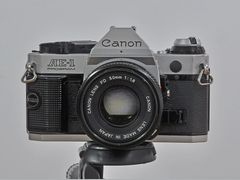
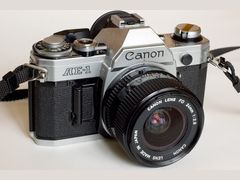 AE-1
A single-lens reflex (SLR) uses the same lens for viewing and for taking the picture. A mirror behind the lens bounces the image up to the viewfinder, so you see what the film will see, and when you press the shutter release that mirror swings out of the way.
A rangefinder has no mirror. You look through a separate window next to the lens, and a bright patch in the middle shows a second image of the subject. Turning the focus ring moves that image, and when the two line up, your subject is in focus.
One common mix-up: many manual SLRs, such as the Canon AE-1, have a focusing aid described as a split-image rangefinder. That is a feature on the SLR's focusing screen, not a rangefinder camera.
Rangefinders were common from the 1930s to the 1970s, then the more advanced models lost ground to SLRs. Both are commonly found in 35mm, which Vintage Camera Hut calls the easiest film format to recommend.
Sources: en.wikipedia.org, camera-wiki.org, en.wikipedia.org, en.wikipedia.org, vintagecamerahut.com
How to focus a rangefinder vs an SLR
Each type focuses differently. Here is the routine for both, plus zone focusing.
- 1
Rangefinder: merge the images
Look through the finder, find the bright patch in the center and turn the focus ring until the ghost image merges with the main one. When they coincide, that spot is in focus.
- 2
SLR: watch the screen
Look through the lens and turn the focus ring until the subject snaps sharp. Many manual SLRs add a split-image circle and a microprism ring in the center to confirm focus.
- 3
Rangefinder: frame inside the lines
Compose inside the bright-line frame for the lens you mounted. On better cameras the lines shift as you focus closer to correct parallax, and anything outside them is cropped.
- 4
Either: zone focus for street shots
Estimate the distance, set it on the lens scale and stop down to around f/8 so the zone of sharp focus covers small errors. Our Sunny 16 and zone focusing guide covers the settings.
Sources: en.wikipedia.org, vintagecamerahut.com, ilottvintage.com, shootitwithfilm.com
Parallax, framing and close-ups: why SLRs win up close
Because a rangefinder's window sits beside the lens, it sees a slightly different view. This parallax error is negligible far away and significant up close. Better rangefinders project bright-line frames that move as you focus to correct it, down to the minimum focus distance.
Parallax is also why rangefinder lenses stop focusing fairly far out. Ilott Vintage says most cannot focus closer than 3 feet; Tahusa puts the usual limit at about 1 m, with some modern lenses reaching 0.7 m. The current Leica M6 spec starts at 70 cm, about 2.3 feet.
An SLR views through the lens, so it has no parallax at any distance, which is what makes macro photography possible. It can also display depth of field for a given aperture, something a rangefinder design cannot do.
Framing differs too. Leica's M6 spec says its frame lines match the film area exactly only at 2 m; at infinity the mismatch runs from about 7.3% (28mm) to 18% (135mm). Most SLR finders show slightly less than 100% of the frame, so a little more ends up on the film than you saw.
A rangefinder window does not look through the lens, so it will not warn you that the lens cap is still on.
Sources: en.wikipedia.org, ilottvintage.com, tahusa.co, leicastoremiami.com, camera-wiki.org
Lenses: rangefinders favor wide angles, SLRs go long
With no mirror box, a rangefinder lens's rear element can sit deep inside the body, which makes high-quality wide-angle lenses easier to design. SLRs need larger, more complex retrofocus designs for the same focal lengths.
At the long end, rangefinders run out. Leica lists M lenses from 16mm to 135mm for the M6, and Simon King, a long-time M6 user writing on 35mmc, says the rangefinder kept him from going longer than 135mm. True zooms are almost absent: Wikipedia names only one, the Contax G2's Zeiss 35-70mm Vario-Sonnar.
SLRs take short telephotos like 85mm, 100mm and 135mm for tight portraits, plus macro lenses. Simon King says an SLR gave him 80-200mm, which his rangefinder could not take. The price gap can be wide: in October 2026, Coastal Film Lab listed a used Pentax Takumar 135mm f/2.8 for $69.99, while Camera West listed a used Leica 135mm f/3.4 APO-Telyt-M for $3,595.
Some blogs say the missing mirror makes rangefinder pictures sharper, but no source we found measures a general sharpness advantage. The documented benefit is the easier wide-angle design; sharpness still comes down to the lens and accurate focus.
Sources: en.wikipedia.org, en.wikipedia.org, leicastoremiami.com, 35mmc.com, vintagecamerahut.com, coastalfilmlab.com, camerawest.com, shotkit.com, tahusa.co
Is a rangefinder smaller, lighter and quieter than an SLR?
A rangefinder is often quieter and smaller, but not much lighter. Wikipedia notes rangefinders are often quieter, particularly with leaf shutters, and smaller than competing SLRs. An SLR's mirror blacks out the finder during exposure, takes time to move and adds noise and vibration, plus a split second of extra delay before the film is exposed.
Lighter is a closer call than most guides admit. Body weights are nearly identical: a Leica M6 weighs 585 g, a Canon AE-1 590 g and a Pentax K1000 620 g. The real saving is depth, 33.5 mm for the M6 against 48 mm for both SLRs. Simon King (35mmc) says a rangefinder body-and-lens combo is more likely than not to weigh less than its SLR equivalent.
| Camera | Type | Weight | Depth | Top speed | Flash sync |
|---|---|---|---|---|---|
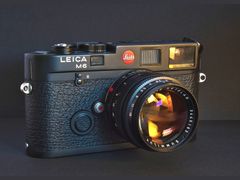 Leica M6 | Rangefinder | 585 g | 33.5 mm | 1/1000 s | 1/50 s |
| Canon AE-1 | SLR | 590 g | 48 mm | 1/1000 s | 1/60 s |
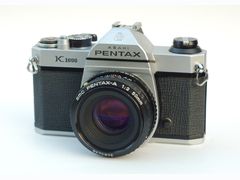 Pentax K1000 | SLR | 620 g | 48 mm | 1/1000 s | 1/60 s |
Sources: en.wikipedia.org, en.wikipedia.org, camera-wiki.org, en.wikipedia.org, en.wikipedia.org, en.wikipedia.org, 35mmc.com
Shutter speed and flash: which type has the edge?
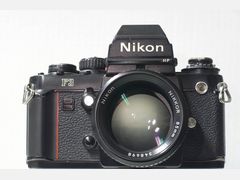 Nikon F3
Tahusa and Shotkit say SLRs have faster shutters, but that depends on the model. The classic beginner SLRs, the Canon AE-1 and Pentax K1000, top out at 1/1000 s, the same as a Leica M6. Pro SLRs go faster: the Nikon F3 reaches 1/2000 s and the Nikon F4 1/8000 s.
Simon King (35mmc) says the 1/1000 s ceiling on most film rangefinders he has shot has limited him with ISO 400 film in sun.
Flash favors the common rangefinder. Most rangefinders ever made are fixed-lens models with leaf shutters, which open fully and sync flash at every speed. Focal-plane shutters, used in almost all contemporary SLRs and in Leica M bodies, sync only when the whole frame is open at once, typically 1/60 s or slower. Vintage Camera Hut calls the leaf shutter a hidden advantage for daylight fill flash.
Metering differs as well. The Nikon F3 puts 80% of its emphasis on a 12mm circle in the center, a classic center-weighted reading. The Leica M6 TTL reads only a small central area, about 12-13% of the frame, so it behaves more like a spot meter.
Sources: tahusa.co, shotkit.com, en.wikipedia.org, en.wikipedia.org, en.wikipedia.org, en.wikipedia.org, 35mmc.com, en.wikipedia.org, en.wikipedia.org, flashofdarkness.com, vintagecamerahut.com, en.wikipedia.org
Rangefinder or SLR for beginners, street, travel and portraits?
For beginners, most sources point to an SLR. Shotkit says SLRs are easier for new photographers and that learning to focus a rangefinder properly has a steeper learning curve. Vintage Camera Hut makes an exception for people who mainly want a small everyday camera, where a fixed-lens rangefinder fits well.
For street and travel, the rangefinder's traits line up: quiet, no blackout, and a finder that shows a little more than the lens, so you can see people about to walk into the frame. Kamerastore points out that Henri Cartier-Bresson, Robert Frank, Garry Winogrand and Joel Meyerowitz all used Leicas.
For portraits, wildlife and close-ups, the SLR is the practical pick. You can mount an 85mm to 135mm lens for flattering compression, focus close and see the background blur before you shoot.
Sources: shotkit.com, vintagecamerahut.com, en.wikipedia.org, kamerastore.com
Why are rangefinders more expensive than SLRs?
Ordinary rangefinders are mostly not more expensive than SLRs; Leica M-mount bodies are. In October 2026, Coastal Film Lab in Tampa listed an Olympus 35 RC for $179.99 and a Canonet QL17 GIII for $399.99, against $279.99 for a Canon AE-1 with a 50mm lens. Japanese fixed-lens rangefinders of the 1960s were built to be compact like a Leica but much less expensive, and a member of The Photo Forum calls rangefinders often cheaper, tough and low on moving parts. Condition matters at these prices: the same shop says the Olympus 35 RC's built-in meter does not work, and the Nikon F's Photomic meter is dead.
The reputation comes from Leica M-mount gear. When Leica reissued the M6 in 2022, PopPhoto reported a price of $5,295 and noted it is still hand-made in Germany from more than 100 parts. In October 2026 Leica Store Miami listed the new M6 at $7,000 (out of stock, pre-order), and Camera West listed used Leica M3 and MP bodies at $1,795 and $4,795.
Sources: coastalfilmlab.com, coastalfilmlab.com, coastalfilmlab.com, en.wikipedia.org, thephotoforum.com, popphoto.com, leicastoremiami.com, camerawest.com, camerawest.com, coastalfilmlab.com
Rangefinder and SLR prices in October 2026
| Seller | Item | Price | Note |
|---|---|---|---|
| Coastal Film Lab (Tampa, FL) | Olympus 35 RC fixed-lens rangefinder, used | $179.99 | In stock; listing says the built-in meter does not work |
| Coastal Film Lab (Tampa, FL) | Canon Canonet QL17 GIII rangefinder, excellent, used | $399.99 | Sold out; listing price |
| Coastal Film Lab (Tampa, FL) | Konica Hexar RF rangefinder, CLA'd, body only, used | $1,799.99 | Sold out; listing price; built around the Leica M lens mount |
| Camera West | Leica M3 DS rangefinder body, used | $1,795 | In stock |
| Camera West | Leica MP 0.72 silver rangefinder body, used | $4,795 | In stock |
| Leica Store Miami | Leica M6 (2022 reissue), black, body only, new | $7,000 | Out of stock, pre-order |
| Coastal Film Lab (Tampa, FL) | Canon FTb QL SLR + 50mm f/1.8 FD, used | $139.99 | In stock; one-off listing, lens has mild internal haze |
| Coastal Film Lab (Tampa, FL) | Canon AE-1 SLR + 50mm f/1.8, used | $279.99 | In stock; one-off listing, chip in the viewfinder and fungus at the lens edge |
| Coastal Film Lab (Tampa, FL) | Pentax K1000 SLR + Pentax-M 50mm f/1.7, used | $349.99 | In stock |
| Coastal Film Lab (Tampa, FL) | Nikon F SLR + Photomic prism + Nikkor 50mm f/1.4 Ai-S, used | $389.99 | In stock; listing says the Photomic meter is dead |
| Camera West | Nikon F3 SLR body + MD-4 motor drive, used | $395 | Out of stock; listing price |
| Coastal Film Lab (Tampa, FL) | Pentax Takumar Bayonet 135mm f/2.8 lens (K mount), used | $69.99 | In stock |
| Camera West | Leica 135mm f/3.4 APO-Telyt-M lens, boxed, used | $3,595 | In stock |
Prices checked October 2026. They change often.
Upkeep: CLA costs and rangefinder calibration
Both types need a clean, lube and adjust (CLA) now and then, and the guide's rangefinder range runs a little higher. Brooklyn Film Camera's repair guide prices a full CLA at $225-325 for a common 35mm SLR and $250-400 for a premium compact or rangefinder. Its pricing estimate page, checked in October 2026, lists $270 for a Canon AE-1, $260 for a Pentax K1000 and $260-$300 for a Canonet.
A rangefinder also has to stay calibrated. Kolari Vision, a US shop that services Leica M8 and M9 rangefinders, lists focus landing short or long, or visible vertical misalignment in the focus cues even when zeroed in, as signs a rangefinder needs adjusting.
Vintage Camera Hut's advice applies to both: condition matters more than type, and a well-kept SLR is a better buy than a poorly stored rangefinder, and the reverse.
Sources: brooklynfilmcamera.com, brooklynfilmcamera.com, kolarivision.com, vintagecamerahut.com
How to check a used rangefinder or SLR before you buy
These checks come from Vintage Camera Hut's maintenance lists and Kolari Vision's rangefinder alignment signs. Our guide to where to buy used film cameras covers where to shop and how to test a camera.
- 1
Rangefinder: check the patch
The viewfinder should be clear and the focus patch should merge cleanly with no vertical offset. A misaligned rangefinder hurts focus accuracy and needs a technician to recalibrate.
- 2
SLR: check the mirror
The mirror should move correctly and return after firing, and the prism and focusing screen should be clear.
- 3
Both: fire every speed
Check that the shutter fires consistently at different speeds. On an SLR, check that the shutter curtains are undamaged.
- 4
Both: inspect the lens
Look for haze or fungus, and make sure the aperture blades are dry, not oily.
- 5
Both: test the advance and meter
The film advance should feel smooth, and the light meter should work.
Sources: vintagecamerahut.com, kolarivision.com
Questions people ask
Is a rangefinder or an SLR better for beginners?
Most sources say an SLR, because what you see through the lens is what you get, including focus and depth of field. Shotkit says rangefinder focusing has a steeper learning curve. A fixed-lens rangefinder still suits a beginner who mainly wants a small everyday camera.
Sources: shotkit.com, vintagecamerahut.com
Is a rangefinder better for street photography?
Several sources favor it. A rangefinder is quieter, has no blackout and shows a little more than the frame, so you can see people about to step in, and Vintage Camera Hut rates a fixed-lens rangefinder excellent for street work against good but more noticeable for an SLR. Classic street photographers such as Henri Cartier-Bresson and Garry Winogrand used Leicas.
Sources: en.wikipedia.org, kamerastore.com, vintagecamerahut.com
Can you use telephoto lenses on a rangefinder?
Only up to about 135mm. Leica lists M lenses from 16mm to 135mm for the M6, and at 135mm the frame lines are off by about 18% at infinity. For anything longer, use an SLR.
Sources: leicastoremiami.com, 35mmc.com
What is the difference between a rangefinder and a viewfinder camera?
Both frame through a window separate from the lens, but only a rangefinder has the coupled focusing patch. A plain viewfinder camera gives an approximate view and no focusing help. The original [Olympus XA](/cameras/olympus-xa/) is a true rangefinder, while the [Olympus Trip 35](/cameras/olympus-trip-35/) uses a four-position zone focus.
Sources: kamerastore.com, en.wikipedia.org, en.wikipedia.org
Is a film SLR better than a DSLR, and why are DSLRs being phased out?
That depends on whether you want to shoot film or digital: both use the same through-the-lens mirror design, and a film SLR records on film while a DSLR records on a sensor. DSLRs are being phased out as makers move to mirrorless cameras, which began outselling DSLRs in 2021. Nikon announced in 2020 it was ending DSLR production in Japan, Canon and Sony made similar announcements, and as of 2025 only Pentax still makes new consumer DSLRs.
Sources: en.wikipedia.org, en.wikipedia.org
Can you tell if the lens cap is on with a rangefinder?
No. The viewfinder does not look through the lens, so a cap or a finger over the lens stays invisible. On an SLR you would see a black finder right away.
Sources: tahusa.co
Do rangefinders take sharper pictures than SLRs?
Not in any general, measured way. Some blogs claim it, but the documented advantage is that wide-angle lenses are easier to design without a mirror box. Sharpness depends mostly on the lens and on accurate focus.
Sources: en.wikipedia.org, shotkit.com
Do rangefinders need calibration?
Sometimes. If shots land short or long of focus, or the patch shows a vertical offset at infinity, the rangefinder needs adjusting, usually as part of a CLA. Brooklyn Film Camera quotes $250-400 for a premium compact or rangefinder CLA (checked October 2026).
Sources: kolarivision.com, brooklynfilmcamera.com
Sources
Every fact on this page comes from one of these. How we choose and check sources is in our methodology.
Show all 33 sources
Manuals and references 12
- Wikipedia: Rangefinder camera
- Wikipedia: Single-lens reflex camera
- Wikipedia: Digital single-lens reflex camera
- Camera-wiki.org: SLR
- Wikipedia: Leica M6
- Wikipedia: Canon AE-1
- Wikipedia: Pentax K1000
- Wikipedia: Nikon F3
- Wikipedia: Leaf shutter
- Wikipedia: Flash synchronization
- Wikipedia: Olympus XA
- Wikipedia: Olympus Trip 35
retailer 11
- Leica Store Miami: Leica M6, black (product page and tech specs)
- Brooklyn Film Camera: Camera repair pricing
- Brooklyn Film Camera: CLA and repair pricing breakdown
- Kolari Vision: CLA service for Leica M8 and M9 cameras
- Coastal Film Lab: Olympus 35 RC
- Coastal Film Lab: Canon Canonet QL17 GIII
- Coastal Film Lab: Canon AE-1 + 50mm f/1.8
- Coastal Film Lab: Pentax Takumar Bayonet 135mm f/2.8
- Camera West: Leica M3 DS
- Camera West: Leica MP 0.72 silver
- Camera West: Leica 135mm f/3.4 APO-Telyt-M
Independent blogs 5
Editorial reviews 4
Forums 1
Keep reading
Film cameras
The best film camera for beginners is usually a used Canon AE-1 Program or Pentax K1000. Compare 8 picks, October 2026 US shop prices and what to check first.
Film cameras
Canon AE-1 vs Pentax K1000: auto exposure vs fully manual, battery dependence, lenses, common faults and October 2026 prices, used and serviced.
Film cameras
What 158 owner and reviewer opinions say about the Mamiya 7 and 7II: used 7II bodies at $2,495-$4,095 in October 2026, the six lenses, faults and repairs.
Techniques and editing
How to use flash photography: stay at or below sync speed (1/60 on a Canon AE-1), set aperture as guide number divided by distance, then bounce and gel it.
Techniques and editing
Film vs digital photography: film costs about $29.94 a roll to shoot and scan, digital almost nothing per frame. Detail, low light, look and which to pick.
Film stocks
35mm vs 120 film: common 120 frames are 2.7 to 5.4 times bigger than 35mm but give 8 to 16 shots a roll. Cost per frame, lab prices and which to pick.