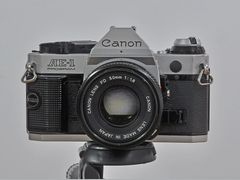
Comparison
Canon AE-1 vs Pentax K1000: Which Film SLR Should You Buy?
The short answer
Buy the Canon AE-1 if you want shutter-priority auto exposure, a self-timer and split-image focusing; buy the Pentax K1000 if you want a fully mechanical camera that still fires with a dead battery and makes you learn exposure.
In October 2026 they cost about the same: $229 vs $219 for a used body at MPEX, and $410 vs $400 serviced with a 50mm lens at Brooklyn Film Camera.
- Years made
- AE-1 1976-1984; K1000 1976-1997en.wikipedia.org
- Exposure
- AE-1 shutter priority + manual; K1000 manual onlybrooklynfilmcamera.com
- Without a battery
- AE-1 dead; K1000 fires, meter offbrooklynfilmcamera.com
- Lens mount
- Canon FD vs Pentax Kbrooklynfilmcamera.com
- Used body, MPEX
- $229 vs $219 (Oct. 28, 2026)mpex.com
- Serviced with 50mm, Brooklyn Film Camera
- $410 vs $400 (Oct. 28, 2026)brooklynfilmcamera.com
Canon AE-1 vs Pentax K1000: specs side by side
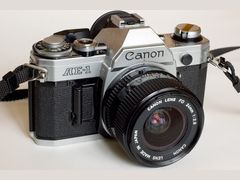 Canon AE-1 | 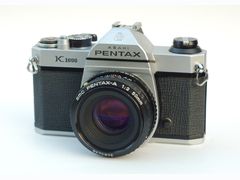 Pentax K1000 | |
|---|---|---|
| Years made | 1976 to 1984, Japan | 1976 to 1997: Japan, then Hong Kong (1978) and China (1990) |
| Exposure modes | Shutter-priority auto plus manual | Manual only (match needle) |
| Shutter | Electronic cloth focal plane, 2 s to 1/1000 s, B and X | Mechanical cloth focal plane, 1 s to 1/1000 s and B |
| With a dead battery | Does not fire at all | Fires at every speed; only the meter stops |
| Battery | One 6V 4LR44, 4SR44 or PX28-type cell | One LR44, SR44, S76 or A76 cell, meter only |
| Light meter | Silicon photocell, center-weighted, EV 1 to 18 | CdS cell, full-scene averaging, EV 1.7 to 18 |
| Film speed range | ISO 25 to 3200 | ASA 20 to 3200 (Jim Grey) or 8 to 6400 (camera-wiki) |
| Viewfinder | 0.86x, 93.5% vertical and 96% horizontal coverage | 0.88x, 92% coverage |
| Focusing aid | Split image with microprism collar | Microprism spot (split image only on the K1000 SE) |
| Exposure display | One needle on an f-stop scale | One needle between + and - marks |
| Self-timer | 10-second electronic | None |
| Motor winder | Power Winder A, 2 frames per second | None |
| Flash | Dedicated Speedlite 155A and 177A | Hot shoe and PC socket, sync at 1/60 s, no dedication |
| Lens mount | Canon FD and New FD (not compatible with Canon EF lenses) | Pentax K (still used on Pentax DSLRs) |
| Body weight | 590 g | 620 g (525 g on later China-assembled bodies) |
| Common faults | Canon squeal, broken battery doors, frozen mirrors, jammed advance levers | Meter drains the battery if the lens cap is off; later bodies use plastic plates |
| Used body, MPEX (Oct. 2026) | $229 | $219 |
| Serviced with 50mm, Brooklyn Film Camera (Oct. 2026) | $410 with 50mm f/1.8 | $400 with 50mm f/2 |
| Body CLA estimate, Brooklyn Film Camera (Oct. 2026) | $270 | $260 |
Pick the Canon AE-1 if
- You want to choose the shutter speed and let the camera set the aperture, for moving subjects and changing light.
- You want a self-timer, a motor winder or a dedicated Canon flash.
- You already own Canon FD lenses.
- You want a split-image focusing aid in the finder.
- You are fine carrying a spare 6V 4LR44 and buying a serviced body.
Pick the Pentax K1000 if
- You want to learn exposure by setting shutter speed and aperture yourself.
- You want a camera that keeps shooting if the battery dies or the compartment corrodes.
- You want lenses that also mount on current Pentax DSLRs.
- You want fewer electronic parts that can fail.
- You can find a Japan-made body with metal top and bottom plates.
Sources: global.canon, en.wikipedia.org, en.wikipedia.org, camera-wiki.org, camera-wiki.org, blog.jimgrey.net, brooklynfilmcamera.com, mpex.com, mpex.com, brooklynfilmcamera.com, brooklynfilmcamera.com, brooklynfilmcamera.com
Which is better for beginners, the Canon AE-1 or Pentax K1000?
AE-1It depends on how you want to learn. The K1000 has no automation: you set the shutter speed and aperture and center a needle in the finder, which is why photography courses recommended or even required it for many years. The AE-1 was also built for newcomers, but it does half the work: you pick a shutter speed and the camera sets the aperture.
Reviewers split along that line. Mike Eckman, who has handled many of both, picks the K1000 for first-time film shooters on value, simplicity and reliability. Film Supply Club and Brooklyn Film Camera treat it as temperament: the AE-1 for auto-exposure help, the K1000 for learning manual. A ThePhotoForum member who owned both wrote in 2005 that the K1000 is the one for learning photography from the ground up.
One caution about other comparisons: Eckman's showdown uses the AE-1 Program, and Brooklyn Film Camera's guide mixes AE-1 Program details into its AE-1 specs. The specs on this page come from Canon's camera museum, Wikipedia and camera-wiki. If you are torn between the two Canons, read Canon AE-1 vs AE-1 Program. For each camera on its own, see the full Canon AE-1 and Pentax K1000 guides, and for a wider list of first cameras, Best Film Cameras for Beginners.
Sources: en.wikipedia.org, en.wikipedia.org, mikeeckman.com, filmsupply.club, brooklynfilmcamera.com, thephotoforum.com
Auto exposure vs fully manual: how each camera meters
The AE-1 is a shutter-priority camera. You choose a shutter speed, the camera picks the aperture, and a needle on an f-stop scale at the right of the finder shows the aperture it will use. Canon calls it the world's first 35mm AE SLR with shutter-priority TTL metering and a CPU.
There is no aperture-priority mode, as Casual Photophile points out. To get a particular f-stop, you change the shutter speed until the needle lands where you want it. For backlit subjects, holding the backlight button adds 1.5 stops of exposure, and full manual exposure works with stopped-down match-needle metering.
The K1000 does none of this for you. Its CdS meter reads the scene, and you turn the shutter dial or the aperture ring until the needle sits between the + and - marks. Wikipedia calls the meter slow to respond, even by 1976 standards, and Eckman says the AE-1's silicon cell is more sensitive, especially in low light.
The metering patterns differ too. The AE-1 is center-weighted, so it favors the middle of the frame; Wikipedia and camera-wiki describe the K1000 as full-scene averaging, so a bright sky anywhere in the frame pulls the reading. Brooklyn Film Camera's K1000 listing calls its meter center-weighted, so sources disagree on that point.
Sources: global.canon, global.canon, en.wikipedia.org, camera-wiki.org, casualphotophile.com, en.wikipedia.org, camera-wiki.org, mikeeckman.com, brooklynfilmcamera.com
Battery and reliability: which one keeps working?
This is the biggest practical difference. The AE-1 runs its shutter and meter from one 6V battery (4LR44, 4SR44 or PX28 type), and Wikipedia and camera-wiki say it does not function at all without one. Brooklyn Film Camera's own AE-1 listing agrees, even though its comparison guide claims bulb still works on a dead battery. Carry a spare; the Canon AE-1 battery guide covers which cells fit.
The K1000's shutter is mechanical. Its single LR44, SR44, S76 or A76 cell powers only the meter, so with a dead battery you lose the needle but keep shooting. Eckman notes that even a K1000 with a corroded battery compartment still fires. The catch: the meter has no off switch, so keep the lens cap on in the bag or the battery drains.
The AE-1's weak spots are well documented. Wikipedia lists the fragile battery door and mirror linkage wear, the noise owners call the Canon squeal; Casual Photophile adds frozen mirrors and advance levers jammed by broken bits of internal plastic. Canon used a lot of structural plastic to make the AE-1 light and cheap, which also makes it less impact resistant. Eckman says the number of faults is much higher on the Canon.
The K1000 has flaws of its own. Later bodies swapped the satin-chromed brass top and bottom plates for plastic, and Casual Photophile's reviewer found it loud, with heavy mirror slap and a stiff advance stroke. But with no electronics in the shutter, there is less to fail.
Match the cell to your camera before you order with the Film Camera Battery Finder.
Sources: en.wikipedia.org, camera-wiki.org, brooklynfilmcamera.com, brooklynfilmcamera.com, en.wikipedia.org, mikeeckman.com, casualphotophile.com, casualphotophile.com
Viewfinder and focusing: AE-1 vs K1000
The AE-1 finder has 0.86x magnification and 93.5% vertical, 96% horizontal coverage, with a split-image rangefinder circled by a microprism ring. You focus by lining up the two halves of the split image or by watching the microprism snap sharp. Eckman judged it noticeably brighter than the K1000's, with two focus aids and an aperture readout. His comparison uses the AE-1 Program, though, and Brooklyn Film Camera's AE-1 page says the Program adds a brighter finder, so the plain AE-1's edge may be smaller.
The standard K1000 has a 0.88x finder with 92% coverage and a microprism spot on a matte screen. The split-image screen came only on the K1000 SE, so check which version a listing shows if you want it. Brooklyn Film Camera's comparison says the K1000 has the same split-image setup as the AE-1; Wikipedia and camera-wiki say it does not.
Each camera shows one needle. On the AE-1 it points to an aperture number; on the K1000 it floats between + and - marks, and you read your settings off the shutter dial and the lens.
Sources: global.canon, en.wikipedia.org, mikeeckman.com, camera-wiki.org, en.wikipedia.org, brooklynfilmcamera.com, brooklynfilmcamera.com
Self-timer, winder, flash and weight
Asahi built the K1000 by taking the Pentax KM and removing the self-timer, depth-of-field preview and other features, aiming for the cheapest big-brand 35mm SLR on the market. The AE-1 has the extras the K1000 lacks: a 10-second electronic self-timer, the Power Winder A for two frames per second, and dedicated Canon Speedlite 155A and 177A flashes. The K1000 has a plain hot shoe and PC socket with no flash dedication and no winder option.
On paper the AE-1 is lighter: Canon lists 590 g against Wikipedia's 620 g for the K1000. Later China-assembled K1000s with plastic plates drop to 525 g, the figure Brooklyn Film Camera's comparison gives for every K1000. In the hand, Eckman calls it a tie: the K1000 has slightly taller shoulders, and the AE-1 is a little longer front to back.
Sources: en.wikipedia.org, camera-wiki.org, global.canon, en.wikipedia.org, brooklynfilmcamera.com, global.canon, brooklynfilmcamera.com, brooklynfilmcamera.com, mikeeckman.com
Lenses: Canon FD vs Pentax K mount
The AE-1 takes Canon FD and New FD lenses, but it is not compatible with Canon's later EF mount, and Brooklyn Film Camera says Canon stopped making FD lenses in 1987. Used glass is plentiful: over 50 FD lenses were available by the late 1970s, and Brooklyn Film Camera's lens guide (read in October 2026) says a clean FD 50mm f/1.8 sells for $40 to $100.
The K1000 takes any manual-focus Pentax K-mount lens, including SMC Pentax, Pentax-M and Pentax-A glass. The K mount debuted in 1975 and Ricoh/Pentax digital SLRs still use it; Brooklyn Film Camera says Ricoh keeps a trickle of new limited primes coming for them. Jim Grey wrote in 2012 that he could snap his K1000's 50mm f/2 Pentax-M straight onto Pentax's latest digital SLRs. The same guide prices a good K-mount 50mm f/1.7 at $50 to $130 and an f/1.4 at $120 to $250.
One trap on the Pentax side: new K-mount lenses are still made, but most lack the aperture ring the K1000 needs, so stick to older manual lenses. The two mounts are not interchangeable, so the lenses you already own may decide this for you.
Sources: en.wikipedia.org, brooklynfilmcamera.com, en.wikipedia.org, mikeeckman.com, blog.jimgrey.net, brooklynfilmcamera.com
Canon AE-1 and Pentax K1000 prices in October 2026
| Seller | Item | Price | Note |
|---|---|---|---|
| MPEX, Columbus, OH | Used Canon AE-1 body, chrome, no lens | $229.00 | In stock, no grade stated |
| MPEX, Columbus, OH | Used Pentax K1000 body, no lens | $219.00 | In stock, no grade stated |
| Brooklyn Film Camera | Canon AE-1, black, CLA'd, with 50mm f/1.8 | $410.00 | 6-month warranty; silver out of stock |
| Brooklyn Film Camera | Pentax K1000, A grade, CLA'd, with 50mm f/2 | $400.00 | 6-month warranty; Brooklyn's AE-1 page shows a K1000 at $360 |
| Film Supply Club | Canon AE-1 with FD 50mm f/1.8 | $350.00 | Sold out; recent sale price |
| Kamerastore (Finnish shop, US storefront) | Pentax K1000, average certified-condition price | $322.00 | Sold out |
| Kamerastore (Finnish shop, US storefront) | Pentax K1000, Rescue grade | $164.00 | Staff notes: shutter capping at fast speeds, heavy corrosion; as-is, no warranty, 30-day returns |
| eBay sold listings (Underpriced AI tally) | Canon AE-1 body, black | $102.24 typical | 60 recent sales, middle half $65-151; four of the six sales shown are AE-1 Programs |
| eBay sold listings (Underpriced AI tally) | Pentax K1000 with Takumar-A 135mm zoom | $120 median | 39 recent sales, $49.99-$275; bundle, not body only; updated July 2026 |
| Brooklyn Film Camera | Full CLA, Canon AE-1 or Pentax K1000 body | $225-325 | Plus $50-100 with a lens; 3-month warranty |
Prices checked October 2026. They change often.
How much do an AE-1 and a K1000 cost now, serviced or not?
The price gap has nearly closed. In a 1977-78 Sears catalog the K1000 with a 50mm f/2 sold for $154.50 and the AE-1 for $279.50, and Eckman's 2019 eBay averages still had the AE-1 averaging 17.5% more than the K1000 ($76.47 vs $65.07). In October 2026, MPEX lists used bodies at $229 (AE-1) and $219 (K1000) without saying whether they were serviced, and Brooklyn Film Camera sells serviced kits with a 50mm at $410 and $400.
Film Supply Club's blog (read in October 2026) says it has sold AE-1s with a 50mm lens from $225 up to $435 (the top end includes extra glass) and K1000s from $125 up to $375 (freshly serviced, premium lenses), so the K1000 has the lower floor and a similar ceiling.
Servicing changes the math. In October 2026 Brooklyn Film Camera's estimate page lists a body CLA at $270 for the AE-1 and $260 for the K1000, calls all prices estimates and requires a non-refundable $50 diagnostic fee before any repair work. Its repair guide puts single fixes such as light seals, a stuck shutter or a jammed advance at $80 to $120. A $229 MPEX body plus a $270 Brooklyn CLA comes to $499 before the diagnostic fee or a lens, which is more than the $410 serviced AE-1 kit with a warranty.
eBay sold prices run lower, but treat them as rough. Underpriced AI's tally of 60 recent sales puts a black AE-1 body at a typical $102.24, though four of the six sales it displays are AE-1 Programs and sales range from $34.99 to $441.79, so condition varies widely. Before you buy from a private seller, read where to buy used film cameras and how to test one.
Sources: mikeeckman.com, mpex.com, mpex.com, brooklynfilmcamera.com, brooklynfilmcamera.com, filmsupply.club, brooklynfilmcamera.com, brooklynfilmcamera.com, underpricedai.com
How to check a used Canon AE-1 or Pentax K1000 before you buy
These checks come from the faults owners and repair shops report most often for each camera.
- 1
Fit a fresh battery
Put a new 4LR44 in an AE-1 or an LR44 in a K1000. An AE-1 that stays dead with a fresh cell needs repair. A K1000 should fire either way, so point it at bright and dark areas and watch the meter needle move.
- 2
Listen to the AE-1 fire
Fire it at several shutter speeds. A squeak or squeal is the mirror linkage wear known as the Canon squeal, so budget for a service.
- 3
Work the AE-1 battery door and advance lever
The battery door breaks often, and Casual Photophile lists advance levers jammed by broken internal plastic as a common fault. Open the door and wind the lever several times.
- 4
Look inside the K1000 battery compartment
Corrosion will not stop the mechanical shutter, but the meter needs power to work. Check the needle responds with a fresh cell.
- 5
Ask where the K1000 was made
Production moved from Japan to Hong Kong in 1978 and to China in 1990. Later China-assembled bodies use plastic top and bottom plates instead of chromed brass.
- 6
Budget for service or buy serviced
Brooklyn Film Camera's October 2026 prices are $80 to $120 for light seals or a jammed advance and $225-325 for a full CLA. If a seller offers no returns, price that in or buy a serviced camera with a warranty.
Sources: en.wikipedia.org, casualphotophile.com, mikeeckman.com, en.wikipedia.org, camera-wiki.org, brooklynfilmcamera.com
Why are the Canon AE-1 and Pentax K1000 so popular?
The AE-1 was a first. Canon calls it the world's first 35mm AE SLR with a CPU, and electronics cut its parts count by 300, which let Canon sell high-end features at a low price. A massive US TV campaign with golf and tennis stars such as John Newcombe helped make it the first SLR for millions of amateurs.
Sales figures vary by source: more than a million (Casual Photophile), over 5 million (Film Supply Club), or over ten million counting the AE-1's close relatives (Brooklyn Film Camera).
The K1000 won on price and staying power. Asahi made it from 1976 to 1997 and sold over three million, and it became the archetypal student camera. Casual Photophile says Time magazine put it on its list of the 100 all-time gadgets.
Sources: global.canon, global.canon, casualphotophile.com, en.wikipedia.org, filmsupply.club, brooklynfilmcamera.com, en.wikipedia.org, camera-wiki.org, casualphotophile.com
Alternatives to the AE-1 and K1000
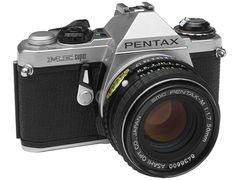 ME Super
If you like the K1000's approach but miss the self-timer and depth-of-field preview, the Pentax KM is the same camera with those features left in. Casual Photophile's K1000 reviewer says other stripped-down SLRs, such as the Pentax Spotmatic, Minolta SRT or Nikkormat FTN, do the job much better. For another K-mount body, see the Pentax ME Super guide.
On the Canon side, the AE-1 Program is the model some comparisons confuse with the AE-1; Canon AE-1 vs AE-1 Program explains the differences.
Sources: en.wikipedia.org, casualphotophile.com
Questions people ask
Is the Canon AE-1 a professional camera?
No. Wikipedia says the AE-1 was never designed to be a professional camera; Canon gave it straightforward controls and automatic aperture for newcomers. That focus and a low price made it the first SLR for millions of amateur photographers.
Sources: en.wikipedia.org
Is the Pentax K1000 a professional camera?
No. Asahi set out to make the cheapest big-brand 35mm SLR and aimed it at amateur photographers. It became the archetypal student camera, and for years photography courses recommended or required it.
Sources: en.wikipedia.org, camera-wiki.org
Which is better, Canon or Pentax?
For these two cameras, neither wins outright. The Canon AE-1 adds shutter-priority auto exposure, a more sensitive silicon meter and a self-timer; the Pentax K1000 is fully mechanical and fires without a battery. Pentax's K mount still fits Pentax DSLRs, while the AE-1 cannot use Canon's later EF lenses.
Sources: global.canon, en.wikipedia.org, en.wikipedia.org
Why is the Canon AE-1 so popular?
Canon calls it the world's first 35mm AE SLR with a CPU, and electronics cut 300 parts so Canon could price it low. A big US TV campaign followed, and millions of amateurs bought it as their first SLR.
Sources: global.canon, casualphotophile.com, en.wikipedia.org
Does the Canon AE-1 work without a battery?
No. Its 6V 4LR44 (PX28-type) battery runs both the shutter and the meter, and the camera does not fire without it. The K1000 is the opposite: its battery only powers the meter.
Sources: en.wikipedia.org, brooklynfilmcamera.com, en.wikipedia.org
Do the Canon AE-1 and Pentax K1000 take the same lenses?
No. The AE-1 uses Canon FD and New FD lenses and the K1000 uses Pentax K-mount lenses, and they are not interchangeable. The AE-1 also cannot use Canon's later EF lenses.
Sources: en.wikipedia.org, en.wikipedia.org
Can you use Pentax K1000 lenses on a digital camera?
Yes, on Pentax digital SLRs. The K mount debuted in 1975 and Ricoh/Pentax DSLRs still use it, and Jim Grey wrote in 2012 that he could mount his K1000's 50mm f/2 Pentax-M directly on Pentax's latest digital SLRs.
Sources: mikeeckman.com, blog.jimgrey.net, brooklynfilmcamera.com
Why is the Pentax K1000 so expensive used?
Wikipedia notes that good used K1000s now fetch more than the pricier, better-featured K-series siblings it was cut down from, and camera-wiki calls it the archetypal students' camera. In October 2026 MPEX listed a used body at $219 and Brooklyn Film Camera listed a serviced kit with a 50mm f/2 at $400.
Sources: en.wikipedia.org, camera-wiki.org, mpex.com, brooklynfilmcamera.com
Sources
Every fact on this page comes from one of these. How we choose and check sources is in our methodology.
Show all 24 sources
retailer 13
- Brooklyn Film Camera: Canon AE-1 vs. Pentax K1000
- Brooklyn Film Camera: Canon AE-1 (product page)
- Brooklyn Film Camera: Pentax K1000 (product page)
- Brooklyn Film Camera: Film camera repair cost, CLA & repair pricing
- Brooklyn Film Camera: Camera repair pricing estimate
- Film Supply Club: Canon AE-1 vs Pentax K1000
- Film Supply Club: Canon AE-1 with 50mm FD f/1.8 (sold listing)
- MPEX: Used Canon AE-1 body chrome
- MPEX: Used Pentax K1000 body
- Kamerastore: Pentax K1000 (certified price)
- Kamerastore: Pentax K1000 (rescue grade)
- Underpriced AI: Canon AE-1 body (black) sold prices
- Underpriced AI: Asahi Pentax K1000 with Takumar-A 135mm sold prices
Manuals and references 4
official 2
Independent blogs 2
Editorial reviews 2
Forums 1
Keep reading
Film cameras
We sorted 168 owner and reviewer opinions on the Canon AE-1: what people love, the squeal and battery problems, repair costs and what a working one costs today.
Film cameras
The Pentax K1000 is a fully mechanical 35mm SLR made 1976-1997. What 150-plus owners and reviewers say, plus used prices ($250-$400), lenses and problems.
Film cameras
Canon AE-1 vs AE-1 Program: the Program adds full auto, an LED finder readout and a grip on the same shutter and FD mount. Serviced copies run $375-$415.
Film cameras
The best film camera for beginners is usually a used Canon AE-1 Program or Pentax K1000. Compare 8 picks, October 2026 US shop prices and what to check first.
Film cameras
Where to buy film cameras used in the US: KEH, MPB, B&H, local shops, eBay and thrift, with warranties, October 2026 prices and a checklist to test one.
Film cameras
The Canon AE-1 takes one 6V 4LR44 battery (PX28, A544 and PX28L fit too). How to open the front door, fit it the right way and check that it works.