Comparison
Canon AE-1 vs AE-1 Program: Differences, Prices and Which to Buy
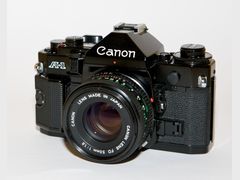
The short answer
The Canon AE-1 Program is the 1981 update of the Canon AE-1: it adds a full Program auto mode, an LED aperture readout instead of a meter needle, a brighter swappable focusing screen and a built-in grip.
The shutter (2 seconds to 1/1000), the FD lens mount and the 6V 4SR44 battery are the same, and in October 2026 Brooklyn Film Camera lists serviced copies of both at about $375 to $415. Analog.Cafe and a Casual Photophile review both favor the Program; the AE-1 makes sense if you only want shutter priority, its +1.5-stop backlight button or the original design.
- AE-1 released
- April 1976global.canon
- AE-1 Program released
- April 1981global.canon
- Full Program auto mode
- AE-1 Program onlyglobal.canon
- Shutter
- Same on both: 2 s to 1/1000 s plus Bcasualphotophile.com
- Lens mount
- Canon FD on both (FD and New FD lenses)en.wikipedia.org
- Serviced price, Oct. 2026
- AE-1 $375-$410; AE-1 Program $375-$415brooklynfilmcamera.com
Canon AE-1 vs AE-1 Program: specs side by side
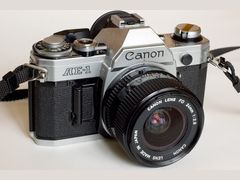 Canon AE-1 | 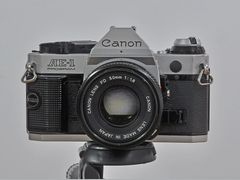 Canon AE-1 Program | |
|---|---|---|
| Released | April 1976 | April 1981 |
| Production | 1976 to 1984 | 1981 to 1989 |
| Exposure modes | Shutter-priority AE, stopped-down match-needle manual | Program AE, shutter-priority AE, dedicated flash AE, manual |
| Aperture priority | No | No (some listings wrongly claim it) |
| Viewfinder readout | One meter needle pointing to the f-stop, red M, low-light LED | LED display: P, M, aperture in full stops, over/under warnings, flash-ready mark |
| Shutter speed shown in finder | No | No |
| Focusing screen | Fresnel matte, split image and microprism; Canon lists no screen swap | New laser matte screen; 8 screens the owner can swap |
| Finder magnification and coverage | 0.86x; 93.5% vertical, 96% horizontal | 0.83x; 94% |
| Shutter | Cloth focal-plane, 2 s to 1/1000 plus B, electronically controlled | Same |
| Flash sync | 1/60; hot shoe with dedicated-flash contact, PC socket | 1/60; hot shoe with dedicated contact, PC socket; automatic with dedicated Speedlites |
| Film speed range | ISO 25-3200 | ISO 12-3200 |
| Setting ISO | Lift and turn the shutter dial's knurled edge | Press a button, move a lever |
| Exposure compensation | Backlight button: +1.5 stops while held | AE lock only |
| Battery | One 6V 4SR44 or 4LR44 | Same |
| Battery check | Meter needle must drop below halfway | Beeper: 6 or more beeps a second is good |
| Lens mount | Canon FD (FD and New FD lenses) | Same |
| Winders and motor drive | Winder A (up to 2 fps), Power Winder A2; no Motor Drive MA | Same winders, plus Motor Drive MA (3 base contacts) |
| Grip | None | A-1 style palm grip that also covers the battery door |
| Size and weight (Canon) | 141 x 87 x 48 mm, 590 g | 141 x 88 x 48 mm, 565 g |
| Serviced price, Brooklyn Film Camera (Oct. 28, 2026) | $375-$410 | $375-$415 |
Pick the Canon AE-1 if
- You want to learn exposure by choosing the shutter speed yourself and will never use full auto, which is when Casual Photophile says to skip the Program
- You shoot backlit subjects: hold the AE-1's backlight button and it adds 1.5 stops, a control the Program dropped
- You like the older design and simple control layout, Analog.Cafe's reason to pick the original
- You find a good copy for less: recent sold AE-1 kits at Legacy Photo Lab started at $239.99
Pick the Canon AE-1 Program if
- It is your first film SLR: Program mode sets both shutter speed and aperture while you learn, and a Casual Photophile reviewer recommends it to beginners right away
- You shoot in dim light: the LED readout changes brightness in four stages and stays readable where the AE-1's needle is hard to see
- You use slower lenses: the brighter screen helps with lenses up to f/5.6
- You want a grip, an easier ISO control and a beeper battery check
- You want the Motor Drive MA, which only the Program can use
Sources: global.canon, global.canon, canonclassics.com, en.wikipedia.org, en.wikipedia.org, camera-wiki.org, casualphotophile.com, casualphotophile.com, analog.cafe, brooklynfilmcamera.com, legacy-photolab.com
What is the main difference between the AE-1 and AE-1 Program?
AE-1Automation. The Canon AE-1 is a shutter-priority camera: you pick the shutter speed, leave the lens on A, and the camera picks the aperture. The AE-1 Program keeps that mode and adds Program AE, where the camera sets both. Canon built it because users wanted the Program mode of the Canon A-1, which in 1978 became the first SLR to offer one.
According to camera-wiki, the Program line favors moderate apertures, around f/5.6 to f/8 in good light with normal film speeds, and finds workable settings in all kinds of light.
The rest follows from the five years between them. The AE-1 went on sale in April 1976 as the first SLR with a digital integrated circuit, and US street prices in March 1977 put it at $265 with an f/1.8 lens. The AE-1 Program arrived in April 1981, stayed in production until 1989 and, per camera-wiki, became even more popular than the AE-1.
Along with Program mode, the newer body borrowed the A-1's palm grip and gained Motor Drive MA support, an LED viewfinder display and interchangeable screens. The shutter, lens mount and battery did not change, so lenses and batteries move freely between the two bodies.
Sources: global.canon, global.canon, analog.cafe, camera-wiki.org, en.wikipedia.org, en.wikipedia.org, vintagecameradigest.com
Does the AE-1 Program have aperture priority?
No. The owner's manual specification, reproduced by Canon Classics, lists Programmed AE, shutter-speed priority AE, AE flash with dedicated Canon flashes, and manual. Analog.Cafe's review confirms it: take the lens off A with the dial on Program and the camera simply fires at one fixed speed.
The confusion is common. Digital Camera World's review and Retrospekt's product listing both claim aperture priority, and Canon's own museum page lists a "preset aperture-priority AE" among four AE modes, though the owner's manual specification and owners describe no aperture-priority mode. The original AE-1 has no aperture priority either: its options are shutter-priority AE and stopped-down match-needle manual.
If you like to choose the aperture first, use manual mode on either camera. On both, the finder shows only the aperture the meter suggests, not the one set on the lens, so you turn the ring to match the readout and pick the shutter speed yourself.
Sources: canonclassics.com, analog.cafe, digitalcameraworld.com, retrospekt.com, global.canon, global.canon, en.wikipedia.org
Viewfinder: meter needle vs LED display
The finder readout is the most visible difference. The AE-1 shows a single needle pointing to the recommended f-stop, with no second needle for the aperture you set and no plus or minus symbols. A red M lights when the lens is off A, and a red LED warns when there is too little light.
The AE-1 Program replaces the needle with an LED display to the right of the image: a P mark, an M mark, the aperture in full stops, blinking over and under warnings and a flash-ready mark. Analog.Cafe notes that the LEDs change brightness in four stages with the light, so they stay readable in dim scenes where the AE-1's needle is hard to see. Canon's museum page still lists a meter needle for the Program, but the owner's manual spec and owner reviews describe LEDs only.
Neither camera shows the shutter speed in the finder. In Program mode the AE-1 Program does not reveal the speed it picked, but its P mark doubles as a camera-shake warning.
The Program's focusing screen is brighter than any earlier Canon manual-focus screen, which helps with slow lenses up to f/5.6, and owners can swap it for one of eight focusing screens through the mirror box. The A-1's screens, by contrast, were meant for the factory or a technician.
Sources: en.wikipedia.org, camera-wiki.org, canonclassics.com, analog.cafe, global.canon, global.canon, en.wikipedia.org
Handling: grip, ISO control and the backlight button
On the AE-1 you set film speed by lifting the knurled edge of the shutter speed dial and turning it. The Program uses a button and a lever, which Casual Photophile calls a big improvement over the AE-1's finicky dial. Canon lists ISO 25 to 3200 for the AE-1 and ISO 12 to 3200 for the Program; Analog.Cafe's guide says 12 to 6400, but Canon's spec stops at 3200.
The Program's shutter speed dial also sits further in toward the center of the top plate. On the AE-1 it sits right at the edge, and an AE-1 owner on Flickr says resting a finger there sometimes changed the speed by accident.
The grip is the other physical change. An owner of both cameras on Flickr singles it out, and it protects the battery door, a part that often breaks on the AE-1. One step backward: the Program's shutter lock lever is a flimsy plastic part carried over from the A-1. Canon lists the Program as 25 g lighter (565 g against 590 g), though Wikipedia gives 575 g.
Exposure compensation went the other way. The AE-1 has a small chrome backlight button: hold it while shooting in AE and it adds 1.5 stops. The Program drops it, and its AE lock is the only compensation besides changing the ISO setting.
Sources: camera-wiki.org, casualphotophile.com, global.canon, global.canon, analog.cafe, flickr.com, canonclassics.com, en.wikipedia.org
How to use a flash on a Canon AE-1 Program
Both cameras sync at 1/60 through a hot shoe with a dedicated-flash contact or a PC socket, and both top out at 1/1000, which limits daylight fill flash. The Program automates the settings with a dedicated Canon Speedlite. Our flash photography guide explains guide numbers and PC sync.
- 1
Mount a dedicated Speedlite
Slide a dedicated Canon Speedlite into the hot shoe. Canon Classics names the Speedlite 188A and 166A for the flash confirmation signal in the finder, and Wikipedia lists the 155A (guide number 56 in feet at ISO 100) and 177A (guide number 83) as period flashes for the AE-1.
- 2
Set the lens to A and wait for the pilot lamp
Turn the aperture ring to the A mark, then switch the flash on. When its pilot lamp glows, the AE-1 Program sets the shutter speed and the flash's auto aperture by itself, and the flash-ready mark shows in the finder.
- 3
Using any other flash
According to the manual, with an ordinary non-dedicated auto flash you turn the shutter speed dial to 1/60 and set the lens to the aperture chosen on the flash.
Sources: canonclassics.com, camera-wiki.org, en.wikipedia.org, casualphotophile.com, cameramanuals.org
Is the AE-1 Program more reliable than the AE-1?
Not really. They share the same shutter and the same weak spots. Both can develop the "Canon squeal" as the mirror brake's lubricant dries out; relubrication fixes it, and leaving it can cause lasting damage. Both have a plastic battery door that breaks easily, though on the Program the grip covers it if it does.
Wikipedia notes that the Program's extra electronics have produced more electronic faults over the years, and that some consider it harder to repair than simpler A-series bodies.
Repair is routine, not exotic. Brooklyn Film Camera says the AE-1 and AE-1 Program are its most common repair and that it services everything on them. Its typical ranges are $85-150 for light seals, $90-150 for unjamming and $325-850 for a full CLA (clean, lube and adjust), after a $50 inspection fee that is credited to the repair. Price that in when a cheap untested body looks tempting.
Sources: camera-wiki.org, en.wikipedia.org, global.canon, brooklynfilmcamera.com
What to check before buying an AE-1 or AE-1 Program
The same checks work for both bodies. Our guide to where to buy used film cameras covers sellers and how to test a camera in more depth.
- 1
Buy tested, with a warranty
Analog.Cafe advises a tested or film-tested copy from a reputable seller over gambling on repairs. Brooklyn Film Camera gives 6 months on its serviced bodies, and Retrospekt's refurbished copies carry 90 days.
- 2
Fit a fresh battery and run the check
Use a new 4SR44 or 4LR44. On the AE-1 the needle should drop below halfway when you press the check button; on the Program, listen for six or more beeps a second.
- 3
Listen for the squeal
Fire the shutter a few times and listen for a squeak or squeal. It comes from drying lubricant and a CLA fixes it, so treat it as a repair cost, not a dealbreaker.
- 4
Check the battery door
Open and close it gently. The plastic door breaks easily on both cameras; on the Program the grip covers it if it does.
Sources: analog.cafe, brooklynfilmcamera.com, retrospekt.com, camera-wiki.org, camera-wiki.org, canonclassics.com
Canon AE-1 and AE-1 Program prices in the US
| Seller | Item | Price | Note |
|---|---|---|---|
| Brooklyn Film Camera (Brooklyn, NY) | Canon AE-1, serviced | $375-$410 | Range across listed copies; black or silver; 6-month warranty |
| Brooklyn Film Camera (Brooklyn, NY) | Canon AE-1 Program, serviced | $375-$415 | Range across listed copies; B or A grade cosmetics; 6-month warranty |
| Brooklyn Film Camera (Brooklyn, NY) | Canon AE-1 Program with 50mm f/1.8 | $375 | B grade; CLA, new seals and battery, shutter speeds verified, meter calibrated |
| Brooklyn Film Camera (Brooklyn, NY) | Canon AE-1 Program bundle, serviced | $435 | 6-month warranty |
| Legacy Photo Lab | Canon AE-1 with FD 50mm f/1.8 | $329.99 | In stock |
| Legacy Photo Lab | Canon AE-1 Program with Sigma Zoom 35-70mm f/2.8-4 | $279.99 | In stock |
| Legacy Photo Lab | Canon AE-1 Program with FD 50mm f/1.8 | $349.99 | Sold out; other sold AE-1 Program kits ran $289 to $379 |
| Legacy Photo Lab | Canon AE-1 with FD 50mm f/1.8, silver | $239.99 | Sold out; other sold AE-1 kits ran $269.99 to $369.99 |
| Retrospekt (ships from Milwaukee, WI) | Refurbished Canon AE-1 Program with 50mm f/1.8 | $299 | Sold out; 90-day warranty; the listing wrongly claims an aperture priority mode |
| Retrospekt (ships from Milwaukee, WI) | Refurbished Canon AE-1 | $399 | Sold out; 90-day warranty |
Prices checked October 2026. They change often.
AE-1 or AE-1 Program: which should you buy?
For most people, the AE-1 Program. Casual Photophile points low-light shooters to it for the brighter finder, Analog.Cafe rates it more capable than the original, and a Casual Photophile reviewer who shot one for two years recommends it to beginners.
Price does not clearly favor either body. In October 2026 Brooklyn Film Camera lists serviced AE-1s at $375-$410 and AE-1 Programs at $375-$415. At Legacy Photo Lab an AE-1 with a Canon 50mm f/1.8 was $329.99 and an AE-1 Program with a Sigma zoom was $279.99, so compare the lens as well as the body. Analog.Cafe put the AE-1, AE-1 Program and A-1 at similar prices in 2024, usually $200 to $300 depending on condition.
The AE-1 still has a case. Casual Photophile says to skip the Program if you will never use Program mode, and Analog.Cafe calls the original not significantly worse, just less capable, and would pick it mainly for its looks and simple controls. It also keeps the +1.5-stop backlight button the Program lost.
Both share the same limits. Casual Photophile says the 1/1000 top speed can be a bit slow in bright light when shooting wide open, and the 1/60 flash sync limits daytime fill flash. If you are still comparing brands, see our Canon AE-1 vs Pentax K1000 comparison and the list of best film cameras for beginners.
Sources: casualphotophile.com, casualphotophile.com, analog.cafe, brooklynfilmcamera.com, legacy-photolab.com
Questions people ask
When did the Canon AE-1 come out?
Canon put the AE-1 on the market in April 1976 and made it until 1984. The AE-1 Program followed in April 1981, five years later, and stayed in production until 1989.
Sources: global.canon, en.wikipedia.org, global.canon, en.wikipedia.org
Is the Canon AE-1 a good camera?
Reviewers generally say yes. Vintage Camera Digest admits there are better cameras but calls it a pretty good one, and Analog.Cafe calls it less capable than the AE-1 Program but not significantly worse. It is a straightforward shutter-priority SLR on a large lens system. The usual weak points are the Canon squeal, a fragile battery door, total battery dependence and a 1/1000 top speed.
Sources: vintagecameradigest.com, en.wikipedia.org, analog.cafe, camera-wiki.org, casualphotophile.com
What lens mount does the Canon AE-1 use?
The Canon FD breech-lock mount, the same as the AE-1 Program. Both take original FD and New FD lenses, but not Canon EF autofocus lenses, so any FD lens moves freely between the two bodies.
Sources: en.wikipedia.org
Does the original AE-1 have an automatic mode?
Partly. It has shutter-priority auto: you choose the shutter speed and the camera sets the aperture with the lens on A. It has no full Program mode where the camera sets both; that arrived on the AE-1 Program in 1981.
Sources: global.canon, global.canon
Do the AE-1 and AE-1 Program use the same battery?
Yes, one 6V 4SR44, or the alkaline 4LR44. Neither camera works without it, because every shutter speed is electronically controlled. The manual spec puts battery life in the Program at about one year of normal use.
Sources: analog.cafe, en.wikipedia.org, canonclassics.com
Which is better for beginners, the AE-1 or the AE-1 Program?
The reviews we found lean toward the AE-1 Program. Program mode sets both shutter speed and aperture while you learn, the LED readout is easier to see in dim light, and a Casual Photophile reviewer who shot one for two years recommends it to beginners. Casual Photophile says the AE-1 is the better fit if you will never use Program mode.
Sources: casualphotophile.com, casualphotophile.com, analog.cafe
Can the Canon AE-1 use the Motor Drive MA?
No. The AE-1 takes the Winder A, which shoots up to 2 frames per second, and the later Power Winder A2. The AE-1 Program added a third electrical contact on its base so it can run the Motor Drive MA.
Sources: en.wikipedia.org, global.canon
Sources
Every fact on this page comes from one of these. How we choose and check sources is in our methodology.
Show all 22 sources
retailer 6
Manuals and references 5
official 3
Editorial reviews 3
Independent blogs 3
Forums 2
Keep reading
Film cameras
We sorted 168 owner and reviewer opinions on the Canon AE-1: what people love, the squeal and battery problems, repair costs and what a working one costs today.
Film cameras
What 116 owner and reviewer opinions say about the Canon AE-1 Program: $289-$445 shop prices, the 6V battery it needs, common faults and how to check one.
Film cameras
The Canon A-1 (1978) is widely called the first SLR with Program mode. Owner views, US used prices, the 4LR44 battery and the squeal to check before you buy.
Film cameras
Canon AE-1 vs Pentax K1000: auto exposure vs fully manual, battery dependence, lenses, common faults and October 2026 prices, used and serviced.
Film cameras
The Canon AE-1 takes one 6V 4LR44 battery (PX28, A544 and PX28L fit too). How to open the front door, fit it the right way and check that it works.
Film cameras
Where to buy film cameras used in the US: KEH, MPB, B&H, local shops, eBay and thrift, with warranties, October 2026 prices and a checklist to test one.