How-to
How to Use Flash Photography: Guide Numbers, PC Sync, HSS and Gels
The short answer
To use flash photography well, set the shutter at or below your camera's flash sync speed (1/60 on a Canon AE-1 or Pentax K1000, usually 1/160 to 1/250 on modern camera and flash combinations), then let the shutter speed decide how bright the background looks while the flash lights the subject.
With a manual flash, set the aperture by dividing the guide number by the distance: a Godox Lux Junior (GN 39.4 ft at ISO 100) on ISO 400 film needs about f/8 for a subject 10 ft away. Bounce the flash off a ceiling or light wall instead of firing straight on, and gel it orange (CTO) under tungsten bulbs.
- Manual flash aperture
- Guide number divided by distance (same unit)en.wikipedia.org
- Sync speed, classic SLRs
- 1/60 on the Canon AE-1 and Pentax K1000camera-wiki.org
- Sync speed, modern setups
- Usually 1/160 to 1/250iphotography.com
- High-speed sync
- Up to about 1/8000, at a big power costdigital-photography-school.com
- PC sync plug
- 3.5 mm coaxial (Prontor/Compur)en.wikipedia.org
- Canon trigger voltage limit
- 6 V or less (ISO 10330 allows 24 V)en.wikipedia.org
How flash exposure works: two exposures in one frame
Every flash photo is two exposures layered on one frame. Strobist's Lighting 101 course breaks it down this way: aperture and shutter speed set the ambient exposure, while the flash, which fires in an instant, is controlled by the aperture and the flash's own power.
That gives you two separate controls. With electronic flash, shutter speed has no effect on the flash part of the exposure; it only changes how much of the room or background shows. Flash power changes only the flash part, and aperture and ISO change both. If aperture and shutter speed are still new to you, start with the exposure triangle.
Distance changes flash exposure fast. Light from a small flash falls off with the square of the distance, so a wall twice as far away as your subject gets one quarter of the light, two stops less. That is why a subject at 5 ft can look right while the wall at 10 ft goes dim.
Sources: strobist.blogspot.com, strobist.blogspot.com, en.wikipedia.org, en.wikipedia.org
How to use flash photography, step by step
This order applies to a speedlight on a digital camera and to a manual flash on a film SLR.
- 1
Find your sync speed and flash connection
Check the shutter dial or the manual. A Canon AE-1 or Pentax K1000 syncs at 1/60, a Nikon FM2n at 1/250, and leaf-shutter cameras like the Mamiya 7 at every speed. Note whether the camera has a hot shoe, a PC socket or both.
- 2
Mount the flash and power up in order
Slide the foot all the way into the hot shoe and lock it. Canon's guide says to power on the camera first, then the flash, and not to mix new and old batteries, brands, or alkaline and lithium cells, which can cause leakage.
- 3
Choose TTL (or auto) or manual
TTL meters the flash for you and suits fast-changing scenes like events. Manual gives the same output every frame, which suits posed shots, off-camera setups and film cameras without TTL.
- 4
Set the shutter at or below sync speed
Go faster and a dark band appears across part of the frame. Within that limit, shutter speed sets how much of the room shows: 1/15 to 1/40 second keeps the background from turning black.
- 5
Expose for the room, then decide how dark it should be
Strobist's method: find a normal ambient exposure, darken it a little for mood, then bring the subject back up with flash. For an evening event, Promptographer's starting point is ISO 800, 1/40 or 1/60, f/2.8 and TTL flash.
- 6
Set the aperture from the guide number (manual flash)
Divide the guide number for your ISO by the flash-to-subject distance, in the same unit. A Godox Lux Junior is GN 39.4 ft at ISO 100; ISO 400 film doubles that to 78.8 ft, so a subject 10 ft away needs 78.8 / 10 = f/7.9, call it f/8.
- 7
Bounce or diffuse the light
Tilt the head toward a white ceiling or a light wall instead of firing straight at the subject. If the ceiling leaves shadows under the eyes, Nikon's fix is to point the head slightly behind you so the light hits the wall and the ceiling.
- 8
Take a test shot and fine-tune the flash
In TTL, use flash exposure compensation; Nikon's contributor starts at +0.7 to +1.0 EV when bouncing. In manual off-camera work, Lensbaby's guide starts at 1/4, 1/8 or 1/16 power and adjusts from the test shot.
- 9
Gel the flash to match the room
Under tungsten bulbs, a CTO (orange) gel makes the flash match the warm room light. Under fluorescent tubes, use a green gel.
- 10
Use rear-curtain sync for slow shutter speeds
Rear-curtain sync fires at the end of the exposure, so motion streaks trail behind a moving subject instead of running over it.
Sources: camera-wiki.org, camera-wiki.org, camera-wiki.org, camera-wiki.org, snapshot.canon-asia.com, digital-photography-school.com, en.wikipedia.org, strobist.blogspot.com, promptographer.com, glazerscamera.com, nikonusa.com, lensbaby.com, strobist.blogspot.com, en.wikipedia.org
How to use a guide number to set the aperture
A guide number (GN) is the flash's power written as f-number times distance. Divide the GN by the distance and you get the aperture; divide it by the aperture and you get the distance. Wikipedia's example: a flash with GN 28 m (92 ft) used at f/2.8 has to be 10 m (33 ft) from the subject.
Three details trip people up. Flashes sold in the US often list two GNs, one in meters and one in feet (for example 30 m / 98 ft), and you must use the matching distance unit. Most GNs are quoted at ISO 100, and a GN quoted at ISO 200 looks 41% bigger for the same flash. And check the zoom setting: the Godox TT350C's GN of 36 m (118 ft) is measured with the head at its 105mm position, and widening the beam lowers it.
The GN changes with the square root of ISO, so each doubling of film speed multiplies it by about 1.41, and ISO 400 doubles the ISO 100 number. Power works the same way in reverse: 1/4 power halves the GN and 1/16 power quarters it. Gels on the flash and filters on the lens lower it too. With a basic manual flash on a film camera you can ignore shutter speed in this math, as long as you stay at or below sync. If film speed itself is fuzzy, read film ISO explained.
| Film ISO | GN multiplier (rounded) | GN in feet | Aperture at 10 ft |
|---|---|---|---|
| 100 | x1 | 39.4 | f/3.9, about f/4 |
| 200 | x1.41 | 55.7 | f/5.6 |
| 400 | x2 | 78.8 | f/7.9, about f/8 |
| 800 | x2.83 | 111.4 | f/11 |
Turning the Lux Junior down to 1/4 power halves its GN, so on ISO 400 film the same subject at 10 ft needs about f/4 instead of f/8.
Sources: en.wikipedia.org, glazerscamera.com, glazerscamera.com, analog.cafe
What is flash sync speed? Numbers for classic film cameras
Sync speed is the fastest shutter speed at which the whole frame is uncovered when the flash fires. Most SLRs use a focal-plane shutter, and on older cameras that usually means 1/60 or slower. Go faster and the second curtain starts closing before the flash is over, which leaves a dark band across part of the frame.
Modern digital camera and flash combinations usually sync between 1/160 and 1/250, and Lensbaby's guide says most cameras sync at 1/250. Many classic film cameras are slower, and a few have quirks: the Nikon F3 syncs at 1/80 and shuts off its regular meter the moment a flash is switched on.
Leaf shutters, built into the lens, open fully at every speed, so flash syncs at all of them. That makes leaf-shutter cameras the easy option for daylight fill flash, covered below.
| Camera | Sync speed | Flash connection and notes |
|---|---|---|
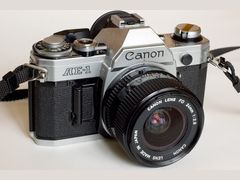 Canon AE-1 | 1/60 | Hot shoe with a contact for dedicated flashes, plus a PC socket |
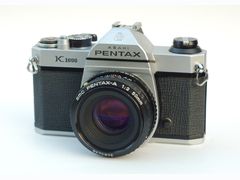 Pentax K1000 | 1/60 | Hot shoe or PC socket, X sync only |
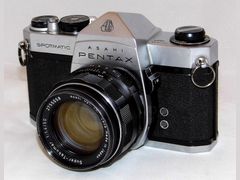 Pentax Spotmatic SP | 1/60 | Cold accessory shoe only: use a cord to the front sync connector |
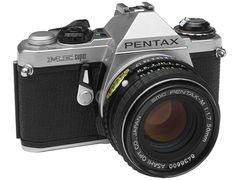 Pentax ME Super | 1/125 | Electronically timed focal-plane shutter |
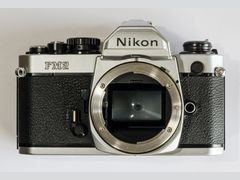 Nikon FM2 / FM2n | 1/200 / 1/250 | The FM2n raised the sync speed |
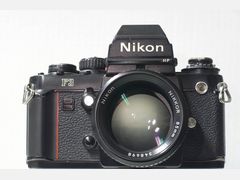 Nikon F3 | 1/80 | Regular metering shuts off when a flash is switched on |
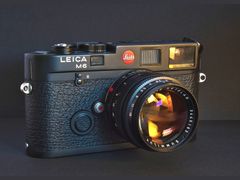 Leica M6 | 1/50 | TTL flash only on the later M6 TTL |
| Olympus OM-4Ti with F280 flash | Up to 1/2000 | Super FP sync, a film-era high-speed sync |
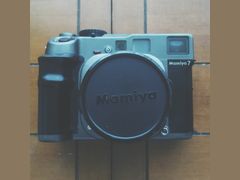 Mamiya 7 | All speeds (to 1/500) | Leaf shutter; hot shoe or PC socket |
Sources: en.wikipedia.org, en.wikipedia.org, iphotography.com, lensbaby.com, en.wikipedia.org, camera-wiki.org, camera-wiki.org, camera-wiki.org, camera-wiki.org, camera-wiki.org, camera-wiki.org, camera-wiki.org, camera-wiki.org, camera-wiki.org
PC sync cords, hot shoes and old-flash trigger voltage
A PC cord connects a flash to the camera's PC socket with a standardized 3.5 mm coaxial plug; PC stands for Prontor/Compur. Strobist calls a sync cord one of the cheapest and most reliable ways to fire a flash off the camera, with the obvious downside that you are tethered. If your camera has a standard hot shoe but no sync socket, a Nikon AS-15 adapter adds one.
The hot shoe's shape is standardized, but its trigger voltage is not. ISO 10330 allows up to 24 V and Canon asks for no more than 6 V, while some older flashes put hundreds of volts across the contacts. Old Vivitar 283 units have been reported as high as 600 V. That is fine on a purely mechanical film camera, but it can damage electronic and digital cameras.
Readings vary even within one model. Vivitar told one reader the 285HV runs at 12 V and the older 285 at 350 V, while other readers measured their 285 and 285HV units at about 6 V to 8.5 V. Botzilla's list was compiled around 2001 to 2005 from reader measurements, so treat any old flash as unknown until you or the seller measure it.
Going the other way is easier. Botzilla says even high trigger voltage is fine on a mechanical film camera, so a modern low-voltage flash is no worry there, and single-contact flashes like the Godox iM30 are sold as fitting most mirrorless and film cameras. Automatic features such as TTL and HSS need a flash made for that camera system.
An optical slave fires a flash the instant it sees another flash go off, a cheap way to add a second light with no wire at all. If the main flash is TTL, use a slave mode that ignores the pre-flash, such as the Lux Junior's S2 mode.
Before you put an old flash on a digital camera, check its trigger voltage against your camera maker's limit; Canon's is 6 V.
Sources: en.wikipedia.org, strobist.blogspot.com, glazerscamera.com, en.wikipedia.org, botzilla.com, districtcamera.com, en.wikipedia.org, glazerscamera.com
How does TTL flash work, and should you use TTL or manual?
TTL means through the lens. Film-era TTL read light bouncing off the film itself during the exposure and cut the flash once enough had arrived; the Olympus OM-2 was the first camera with this off-the-film metering. Digital TTL (Canon E-TTL, Nikon i-TTL) fires a quick pre-flash, measures it through the lens and sets the main flash from that reading.
Sources split on which to learn first. Digital Photography School tells on-camera shooters to set the flash to TTL and use it extensively, especially in fast-paced situations. Strobist works in manual for predictability and repeatability, and Lensbaby's Kate Hailey treats TTL as a starting point before switching to manual and adjusting. A fair way to split it: TTL for events and moving subjects, manual for posed or off-camera shots and for any film camera without dedicated TTL.
Two TTL quirks are worth knowing. The pre-flash can make some people blink, so they have closed eyes in every frame. And flash exposure compensation is not regular exposure compensation: the first changes only the flash output, the second changes the ambient, background exposure.
Sources: en.wikipedia.org, camera-wiki.org, digital-photography-school.com, strobist.blogspot.com, lensbaby.com, en.wikipedia.org, snapshot.canon-asia.com
High-speed sync (HSS) and daylight fill flash
Fill flash lightens a nearby subject who would otherwise sit in shade compared with the rest of the scene. In bright sun, sync speed gets in the way. By the Sunny 16 rule, ISO 400 film in direct sun needs about 1/400 at f/16. A camera that syncs at 1/60 lets in 400 / 60 = 6.7 times as much light at its fastest flash speed, about 2.7 stops, so you would need roughly f/41 (16 times the square root of 6.7) to compensate. ISO 100 film (1/100 at f/16) brings that to about f/21.
There are three ways around it: slower film or an ND filter, a leaf-shutter camera such as the Mamiya 7 (flash at every speed up to 1/500), or high-speed sync.
HSS fires the flash as a rapid series of smaller pulses, so the moving slit between the shutter curtains is lit all the way across the frame. It allows shutter speeds up to about 1/8000 and only kicks in above the normal sync speed. That is enough for wide apertures in sun: at ISO 100, Sunny 16 gives 1/100 at f/16, and opening to f/1.8 lets in about 79 times more light ((16 / 1.8) squared), which lands right around 1/8000.
The catch is power. One Metz flash drops from GN 58 in normal mode to GN 20 in HSS, roughly one eighth of the light ((20 / 58) squared is about 0.12). HSS also needs a flash dedicated to your camera brand, such as the Godox TT350C for Canon, which supports E-TTL and high-speed sync. Film had a version too: the Olympus OM-4Ti with the F280 flash offered Super FP sync up to 1/2000.
Sources: en.wikipedia.org, en.wikipedia.org, en.wikipedia.org, camera-wiki.org, en.wikipedia.org, digital-photography-school.com, glazerscamera.com, camera-wiki.org, promptographer.com
How to gel a flash: CTO, green and CineStill 800T
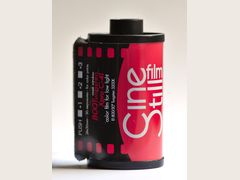 800T
A bare flash is roughly daylight colored (the Godox Lux Junior is rated at 6000K), so it doesn't match warm tungsten room light. Strobist's fix is a CTO (color temperature orange) gel, also sold as a tungsten gel, which turns the flash orange to match the room. Under fluorescent light, a green gel (window green or Plus Green) does the same job.
Gels cost you light: like lens filters, they lower the effective guide number. They can also heat-weld to a speedlight at high power or during rapid firing, especially dense reds and blues, so Strobist's advice is to leave an air gap between the gel and the flash head.
Gelling matters most on tungsten film. CineStill 800T is balanced for 3200K, and for daylight CineStill recommends an 85 filter or rating the film at ISO 400 to 500. CineStill's product page does not mention flash, but by the same logic a bare 6000K flash will render cool on 800T, and a CTO gel moves it toward the tungsten light the film expects.
Bounce has a color too. Nikon notes that a speedlight picks up the color of the wall it bounces from: its example photo came out warmer because the wall was tan. Promptographer warns off walls painted dark red, green or blue.
Sources: glazerscamera.com, strobist.blogspot.com, en.wikipedia.org, strobist.blogspot.com, cinestillfilm.com, nikonusa.com, promptographer.com
What you need for flash photography, with prices
For a film camera with a plain hot shoe, a manual single-contact flash is enough, plus a PC cord or an optical slave if you want the light off the camera. For a digital camera, a TTL flash made for your brand is easier, and a radio trigger gets it off the camera. Prices below were checked on October 28, 2026 at three US camera stores.
A used flash is not automatically cheaper. District Camera had two used Vivitar 283 listings at $39 and $79 on the same day, against $34.90 for a new Godox iM30 and $59.00 for a new Lux Junior, and its used gear carries a 100-day store warranty. A used flash also raises the voltage question above: revised 283s made after 1987 run around 9 to 10 V according to Botzilla's list, and older units have been reported as high as 600 V.
- Film camera, on-camera: a single-contact manual flash such as the Godox iM30 or Lux Junior
- Film camera, off-camera: the same flash plus a PC cord, an AS-15 adapter if there is no PC socket, or an optical slave
- Digital camera: a TTL flash for your brand, plus a radio trigger such as the Godox X2T for off-camera work
- Any camera: CTO and green gels for mixed light
| Item | What it is for | Price | Seller |
|---|---|---|---|
| Godox iM30 mini flash | Small manual flash, GN 15 m, 7 power levels, single-contact shoe | $34.90 | District Camera |
| Godox Lux Junior | Retro manual flash, GN 12 m (39.4 ft), full to 1/64 power | $59.00 | Glazer's Camera |
| Godox Lux Cadet | Retro flash with seven stops of power and an auto mode | $94.90 | Glazer's Camera |
| Godox TT350C (Canon) | Compact TTL flash with HSS and a built-in 2.4 GHz radio | $76.00 | Glazer's Camera |
| Godox TT685C II (Canon) | Full-size TTL speedlight | $129.00 | District Camera |
| Godox V1 (Canon) | Round-head TTL flash | $198.00 | Glazer's Camera |
| Canon Speedlite EL-5 | Canon's own speedlight | $349.99 | Glazer's Camera |
| Nikon SB-700 | Nikon's own speedlight; sale price, regular $379.95, listed out of stock | $299.95 | Pictureline |
| Godox X2T-C (Canon) | TTL radio trigger; Nikon and Sony versions listed too | $59.00 | District Camera |
| Dot Line DL-0424 | 5 ft PC sync cord, male to female | $12.95 | District Camera |
| Nikon AS-15 | Adds a PC socket to a hot shoe | $26.00 | Glazer's Camera |
| Rosco Color Correction Kit, 12x12 in. | Color correction gel sheets | $62.99 to $64.90 | Pictureline, District Camera |
| MagMod Dome Gel 1/4 CTO | Quarter-strength CTO; needs the MagMod mount | $18.95 | District Camera |
| MagMod Pro Creative Gels | Color effect gels | $49.95 | Glazer's Camera |
| Used Vivitar 283 | Auto thyristor flash; check trigger voltage | $39.00 to $79.00 | District Camera |
| Used Canon 550EX Speedlite | Older Canon speedlight | $49.00 | District Camera |
Sources: districtcamera.com, glazerscamera.com, glazerscamera.com, glazerscamera.com, districtcamera.com, glazerscamera.com, glazerscamera.com, pictureline.com, districtcamera.com, districtcamera.com, glazerscamera.com, districtcamera.com, pictureline.com, districtcamera.com, glazerscamera.com, districtcamera.com, districtcamera.com, districtcamera.com, botzilla.com
Common flash photography mistakes
Avoid these habits; each one has a simple fix.
- Firing straight at the subject. Nikon warns that direct flash gives flat light, glare and shadows behind the head, and red-eye comes from the retina reflecting light straight back toward a flash near the lens. Bounce it or move it off the camera, unless the hard direct look is the point, as in the Y2K digicam look.
- Forgetting the sync limit on a slow camera. On a 1/60 camera like the K1000, 1/125 and faster are off limits with a normal flash, even if the dial lets you pick them.
- Reading the wrong guide number. A GN quoted in meters, at ISO 200 or at a 105mm zoom setting gives the wrong aperture if you treat it as feet, ISO 100 or a wide setting.
- Bouncing straight up at the ceiling. Light falling straight down leaves shadows under the eyes. Promptographer calls bouncing off a white wall the easiest and most versatile option and warns that the ceiling gives shadows beneath the eyes; Nikon angles the head slightly behind the photographer instead.
- Putting an old high-voltage flash on a digital camera. Check the trigger voltage first.
Sources: nikonusa.com, en.wikipedia.org, en.wikipedia.org, camera-wiki.org, digital-photography-school.com, en.wikipedia.org, glazerscamera.com, promptographer.com, botzilla.com
Flash troubleshooting: problems and fixes
Match what you see in the photo to the likely cause. On film you only find out after developing, so it pays to know these before the roll goes in.
| Problem | Likely cause | Fix |
|---|---|---|
| Dark band across part of the frame | Shutter faster than sync speed | Use sync speed or slower, or switch on HSS with a dedicated flash |
| Background goes black | Shutter too fast for the room light | Drag the shutter to 1/15 to 1/40, or raise ISO |
| Subject too dark (manual flash) | Subject beyond the flash's reach at that aperture | Distance = GN / aperture: open up, move closer or raise power |
| Subject too bright or washed out | Too much flash for the distance | Lower power a stop at a time, or stop down |
| Shutter won't go past 1/250 with the flash on | HSS is off, so the camera holds you at sync speed | Turn on HSS in the camera, flash or trigger |
| Eyes closed in every frame | The TTL pre-flash makes the subject blink | Switch to manual flash, which has no metering pre-flash |
| Red-eye | Flash too close to the lens axis | Bounce the flash or move it off the camera |
| Orange, green or blue cast | Flash color doesn't match the room, or a colored bounce surface | CTO gel for tungsten, green for fluorescent; bounce off white |
| Slave flash fires too early | It fired on the TTL pre-flash | Use a slave mode that ignores the pre-flash, like the Lux Junior's S2 |
| Flash won't fire on a Pentax Spotmatic SP | It has a cold shoe, not a hot shoe | Run a cord to the front sync connector |
| Nikon F3 meter goes dead | The F3 shuts off regular metering when a flash is switched on | Meter before switching the flash on, or set the aperture from the GN |
| Motion streaks in front of the subject | Front-curtain sync at a slow shutter speed | Switch to rear-curtain sync |
Sources: en.wikipedia.org, en.wikipedia.org, digital-photography-school.com, en.wikipedia.org, promptographer.com, en.wikipedia.org, strobist.blogspot.com, nikonusa.com, glazerscamera.com, camera-wiki.org, camera-wiki.org
Questions people ask
When should you use flash photography?
Use it when the ambient light is inadequate, when a nearby subject is in shade compared with the rest of the scene (fill flash), and at dim events where a slow shutter records the room while the flash freezes the people. Indoors, bounced flash gives softer, lower-contrast light than direct flash.
Sources: en.wikipedia.org, promptographer.com
What is the 20 60 20 rule in photography?
It isn't a flash rule and has no single definition. Ulanzi's guide gives two meanings: splitting a shoot into 20% safe shots, 60% refining and 20% experiments, and layering a frame into foreground, middle ground and background. The first maps well onto flash practice: get a safe exposure, refine power and angle, then experiment.
Sources: ulanzi.com
What are the 7 basics of photography?
There is no official list. One common version, from Techwalla, names seven elements: line, shape, form, texture, pattern, color and space. Light is what reveals all seven, and a flash is a way to control it.
Sources: techwalla.com
Can I use an old flash on a new digital camera?
Only after checking its trigger voltage. Canon asks for 6 V or less, and old Vivitar 283 units have been reported as high as 600 V, enough to damage an electronic camera. Revised 283s made after 1987 run around 9 to 10 V according to Botzilla's list, so the age of the unit matters.
Sources: en.wikipedia.org, botzilla.com
Can I use a modern flash on a vintage film camera?
Usually, yes, in manual or the flash's auto mode. Low trigger voltage is no risk to a mechanical camera, and single-contact flashes like the Godox iM30 ($34.90 at District Camera) are sold as fitting most film cameras. Stay at or below the camera's sync speed, which is 1/60 on a Pentax K1000.
Sources: botzilla.com, districtcamera.com, camera-wiki.org
What is the difference between front-curtain and rear-curtain sync?
Front-curtain sync fires the flash at the start of the exposure and is generally the default; rear-curtain fires it at the end. At slow shutter speeds, rear-curtain puts motion streaks behind a moving subject, trailing where it came from. Promptographer leaves rear-curtain on all the time because it makes no difference at fast shutter speeds.
Sources: en.wikipedia.org, promptographer.com
How do I learn flash photography?
Many photographers start with Strobist's free Lighting 101, which has had more than four million readers. Lensbaby's Kate Hailey recommends starting with just one light. Bounce one flash in TTL or auto first, then move to manual power and take test shots until the numbers feel familiar.
Sources: strobist.blogspot.com, lensbaby.com
Sources
Every fact on this page comes from one of these. How we choose and check sources is in our methodology.
Show all 51 sources
retailer 18
- Glazer's Camera: Godox Lux Junior
- Glazer's Camera: Godox Lux Cadet
- Glazer's Camera: Godox TT350C
- Glazer's Camera: Godox V1 for Canon
- Glazer's Camera: Canon Speedlite EL-5
- Glazer's Camera: Nikon AS-15
- Glazer's Camera: MagMod Pro Creative Gels
- District Camera: Godox iM30
- District Camera: Godox TT685C II
- District Camera: Godox X2T-C
- District Camera: Dot Line DL-0424 PC sync cord
- District Camera: Rosco Color Correction Kit
- District Camera: MagMod Dome Gel 1/4 CTO
- District Camera: Used Vivitar 283 auto thyristor flash
- District Camera: Used Vivitar 283 non-TTL flash
- District Camera: Used Canon 550EX Speedlite
- Pictureline: Nikon SB-700
- Pictureline: Rosco Color Correction Filter Kit
Manuals and references 17
- Wikipedia: Guide number
- Wikipedia: Flash synchronization
- Wikipedia: Flash (photography)
- Wikipedia: Hot shoe
- Wikipedia: Through-the-lens metering
- Wikipedia: Leaf shutter
- Wikipedia: Inverse-square law
- Wikipedia: Sunny 16 rule
- Camera-wiki: Canon AE-1
- Camera-wiki: Pentax K1000
- Camera-wiki: Nikon FM2
- Camera-wiki: Nikon F3
- Camera-wiki: Leica M6
- Camera-wiki: Pentax ME Super
- Camera-wiki: Pentax Spotmatic
- Camera-wiki: Mamiya 7
- Camera-wiki: Olympus OM-1 (OM system)
Independent blogs 9
- Strobist: Lighting 101
- Strobist: Synching your flash
- Strobist: Balancing flash and ambient, pt 1
- Strobist: Using gels to correct light
- Strobist: How to safely gel a speedlight
- Botzilla: Photo strobe trigger voltages
- Analog.cafe: A Simple Guide to Using Flash on Manual Film Cameras
- Promptographer: Using flash in your photography, on and off-camera
- Ulanzi: What Is the 20-60-20 Rule in Photography?
Editorial reviews 4
official 3
Keep reading
Techniques and editing
The exposure triangle links aperture, shutter speed and ISO: one stop on any side doubles or halves the light. How it works on film, where the roll sets ISO.
Techniques and editing
The sunny 16 rule: f/16 at 1/ISO in clear sun, wider for clouds and shade. Chart by ISO, backlight fixes, zone focusing presets and how to meter film.
Film stocks
CineStill 800T is an ISO 800 tungsten film made for night and neon. What 112 opinions say, how to shoot it in daylight, push it, and US prices from $17.00.
Digicams
Get the Y2K digicam look: force the flash on, zoom out and stand 3 to 10 ft away in a dim room. Cameras, prices, settings and fixes for dark or blown-out shots.
Film stocks
Film ISO is a roll's light sensitivity: double the number, one stop faster, more grain. Which ISO to buy, box speed, push and pull, and what a wrong ISO does.
Film cameras
The best film camera for beginners is usually a used Canon AE-1 Program or Pentax K1000. Compare 8 picks, October 2026 US shop prices and what to check first.