Nikon F3: what owners say, common problems and used prices
The short answer
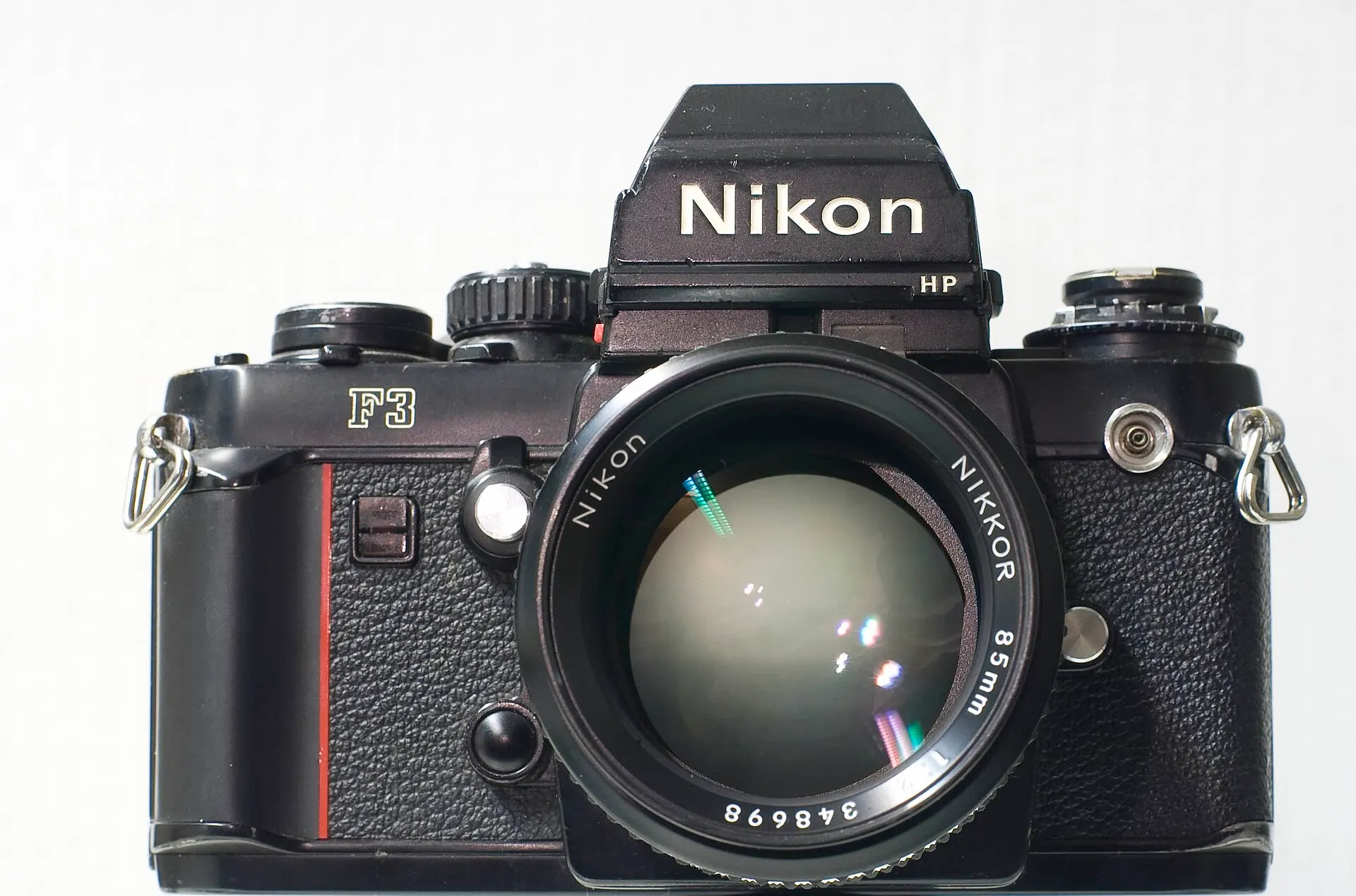
The Nikon F3 is Nikon's professional 35mm SLR, launched in March 1980 and made for about two decades; Nikon had sold more than 751,000 by September 1992.
Owners still praise its reliability (Dante Stella calls it the most reliable Nikon ever made), a finder that shows virtually 100% of the frame, a very smooth film advance, aperture-priority auto and a fit with most Nikkor lenses. On October 28, 2026, US camera shops listed in-stock used F3 kits with a 50mm lens at $895 to $1,100.
- Made
- 1980-2001
- Modes
- Aperture priority, manual
- Shutter
- 8 s to 1/2000 s
- Battery
- 2 x SR44/LR44 or 1 x CR1/3N
Built from 155 opinions from 33 pages and videos. Not yet tested by Camera Dojo. Updated .
The short version
The F3 replaced the mechanical F2 as Nikon's flagship and moved to an electronically controlled titanium shutter running from 8 s to 1/2000 s. That is the point that still divides owners: every speed except a mechanical 1/60 s backup needs batteries, though owners report a set of batteries lasting a year or more. Many shop listings are the F3HP (1982), whose high-eyepoint finder lets glasses wearers see the whole frame.
The complaints are consistent: a small, dim LCD readout in the finder, a slow 1/80 s flash sync with an F3-only flash shoe, and fiddly exposure compensation. Production ended around 2001, so even the newest F3 is about 25 years old and the individual camera matters more than the model. Flickr threads describe bodies that stop firing, often traced to batteries, dirty contacts or the power switch, and ICT lists an F3 body CLA at $325 plus parts.
Good fit if
- You want a rugged pro body with aperture priority, AE lock and full manual control.
- You wear glasses: the F3HP's finder shows the whole frame from about an inch back.
- You own or want manual-focus Nikkors, including pre-AI lenses through the flip-up coupling tab.
- You will buy from a shop that gives a warranty, or budget for a CLA.
Think twice if
- You want a camera that runs without batteries: owners point to the Nikon F2 or FM3A instead.
- You shoot daylight fill flash or want a standard hot shoe: sync tops out at 1/80 s and the shoe is F3-only.
- You want the lightest kit: Marc Jenkins weighed his F3 with a 28mm lens at about 964 g.
- Your lenses are modern G or DX Nikkors: G lenses only work wide open in aperture priority and DX lenses vignette on 35mm film.
What owners and reviewers say, topic by topic
We sorted 155 opinions about the Nikon F3 from 33 pages and videos on 23 websites and channels. Each row shows how many people raised a topic and how many of them were positive. Open a row to read short quotes, each linked to its source.
Owner voices come mostly from long blog reviews and their reader comments (Casual Photophile, 35mmc, EMULSIVE, Jim Grey, Dante Stella, Jake Horn and others), Flickr group threads, a repair technician's blog (ICT) and five YouTube reviews. Reddit, photo.net and Nikonians threads and retailer reviews could not be read, and the Flickr threads came from problem searches, so they show what goes wrong rather than how often.
Controls and features46% positiveof 26
Split evenly. Owners love the ball-bearing film advance, the gentle shutter release and the mirror lock-up; they dislike the 1/80 s flash sync, the flash shoe on the rewind knob, fiddly exposure compensation, the 1/2000 s top speed and having no sign that film is loaded.
“It has a slow flash sync speed and does not have a traditional hot shoe.”
“The slow sync speed (compared to other cameras) was my only issue with the camera.”
Bruno Chalifour, 35mmc (reader comment) 2024-08Owner
“the shutter speed dial is big and handles easily”
Alex Luyckx blog 2015-11Owner
“The controls all feel velvety smooth yet built to last.”
Down the Road (Jim Grey's blog) 2014-11Owner
Viewfinder and focusing65% positiveof 20
The most praised topic: big, bright finders that show the full frame, and an HP finder that works for glasses wearers. The repeated complaint is the small, dim LCD shutter-speed readout; Dante Stella adds that the standard K screen gets hard to focus in low light and with slower lenses.
“Manual focus is surprisingly easy with this camera.”
Dan Finnen 2016-07Owner
“The finders are all big, bright, and 100% of the captured image.”
“its great advantage as a glasses wearer is its full screen viewing.”
John Andrews, 35mmc 2025-10Owner
“Some people complain that the LED panel is too small and dim, but it was fine for my purposes.”
Down the Road (Jim Grey's blog) 2014-11Owner
Reliability today60% positiveof 20
Most owners report decades of trouble-free use, and Dante Stella calls it the most reliable Nikon ever made. The negatives come from Flickr threads about bodies that stopped firing or froze at 1/80 s, often traced to batteries, contacts or oxidized switches; those threads were found by searching for problems.
“The F3 is a good camera - when it works.”
Cecilia Temperli, Flickr I Shoot Film group 2011-03Owner
“The F3 is the most reliable Nikon ever made”
Dante Stella 2009-10Owner
“it was a camera meant to last for the times to come.”
Josh Solomon, Casual Photophile 2023-01Owner
“test the shutter release. This appears to be a weak point on some of the cameras.”
Build quality80% positiveof 15
Owners describe it as rugged and precise, a pro body that feels made to last. The caveats: prism housings that are often dented, one reader who wishes the advance lever were more like the F2's, and standard F3 bodies that lack the extra seals of the F3/P and F3/T.
“Rugged, precise, and endlessly inspiring.”
Robin Ferand 2025-04Owner
“cameras just don't feel this well made anymore.”
Marc Jenkins 2024-10Owner
“hard to find a sturdy F model that fits so well in hand and just goes”
Mark Cimon, Shoot Film, Ride Steel (reader comment) 2020-10Owner
“Prism dents and distortions are almost a given.”
Dante Stella 2009-10Owner
Light meter and exposure54% positiveof 13
Most owners like the heavy 80/20 center-weighted meter paired with aperture priority and AE lock, and Dante Stella says the meters rarely drift. The complaints are about the readout: the small LCD plus/minus display is slower to read than a needle, and the meter stays off until frame 1.
“i do street photography mainly and the F3's meter is far from great.”
Rico Michel, Casual Photophile (reader comment) 2016-05Owner
“The meters on these cameras rarely seem to go out of adjustment.”
Dante Stella 2009-10Owner
“One other thing that I welcome is the presence of a AE lock button. It saved my hide many times”
Julian Tanase 2022-03Owner
“while easy enough to use, is less intuitive than a needle meter.”
Marc Jenkins 2024-10Owner
Repairs and servicing67% positiveof 12
Owners and technicians say F3s are still repairable, with plenty of shops and parts, and a dirty power switch is a common cause of a 'dead' camera. The cautions: shops often insist on a full CLA, and one Flickr owner doubted a repair was worth it on a low-value body.
“Thankfully they can be repaired still today”
Alex Luyckx blog 2015-11Owner
“It is extremely rugged, affordable to service (or replace), and easy to use.”
Nigel Williams, A Flash of Darkness 2016-05Owner
“The LCD is replaceable, and Nikon DOES have the replacement displays in Japan.”
ArthurJS, Flickr Nikon F3 group 2014-05Owner
“While these cameras are getting harder to look after”
Marc Jenkins 2024-10Owner
Ease of use82% positiveof 11
Most owners call it easy to pick up and shoot, with controls that make sense without the manual. The exceptions: one 35mmc reader still finds the Nikon FE's match needles friendlier, and a video reviewer found manual film loading fiddly.
“The camera handles like a dream.”
Jake Horn Photography 2017-06Owner
“It gets out of my way and lets me take the picture.”
“It is fun to use, easy to learn and a joy to carry around.”
“I can certainly say it's a joy and breeze to use, no doubt about it.”
Julian Tanase 2022-03Owner
Batteries and power78% positiveof 9
Owners say a set of button cells lasts a year or more, and the mechanical 1/60 s backup covers a dead battery. One 35mmc author still dislikes that every other speed depends on batteries.
“the F3's electronically operated shutter is something I don't like.”
Domen Nan, 35mmc 2026-07Owner
“I find the 3v Lithium battery to be the longest server and always carry spares.”
David Murray, Shoot Film, Ride Steel (reader comment) 2018-03Owner
“The camera can last a year or even two on the same set of batteries because of its remarkably low power draw.”
Josh Solomon, Casual Photophile (reader comment) 2016-04Owner
“it is helpful to have at least one useful shutter speed, a mechanical one and not depending on batteries that is.”
Julian Tanase 2022-03Owner
Lenses89% positiveof 9
Lens compatibility is a top reason people buy it: AI and AI-S Nikkors meter normally and the flip-up tab takes pre-AI lenses. The one caution is that G lenses with no aperture ring won't work properly, so DSLR lenses may not carry over.
“If you're looking for a camera system with unmatched glass, the F3 is it.”
Josh Solomon, Casual Photophile 2016-04Owner
“it has true mirror-lockup and a flip-up AI coupling, it can mount any Nikkor ever made.”
Dante Stella 2009-10Owner
“this final manual only pro-SLR performs flawlessly with non-Ai, Ai, Ai-S and D type lenses.”
Jake Horn Photography 2017-06Owner
“So you have easy access to what I see as some of the best manual focus lenses, including some cult lenses.”
Alex Luyckx blog 2015-11Owner
Price and value71% positiveof 7
Older reviews called it a bargain, with Alex Luyckx putting a decent body at around $200 in 2015; in-stock shop kits with a 50mm lens run $895 to $1,100 in 2026. One Flickr owner got burnt on an eBay body with a shutter fault at high speeds.
“there is a lot to like in a camera that is a relative bargain at the moment.”
CameraObscure, Camera Obscure 2013-11Owner
“I just picked up a F3 for $65 USD. Near mint condition. Found it in a thrift shop.”
Dan Castelli, Tahusa (reader comment) 2024-09Owner
“You can probably pick up a body for around 200 (USD) on the used market in decent condition.”
Alex Luyckx blog 2015-11Owner
“Looks like I got burnt on ebay!”
Patrick Dunaway, Flickr Nikon F3 group 2008-04Owner
Size and weight67% positiveof 6
Most find the weight right for a pro body, and Camera Obscure notes it is thinner and lighter than the F and F4. Marc Jenkins weighed his with a 28mm lens at about 964 g and points weight-conscious buyers to an FE2 or FM2.
“The camera is also hefty, with the body and my go-to Nikkor 28mm f/2.8 AIS lens weighing around 964 grams.”
Marc Jenkins 2024-10Owner
“it is just an SLR, a film camera, small, beautiful and a joy to use.”
John Andrews, 35mmc 2025-10Owner
“It's also very thin, a film canister width plus a couple of millimetres, like a rangefinder body with a reflex housing”
CameraObscure, Camera Obscure 2013-11Owner
“If you want to be critical, it's heavy.”
Nick Orloff, EMULSIVE 2019-02Owner
Image results60% positiveof 5
Owners are happy with their pictures, but two of them stress that the body matters less to the final image than the lens and film you put in it.
“It takes great pictures. What more could you ask for?”
Nigel Williams, A Flash of Darkness 2016-05Owner
“It captures on film what I've seen with my eyes, and does it with the minimum of fussing about.”
Nick Orloff, EMULSIVE 2019-02Owner
“No real point in showing film pictures as the camera has little impact on image quality.”
“In the analog world the camera is one of the smallest contributors to the final image next to the film stock and the lens.”
Domen Nan, 35mmc 2026-07Owner
PositiveMixedNegative
How to set up and shoot a Nikon F3
The F3 is simple once you know three quirks: where the power switch is, what happens before frame 1, and the mechanical backup release. These steps follow Nikon, Camera-wiki, Jim Grey and Casual Photophile.
- 1
Fit batteries
Use two SR44 silver-oxide cells (Nikon's spec), two LR44 alkalines or one 3V CR1/3N lithium.
- 2
Switch it on
The power switch sits under the advance lever, around the shutter release; pulling the lever out does not turn the camera on. ICT's technician says many owners never realize that collar is the switch.
- 3
Load film and wind to frame 1
Until the counter reaches 1, the meter stays off and the shutter fires at 1/80 s, so shooting off the leader never triggers a long exposure. Judge the meter only from frame 1 on. Our guide on how to load film covers the threading.
- 4
Set the film speed
The ISO dial runs from 12 to 6400 and sits with the exposure compensation dial (+/-2 EV). Marc Jenkins calls changing exposure compensation a two-handed operation and finds ISO changes a little fiddly, so set both before you head out.
- 5
Pick a mode
Turn the shutter dial to A for aperture priority: you set the aperture and the camera picks any speed from 8 s to 1/2000 s, while the LCD shows the nearest standard speed. In manual, the LCD shows + for overexposure, - for underexposure and both signs at correct exposure.
- 6
Use AE lock in tricky light
Meter your subject, hold the exposure memory lock button on the front and recompose. Because 80% of the meter's sensitivity sits in the central 12 mm circle, Casual Photophile says it works like a semi-spot meter.
- 7
If the batteries die
Fire the shutter with the mechanical release lever on the front, which gives about 1/60 s, or T. Owners keep spare cells in the bag and estimate exposure with the Sunny 16 rule in the meantime.
Sources: imaging.nikon.com, camera-wiki.org, flickr.com, ictcamera.com, blog.jimgrey.net, casualphotophile.com, thecamerasite.lauro.fi, marcjenkins.co.uk, 35mmc.com
Nikon F3 batteries: SR44, LR44 or one CR1/3N
The F3 takes two 1.55V SR44 silver-oxide cells (Nikon's original spec, once called G13), two 1.5V LR44 alkalines, or a single 3V CR1/3N lithium. SR44 and LR44 are the same size and are also sold as 357, 303, EPX76, A76 or S76; the CR1/3N is also sold as DL1/3N or 2L76.
Drain is low. Dan Finnen went through two sets in five years, and Casual Photophile's Josh Solomon says one set can last a year or two. A Shoot Film, Ride Steel reader who has run two F3s since 2000 finds the 3V lithium lasts longest and carries spares. For other cameras, use our film camera battery finder.
With an MD-4 motor drive attached, the drive's batteries power the camera, so the body cells are not drained. For cold weather Nikon made the DB-2 anti-cold battery holder, which takes two AA cells. Nikon kept a battery-free backup speed because SR44 cells were hard to find in some regions in 1980.
| Battery | How many | Example price |
|---|---|---|
| SR44 silver-oxide, 1.55V | 2 | $6.99 each (Maxell SR44W, Glazer's Camera) |
| LR44 alkaline, 1.5V | 2 | Same size as SR44; not priced here |
| CR1/3N lithium, 3V | 1 | $8.95 (Eunicell, Victory Camera) |
Without batteries only the mechanical backup works (about 1/60 s, or T), so keep a spare set in the bag.
Sources: thecamerasite.lauro.fi, imaging.nikon.com, en.wikipedia.org, danfinnen.com, casualphotophile.com, shootfilmridesteel.com, glazerscamera.com, victorycamera.com
Which lenses work on the Nikon F3?
AI and AI-S Nikkors mount and meter at full aperture. Older pre-AI lenses mount too: flip up the meter coupling tab and meter stopped down. Dante Stella points out that with the flip-up tab and true mirror lock-up, the F3 can mount any Nikkor ever made.
Modern lenses are the trap. G lenses have no aperture ring, so they only work wide open in aperture priority, and DX lenses vignette on 35mm film. Jake Horn reports flawless results with non-AI, AI, AI-S and AF-D lenses, which keep an aperture ring.
Most shops sell the F3 with a 50mm f/1.8 (often the Series E AI-S) or a 50mm f/1.4 AI. Owners also single out the 28mm f/2.8 AI-S, the 55mm f/2.8 AI-S and the 105mm f/2.5. There is no single holy-grail Nikkor for the F3: a 35mmc commenter calls the 55mm Micro and the 105mm f/2.5 the gold standards in their focal ranges, and Casual Photophile commenters praise the 50mm f/1.2 on this body.
The standard Type K split-image screen is all most shooters need, but its split image blacks out with lenses slower than f/3.5. Dante Stella suggests the R screen for slow lenses and the B or D screens for long lenses; Victory Camera listed a used Type B screen at $34.95.
Sources: casualphotophile.com, camera-wiki.org, dantestella.com, jakehornphotography.com, victorycamera.com, victorycamera.com, 35mmc.com
Flash on the Nikon F3: 1/80 s sync and an F3-only shoe
The F3's flash shoe sits on top of the rewind knob and only fits F3 flashes; the dedicated units are the SB-16A and SB-17. A regular hot-shoe flash needs an AS-4 or AS-7 adapter (no TTL), while the AS-17 adds TTL with later Nikon flashes. The AS-7 also moves the flash off the rewind knob, so you can rewind and open the back without removing it.
Flash sync tops out at 1/80 s, which makes daylight fill flash hard, and TTL flash works only with film from ISO 100 to 400. Casual Photophile adds that a mounted flash blocks the exposure compensation dial and ISO adjuster.
A 35mmc reader who used the F3 for photojournalism called the slow sync his only issue. If flash is central to how you shoot, read our flash photography guide before choosing a body.
Sources: camera-wiki.org, dantestella.com, casualphotophile.com, 35mmc.com
Nikon F3 vs F3HP: which one to buy
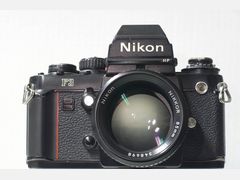 Nikon F3 (DE-2 finder) | Nikon F3HP (DE-3 finder) | |
|---|---|---|
| Introduced | March 1980 | March 1982 |
| Finder magnification | 0.8x, the bigger image | 0.75x |
| Best for | Shooters without glasses who want a bigger image and a smaller camera | Glasses wearers: the whole frame is visible from about 25 mm (1 inch) back |
| Body weight | 715 g (Nikon lists 700 g) | 760 g |
| Body only, K&M Camera (sold out) | $699.99 | $749.99 |
| With 50mm, Victory Camera (in stock) | $895 (50mm f/1.8 AI) to $995 (50mm f/1.4 AI) | $1,049.95 to $1,095 (Series E 50mm f/1.8) |
Pick the Nikon F3 (DE-2 finder) if
- You don't wear glasses and want the bigger finder image.
- You want the slightly smaller, lighter body.
- You want to pay a little less: at Victory Camera and K&M, the standard F3 was listed below the F3HP in October 2026.
Pick the Nikon F3HP (DE-3 finder) if
- You wear glasses.
- You want to see the whole frame without pressing your eye to the eyepiece.
Sources: thecamerasite.lauro.fi, en.wikipedia.org, imaging.nikon.com, kmcamera.com, kmcamera.com, victorycamera.com, victorycamera.com, victorycamera.com, victorycamera.com, cameraobscure.wordpress.com
What to check before buying a used Nikon F3
These checks come from Dante Stella's used-F3 guide, Film Still Photography and US repair shops. A body from a shop that checks it and gives a warranty covers most of them; see where to buy used film cameras.
- 1
Wind the advance
The F3's advance is famously smooth, so any roughness is a reason to pass.
- 2
Fire it on battery power
With fresh batteries and the switch on, fire through several speeds. Film Still Photography calls the shutter release a weak point on some bodies, and a backup lever that fires while the button does nothing points to an electrical fault.
- 3
Look at the LCD
Check the finder readout for black fluid or a faint display, and confirm the eyepiece threads are intact.
- 4
Pull the prism
Slide the two release levers and lift the finder off; sticking can mean impact damage. Dents in the brass prism cover are common and cosmetic, since the prism holds no electronics.
- 5
Check the 1/80 s safety
The camera should fire at 1/80 s only before frame 1. If it stays at 1/80 s after the counter passes 1, it needs a technician.
- 6
Turn it over
A hole with gold pins on the baseplate means the motor-drive terminal cap is missing, and the camera is not light-tight until one is fitted.
- 7
Check the seals
Look at the foam around the back door and the mirror bumper for stickiness or crumbling. Dante Stella notes F3 rear seals can look very degraded before they actually leak.
- 8
Weigh warranty against repair
Victory Camera gives a 90-day warranty and 30-day returns, Brooklyn Film Camera a 6-month warranty. The other route, suggested by Film Still Photography, is a cheaper F3 plus an overhaul: ICT lists an F3 body CLA at $325 plus parts.
Sources: dantestella.com, filmstillphotography.com, victorycamera.com, brooklynfilmcamera.com, ictcamera.com
Nikon F3 problems: won't fire, dim LCD, light seals and repair costs
Most F3 trouble today comes from age, such as oxidized contacts, worn switches and old foam, not from a design flaw, and many 'dead' cameras turn out to need fresh batteries, the power switch turned on or clean contacts. The Flickr threads cited here were found by searching for problems, so they show what can go wrong, not how often.
Shutter won't fire on battery power (only the backup lever works)
Raised in 8 opinions
- How you notice
- The release button goes down but nothing happens, or the LCD stays blank, while the mechanical backup lever still fires the shutter.
- Fix
- Check the simple things first: power switch under the advance lever on, self-timer lever off, batteries facing the right way, fresh batteries and clean contacts. If an MD-4 makes the camera work, suspect the body's battery wiring or the switch between body and motor-drive power. ICT finds dirty power-switch contacts behind many cameras owners think have a bad circuit board. Past that it is an electrical repair.
- Typical cost
- ICT: $50 evaluation applied to labor, F3 body CLA $325 plus parts. Brooklyn Film Camera: $50 inspection credited to the repair, its typical camera CLA range, for all models, is $325-850.
Sources: flickr.com, flickr.com, flickr.com, flickr.com, ictcamera.com, ictcamera.com, brooklynfilmcamera.com, ictcamera.com
Erratic or missing shutter speeds
- How you notice
- Slow speeds run short (a 1 s setting fires at about 1/2 s), or the camera holds no timed speeds at all.
- Fix
- A CLA that cleans the second-curtain release magnet often cures it; ICT names bad timing switches and a failed magnet coil as the other causes.
- Typical cost
- ICT: F3 body CLA $325 plus parts.
Sources: ictcamera.com, ictcamera.com
Jumpy meter or LCD readout
- How you notice
- The +/- signs flicker in manual and the automatic shutter speed jumps around.
- Fix
- ICT traces this to an oxidized ground contact near the ASA dial, cleaned and treated during service. The glass resistor under the dial can also crack from a knock to the top plate.
- Typical cost
- ICT: F3 body CLA $325 plus parts.
Sources: ictcamera.com, ictcamera.com
Faint, leaking or dead viewfinder LCD
Raised in 2 opinions
- How you notice
- The shutter-speed display gets fainter, shows black fluid or disappears.
- Fix
- Have a repair shop replace the LCD. Dante Stella says it fails less often than its reputation suggests, and A Flash of Darkness notes the camera still works in manual without it, but not on auto. A Flickr owner reported in 2014 that Nikon replaced his with a part from Japan.
- Typical cost
- No current US price published; ICT and Brooklyn Film Camera quote after a $50 inspection.
Sources: dantestella.com, flashofdarkness.com, flickr.com, ictcamera.com
Worn light seals and mirror bumper foam
- How you notice
- Light leaks and fogged edges; the foam around the back and the mirror bumper turns sticky or crumbles.
- Fix
- Replace the seals, either yourself with a kit or as part of a CLA. Dante Stella notes the F3's rear seals can be very degraded before they actually leak.
- Typical cost
- Brooklyn Film Camera: light seals typically $85-150 on any camera. Victory Camera values its seal replacement at $75.
Sources: dantestella.com, brooklynfilmcamera.com, victorycamera.com
Shutter capping or bounce at fast speeds
Raised in 2 opinions
- How you notice
- Bright or dark bands, or one side of the frame darker, mostly at 1/2000 s. It only shows on film.
- Fix
- A shutter adjustment during service. Dante Stella calls shutter bounce rare on the F3; a Flickr owner who had banding fixed advises spending '150-200 bucks' rather than living with it.
- Typical cost
- ICT: F3 body CLA $325 plus parts.
Sources: dantestella.com, flickr.com, flickr.com, ictcamera.com
The 1/80 s safety stays on past frame 1
Raised in 1 opinion
- How you notice
- On A, the camera keeps firing at 1/80 s after the counter passes frame 1 instead of metering.
- Fix
- First make sure the film really has been advanced to frame 1, since 1/80 s before that is normal. If it persists, it is a job for a technician.
- Typical cost
- Quoted after a $50 inspection at ICT or Brooklyn Film Camera.
Sources: dantestella.com, camera-wiki.org, flickr.com, ictcamera.com, brooklynfilmcamera.com
Missing motor-drive terminal cap on the baseplate
- How you notice
- A hole in the bottom of the body showing gold pins, with possible light leaks.
- Fix
- Fit a replacement cap (the MD-4 has a slot that stores the original). A Flash of Darkness bought a camera with this hole and had to source a new coupling cover.
- Typical cost
- A small part; no current US price found.
Sources: dantestella.com, flashofdarkness.com
Photos taken with a Nikon F3
Photos shared on Wikimedia Commons by people who shot them on a Nikon F3, from color street scenes to black-and-white film and underwater work.

Stanley, Idaho, July 2019. Nikon F3, 35mm f/2.8 AI-S, Fujifilm Superia 400Photo: minka6 from Beacon, NY, United States, CC BY 2.0 
Cementerio General de Santiago, Chile, 2023. Nikon F3 on Ilford Pan 400Photo: VonFer, CC BY-SA 4.0 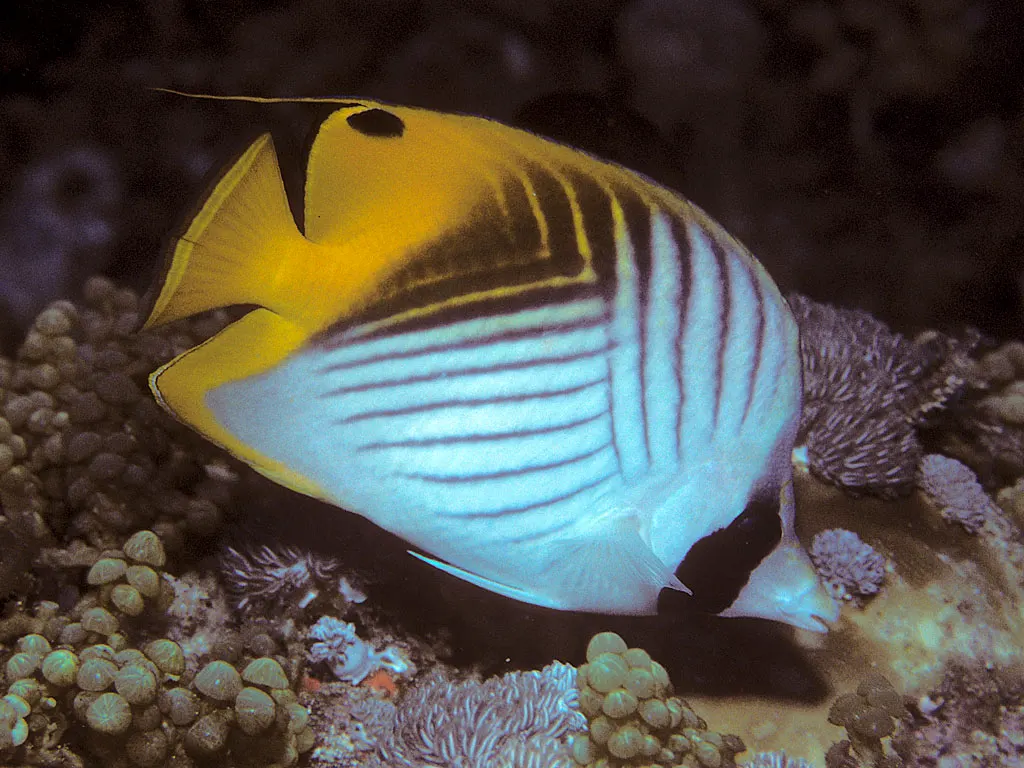
Underwater, Pemba Island, Tanzania, 1999Photo: Bernard E. Picton BernardP, CC BY-SA 4.0 
Underwater, Hoga Island, Sulawesi, Indonesia, 1997Photo: Bernard E. Picton BernardP, CC BY-SA 4.0
What a Nikon F3 costs used in 2026
US camera shops that publish prices listed in-stock used Nikon F3 and F3HP kits with a 50mm lens at $895 to $1,100 on October 28, 2026, most with a warranty or return window. K&M Camera's body-only listings ran $699.99 to $749.99 but were sold out. eBay, KEH, MPB and B&H blocked automated access, so their prices are not shown; check them before you buy.
Victory Camera (Colorado)
Used excellent, in stock, 90-day warranty, F3HP with Series E 50mm f/1.8 AI-S
$1,095
See listingVictory Camera (Colorado)
Used excellent-, new light seals, in stock, F3HP with Series E 50mm f/1.8 AI-S
$1,049.95
See listingVictory Camera (Colorado)
Used excellent-, small prism dent, new light seals, in stock, F3 with Nikkor 50mm f/1.4 AI
$995
See listingVictory Camera (Colorado)
Used excellent, minor prism wear, in stock, F3 with Nikkor 50mm f/1.8 AI
$895
See listingVictory Camera (Colorado)
Used excellent, sold, F3HP with Series E 50mm f/1.8 AI-S
$845
See listingBrooklyn Film Camera (Brooklyn, NY)
Refurbished, A grade, 6-month warranty, F3 with 50mm f/1.8
$1,100
See listingBrooklyn Film Camera (Brooklyn, NY)
Refurbished, B grade, 6-month warranty, F3 with 50mm f/1.8
$930
See listingCute Camera Co. (Austin, TX)
Restored to order, Very Good cosmetic grade, 60-day returns, F3 with a 50mm f/1.4 (a 24-85mm f/2.8-4D zoom is also offered)
From $1,049.99
See listingCute Camera Co. (Austin, TX)
Restored to order, Average cosmetic grade, 60-day returns, F3 with Nikkor 50mm f/1.4 and batteries
$899.99
See listingK&M Camera (New York, NY)
Used, rated 8 of 10, sold out, F3HP body only
$749.99
See listingK&M Camera (New York, NY)
Used, rated 8 of 10, sold out, F3 body only
$699.99
See listingK&M Camera (New York, NY)
Used, rated 8 of 10, sold out, F3/T titanium body only
$899.99
See listingLegacy Photo Lab (Dallas-Fort Worth, TX)
Used, sold out, F3 with Nikon 50mm f/1.8
$729.99
See listingRetrospekt (Milwaukee, WI)
Vintage refurbished, sold out, F3HP
$1,200
See listingFilm Supply Club
Used, normal signs of use, sold out (sale date not shown), F3HP with Nikkor 50mm f/1.4
$400
See listingVictory Camera (Colorado)
Used excellent, several listings, MD-4 motor drive
$65-$95
See listing
Prices checked on October 28, 2026. They move every week, so treat them as a range, not a quote. For scale: the 1981 US price was $1,174.90 with a 50mm f/1.4 (Wikipedia). Alex Luyckx put a decent used body at around $200 in 2015, and in 2024 a Tahusa reader found a near-mint F3 in a thrift shop for $65. Bargains still turn up outside shops.
Video reviews worth your time

Nikon F3: Perhaps the greatest SLR ever
The Nikon F3 is a robust, professional 35mm film SLR with excellent viewfinder options and an exceptionally smooth film advance, despite minor drawbacks like slow max shutter speed and dim LCD metering.

Nikon F3 Review - Possibly the best film camera of all time?
The reviewer highly praises the Nikon F3 as a durable, tactile, and deeply satisfying manual film camera, despite minor ergonomic flaws with its grip and exposure compensation dial.

Nikon F3 Review
The Nikon F3 is an iconic, exceptionally well-engineered 35mm film SLR that offers unmatched reliability, a smooth shooting experience, and a vast ecosystem of lenses and accessories.

The Legendary SLR? || Nikon F3 Review & Guide
The reviewer regards the Nikon F3 as an exceptionally durable, reliable, and iconic professional film SLR camera with excellent ergonomics and lens compatibility.

Nikon F3 Review
The reviewer considers the Nikon F3 an exceptionally well-built professional film camera with excellent smooth mechanics, though its viewfinder meter readout and self-timer controls present minor usability drawbacks.
Specifications
Basics
- Introduced
- March 1980 (F3HP: March 1982)
- Other versions
- F3/T titanium (1982), F3AF autofocus (April 1983)
- Units sold
- More than 751,000 by September 1992
- Original US price
- $1,174.90 with 50mm f/1.4 (1981)
Shutter and exposure
- Shutter speeds
- 8 s to 1/2000 s, stepless in A; T, B and X in manual
- Battery-free backup
- Mechanical 1/60 s (or T) via the backup release lever
- Flash sync
- 1/80 s (X) or slower
- Exposure modes
- Aperture-priority auto (A) and manual
- Meter range
- EV 1 to 18 at ISO 100
- Film speeds
- ISO 12 to 6400
- Exposure compensation
- +/-2 EV in 1/3-stop steps (Camera-wiki says 1/2-stop)
- Meter-on time
- 16 seconds after a half press
- Self-timer
- About 10 seconds, quartz controlled
- Mirror lock-up
- Yes
- Shutter durability
- Camera-wiki: tested for a duty cycle of 150,000 exposures
Viewfinder and focusing
- Coverage
- Virtually 100%
- Focusing screens
- Type K split-image/microprism standard, interchangeable with 19 other types per Nikon (other sources say 15 or 21)
- Exposure display
- LCD, the first on a Nikon camera
Power, size and accessories
- Cold weather
- DB-2 anti-cold battery holder takes two AA cells
- Dimensions
- 148.5 x 96.5 x 65.5 mm
- TTL flash film speeds
- ISO 100 to 400
Questions people ask about the Nikon F3
What is a Nikon F3 worth?
In October 2026, US camera shops priced in-stock used F3 and F3HP kits with a 50mm lens at $895 to $1,100. K&M Camera's body-only listings ran $699.99 to $749.99 before selling out. The titanium F3/T costs more ($899.99 for a body at K&M). Thrift-shop finds can go for far less: in 2024 a Tahusa reader reported a near-mint F3 for $65.
Sources: victorycamera.com, brooklynfilmcamera.com, kmcamera.com, kmcamera.com, kmcamera.com, tahusa.co
Is the Nikon F3 worth it?
Most owners say yes if you want a durable pro body with aperture priority, a full-frame finder and access to manual-focus Nikkors. Think twice if you need flash sync faster than 1/80 s, a standard hot shoe or a camera that works fully without batteries. If weight is the issue, Marc Jenkins suggests an FM2 or FE2; see the [Nikon FM2](/cameras/nikon-fm2/) and [Nikon FE](/cameras/nikon-fe/).
Sources: filmstillphotography.com, casualphotophile.com, marcjenkins.co.uk
What battery does the Nikon F3 take?
Two SR44 silver-oxide cells (also sold as 357 or EPX76), two LR44 alkalines, or one 3V CR1/3N lithium; Nikon specified silver-oxide. Glazer's Camera sells a Maxell SR44 for $6.99 and Victory Camera a CR1/3N for $8.95. Owners report a set lasting a year or more.
Sources: thecamerasite.lauro.fi, en.wikipedia.org, glazerscamera.com, victorycamera.com, casualphotophile.com
How do you change the ISO on a Nikon F3?
Film speed is set on the ISO dial, which runs from 12 to 6400 and shares its spot with the exposure compensation dial. Marc Jenkins calls changing exposure compensation a two-handed operation and ISO changes a little fiddly, and Casual Photophile notes that a mounted flash blocks the dial, so set ISO before you fit a flash. Check the manual for the exact press-and-turn sequence.
Sources: imaging.nikon.com, marcjenkins.co.uk, casualphotophile.com
Why won't my Nikon F3 turn on or fire?
Start with the power switch, the collar under the advance lever, which ICT's technician says many owners don't realize is the on/off switch. Then fit fresh batteries the right way round, clean the contacts and make sure the self-timer lever is off. If the mechanical backup lever fires but the button does nothing, ICT points to oxidized contacts and dirty power switches, which a service cleans.
Sources: flickr.com, ictcamera.com, ictcamera.com
Does the Nikon F3 work without batteries?
Only partly. The separate mechanical release lever fires the shutter at about 1/60 s, or on T, with no batteries at all; every other speed and the meter need power. Nikon kept that backup because SR44 cells were hard to find in some regions in 1980.
Sources: imaging.nikon.com, 35mmc.com
What is the difference between the Nikon F3 and F3HP?
The F3HP, introduced in March 1982, is the F3 with the DE-3 high-eyepoint finder, which shows the whole frame from about 25 mm back, so it suits glasses wearers. The standard DE-2 finder gives a bigger image (0.8x vs 0.75x) and a slightly smaller, lighter camera. Finders are interchangeable, so a body can be switched later.
Sources: imaging.nikon.com, en.wikipedia.org, thecamerasite.lauro.fi
Is it worth fixing a broken Nikon F3?
Often, yes. ICT lists an F3 body CLA at $325 plus parts, and its technician says many apparent failures are dirty power-switch contacts that cleaning fixes. Owners who paid for repairs mostly call them worthwhile, though one Flickr owner warns that shops usually insist on a full CLA, so compare the quote with an in-stock shop kit at $895 and up with a lens.
Sources: ictcamera.com, ictcamera.com, flickr.com, victorycamera.com
What people compare it with
A lighter manual-focus Nikon; Marc Jenkins suggests an FM2 or FE2 if the F3's weight bothers you.
Jim Grey would take an FE for its match-needle meter with optional auto exposure, and a 35mmc reader finds its needles friendlier than the F3's LCD.
Nikon F2
The fully mechanical pro body before the F3, for owners who want no battery dependence.
Nikon F4
Dante Stella says some buyers really want an F4: built-in motor, matrix metering and an ISO TTL hot shoe.
Every source behind this page
Read them yourself. How we pick and count them is in our methodology.
Show all 60 sources
Manuals and references 27
- thecamerasite.lauro.fi: Nikon F3
- brooklynfilmcamera.com: Nikon Film Cameras for Sale
- brooklynfilmcamera.com: Camera Repair NYC: Film Camera Repair in Brooklyn + Mail
- brooklynfilmcamera.com: Nikon F3 35mm SLR Film Camera + 50mm, Tested + Warranty
- camera-wiki.org: Nikon F3 - Camera-wiki.org
- cute.camera: Nikon F3
- en.wikipedia.org: List of battery sizes
- en.wikipedia.org: Nikon F3
- filmsupply.club: Nikon F3 HP with 50mm f/1.4
- ictcamera.com: Best Camera & Lens Repair Technicians San Diego
- ictcamera.com: Nikon F3: Disassembly & Service, Part 2
- ictcamera.com: ICT Camera Services
- imaging.nikon.com: Debut of Nikon F3 | Camera Chronicle
- kmcamera.com: Used Nikon F3 35mm SLR Camera Body | Black
- kmcamera.com: Used Nikon F3 HP 35mm Camera | Black
- kmcamera.com: Used Nikon F3/T | Black
- legacy-photolab.com: Search: 103 results found for "nikon f3"
- retrospekt.com: Nikon F3 HP 35mm SLR Film Camera
- glazerscamera.com: Maxell SR44W Silver Oxide Battery
- victorycamera.com: Eunicell CR1/3N 3V Lithium Battery
- victorycamera.com: Nikon F3 35mm Film Camera w/ Nikon 50mm f1.4 AI Lens
- victorycamera.com: Nikon F3 35mm Film Camera w/ Nikon 50mm f1.8 AI Lens [EXC]
- victorycamera.com: Nikon F3 35mm Film Camera w/ Nikon 50mm f1.8 AI Lens [EXC
- victorycamera.com: Nikon F3 HP F3HP 35mm Film Camera w/ 50mm f1.8 AI-S Lens -Good Seals
- victorycamera.com: Nikon F3 HP F3HP 35mm Film Camera w/ Nikon 50mm f1.8 AI
- victorycamera.com: Nikon F3 HP F3HP 35mm Film Camera w/ Nikon 50mm f1.8 AI-S Lens [EXC
- victorycamera.com: Search
Independent blogs 15
- Tahusa: Nikon F3 HP Film SLR Review: Why This Beauty Still Matters
- Film Still Photography: Nikon F3
- Dan Finnen: Nikon F3 Film SLR Camera Review
- Down the Road: Nikon F3 - Down the Road
- Shoot Film, Ride Steel: Serious photojournalism
- Jake Horn Photography: Nikon F3 Review
- Julian Tanase: Nikon F3
- A Flash of Darkness: Back to Film with the Nikon F3
- Camera Obscure: My Nikon F3 - Camera Obscure
- Robin Ferand: Nikon F3
- Marc Jenkins: Nikon F3: my favourite camera
- Dante Stella: Buying a used Nikon F3
- Alex Luyckx blog: Camera Review Blog No. 24 - Nikon F3 - Alex Luyckx
- International Camera Technicians: Nikon F3
- International Camera Technicians: Nikon F3
Forums 7
- Flickr Nikon F3 group: Discussing My F3 just decided to quit working.? in Nikon F3
- Flickr Nikon F3 group: Discussing Having a problem with my new F3
- Flickr I Shoot Film group: Flickr: Discussing Nikon F3
- Flickr Nikon F3 group: Discussing F3: Shutter working intermittently in Nikon F3
- Flickr I Shoot Film group: Discussing nikon f3 wont fire in I Shoot Film
- Flickr I Shoot Film group: Discussing Nikon F3 problem... in I Shoot Film
- Flickr Nikon F3 group: Discussing F3 shutter problem in Nikon F3
Editorial reviews 6
Video reviews 5
Keep reading
Film cameras
The Nikon FM2 is a fully mechanical 1982 SLR with a 1/4000 shutter. What 145 owner and reviewer opinions say, 2026 prices, versions and common problems.
Film cameras
The Nikon FE is a 1978 35mm SLR with aperture-priority auto and a needle meter. 125 owner and reviewer opinions, used prices from $225 and what fails.
Film cameras
Where to buy film cameras used in the US: KEH, MPB, B&H, local shops, eBay and thrift, with warranties, October 2026 prices and a checklist to test one.
Film cameras
How to load film step by step in 35mm SLRs, point-and-shoots, 120 and instant cameras, plus how to check it caught, rewind it and fix film that won't advance.
Techniques and editing
How to use flash photography: stay at or below sync speed (1/60 on a Canon AE-1), set aperture as guide number divided by distance, then bounce and gel it.