Kodak Ektachrome E100: what it looks like and how to expose it
The short answer
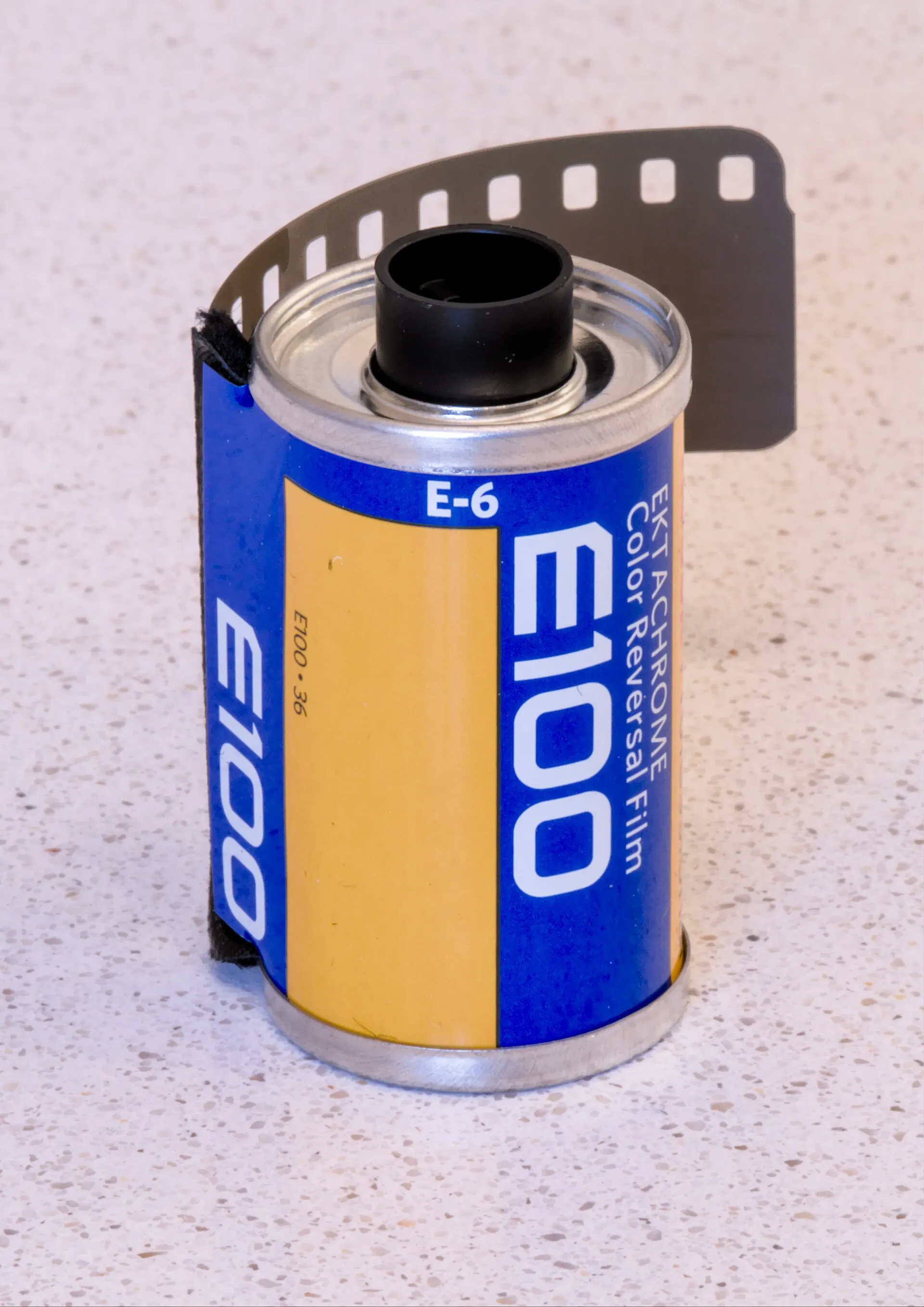
Kodak Ektachrome E100 is an ISO 100 color slide film processed in E-6 chemistry, sold in 35mm, 120 and sheet sizes, and a 36-exposure 35mm roll was listed at $22.99 to $28.63 at US shops on October 28, 2026, though all three shops listed here were sold out or backordered.
Reviewers praise its very fine grain, sharp detail and natural, fairly neutral color. The catch is a narrow exposure window, a cool or blue cast in shade and overcast light, and a high cost per frame once processing is added.
- Speed
- ISO 100
- Process
- E-6 (slide)
- Formats
- 35mm, 120, sheet film
- 35mm roll
- $22.99-28.63 (Oct 2026)
Built from 147 opinions from 31 pages and videos. Not yet tested by Camera Dojo. Updated .
The short version
Kodak discontinued its Ektachrome films in 2012 and 2013 and announced on September 25, 2018 that 35mm Ektachrome was available again; 120 and sheet film reached stores by early 2020. Kodak describes moderately enhanced saturation, a neutral color balance and a low-contrast tone scale, and several reviewers call the color natural or true to life, with Alex Burke finding it closer to reality than Velvia.
Exposure is the hard part. Kodak's own FAQ gives reversal film about half a stop of room either way, and 17 of the 37 opinions on exposure latitude are negative. Reviewers who nail the exposure report outstanding detail, while frames that miss it show blown highlights or muddy shadows. With E-6 processing listed from $20 at The Darkroom, a missed roll is an expensive lesson.
Good fit if
- You shoot landscapes, travel or snow in bright, even light and want real slides for a light table or projector
- You meter carefully, ideally with a spot or incident meter, and don't mind bracketing tricky scenes
- You want very fine grain and sharp scans, especially from 120 or 4x5
- You prefer natural, fairly neutral color to Velvia-style saturation
Think twice if
- You want exposure forgiveness: color negative film such as Ektar 100 or Portra 160 tolerates far more error
- You mostly shoot in overcast weather, open shade or indoors under tungsten light, where it turns cold or needs heavy filtering
- Your budget is tight: a $22.99 roll of 35mm plus E-6 processing from $20 adds up fast
- No lab near you runs E-6 and you don't want to mail film out
- You need 35mm this week: on October 28, 2026 it was sold out or backordered at every US shop listed here
Photos shot on Kodak Ektachrome E100
Photos shot on Kodak Ektachrome E100 in 35mm and 120, shared under free licenses on Wikimedia Commons.
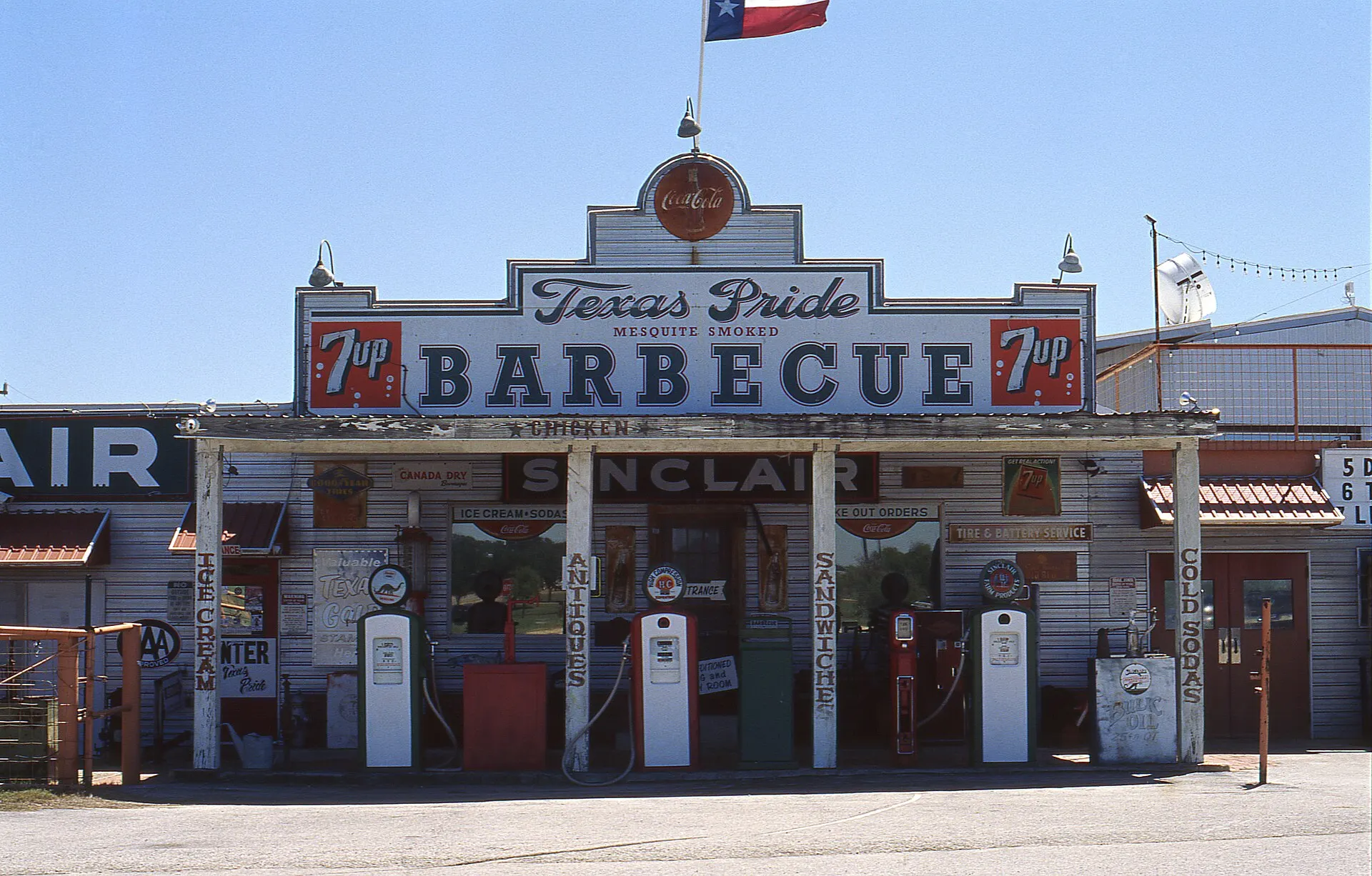
Texas Pride Barbecue, Adkins, Texas, 2024. Canon F-1.Photo: coolanimeboy25, CC BY 4.0 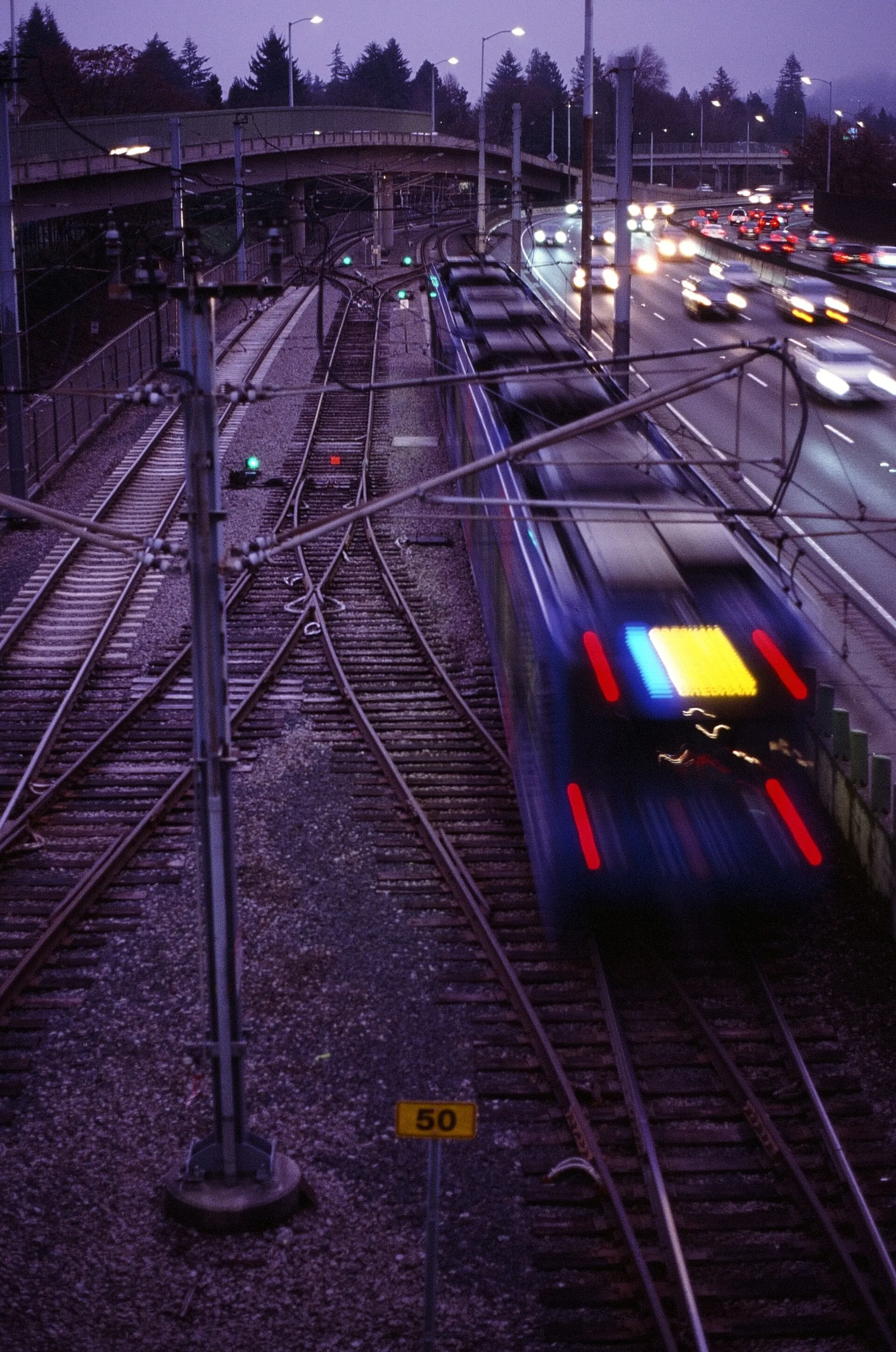
TriMet MAX at Hollywood/NE 42nd Ave station, Portland, Oregon. Canon EOS 650.Photo: Moki8, CC BY-SA 4.0 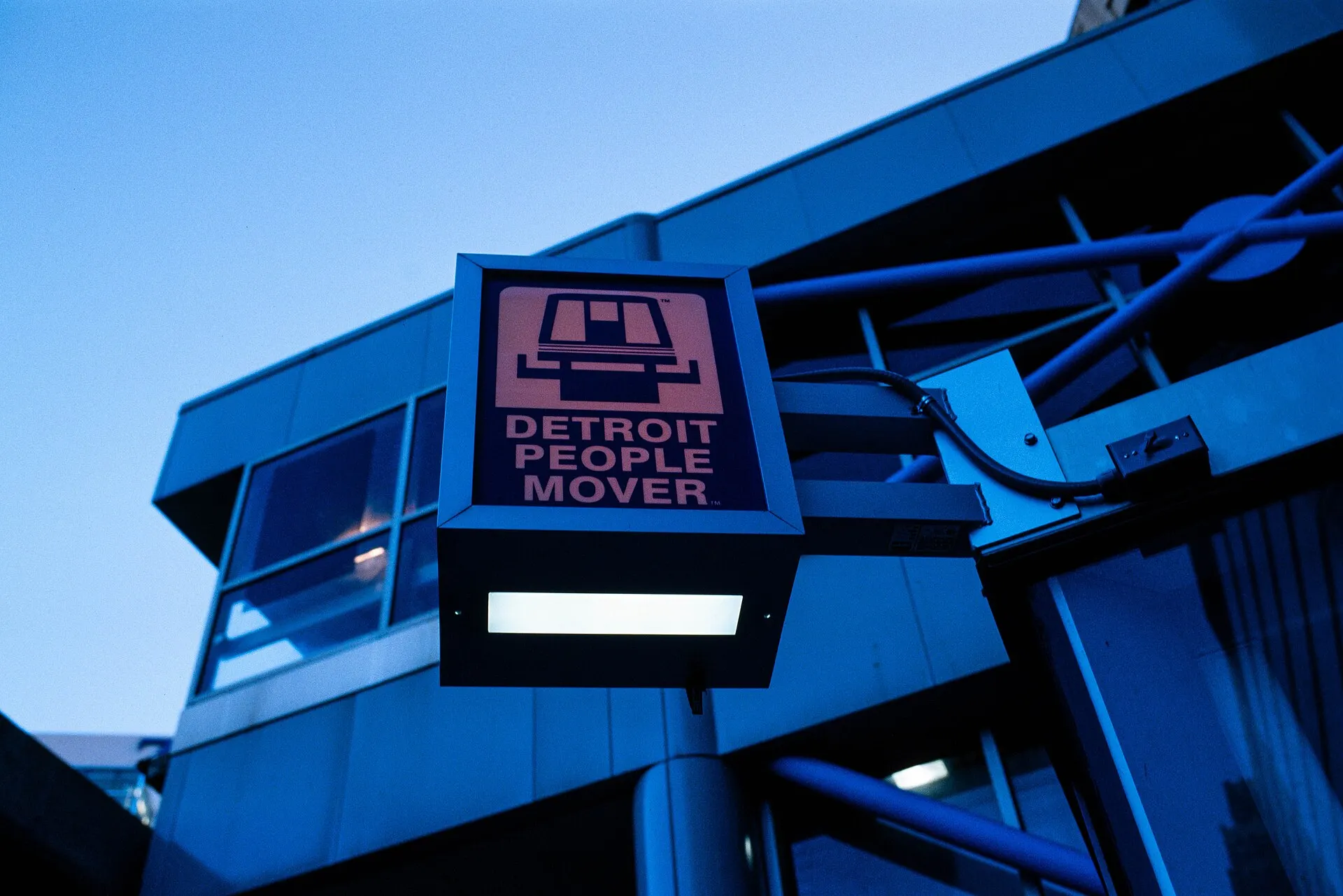
Detroit People Mover, Detroit, Michigan, 2019. Canon Rebel Ti.Photo: Dane from Oxford, Mi, CC BY 2.0 
Inokashira Benzaiten, Tokyo, January 2020. Hasselblad 500C, 1/4 second at f/8.Photo: ejstanz, CC BY 2.0 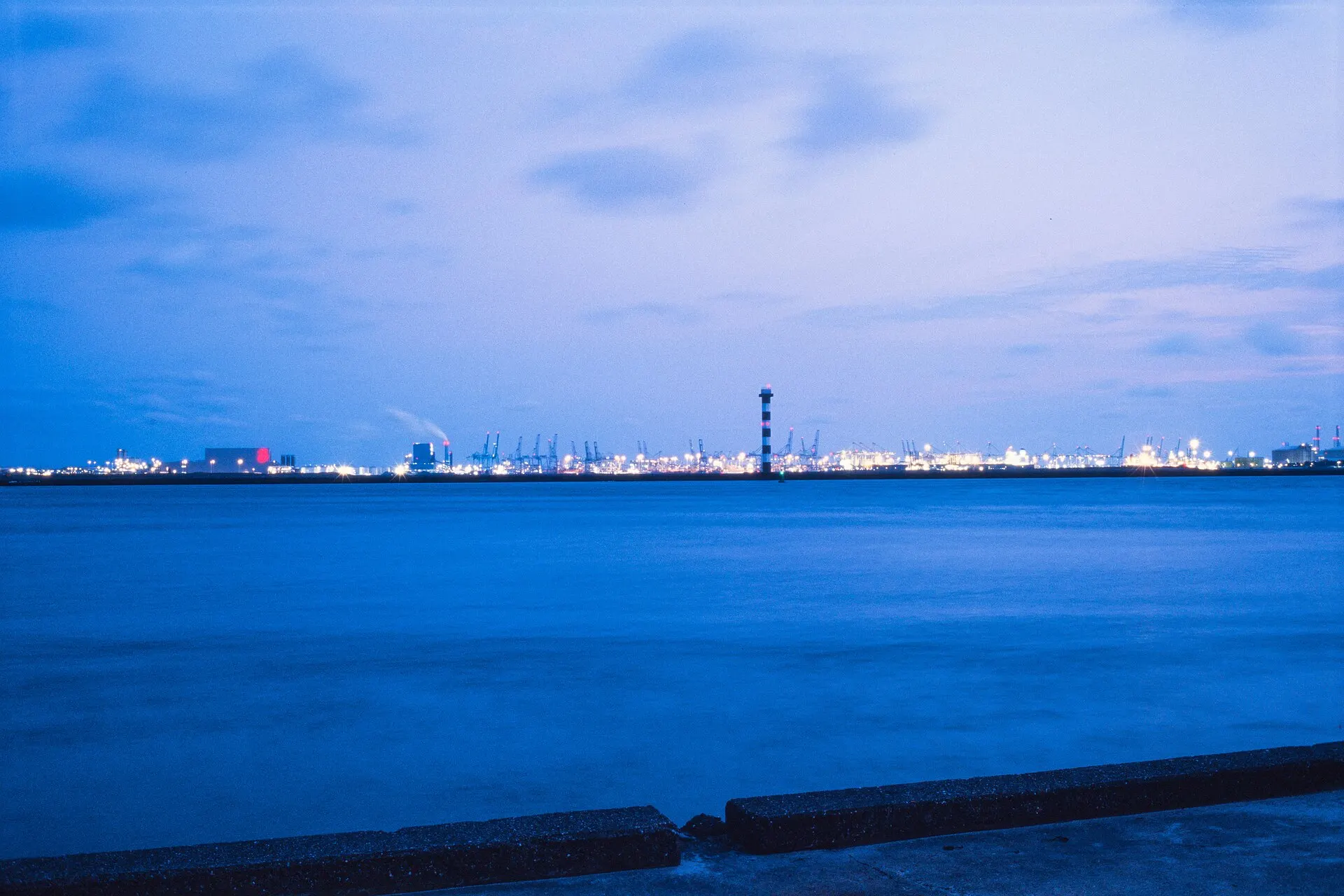
The Maasvlakte seen from Hoek van Holland at blue hour, a multiple-second exposure.Photo: Arandomphotographer, CC BY 4.0 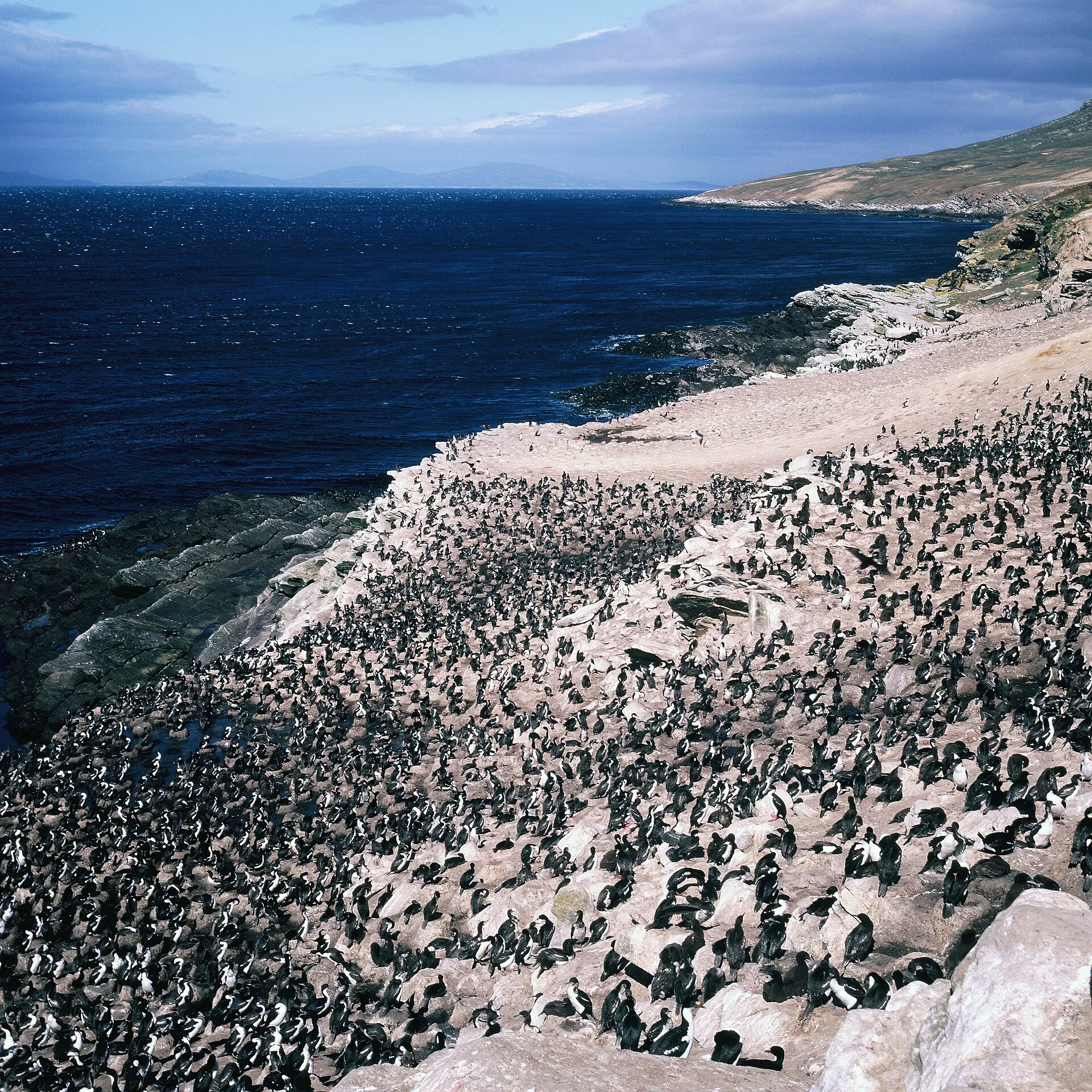
Imperial shag colony, Hawks Nest valley. Agfa Isolette I folding camera (120).Photo: chris lovelock, CC BY 2.0
What owners and reviewers say, topic by topic
We sorted 147 opinions about the Ektachrome E100 from 31 pages and videos on 26 websites and channels. Each row shows how many people raised a topic and how many of them were positive. Open a row to read short quotes, each linked to its source.
Most of these opinions come from photographers' blogs, editorial reviews and five YouTube reviews. Reddit, DPReview, PetaPixel and B&H reviews could not be read, and no Photrio threads are included, so everyday owner voices are thin. Consistency has only three opinions, and no source discussed halation, so that topic is missing.
Exposure latitude35% positiveof 37
The most split topic: 17 negative opinions say it punishes metering errors, sometimes of only half a stop, while 13 positive ones find more highlight and shadow range than older slide films. Reviewers split on which way to err: Hamish Gill and Kyle McDougall favor a little overexposure, while James Madison leans toward underexposure.
“Requires precise metering; no room for error”
Tim Layton Fine Art (guide) 2025-06Owner
“Ektachrome, like other color reversal films, has comparatively poor exposure latitude.”
Wesley King, Beyond the Aperture 2021-07Owner
“the highlight detail almost approaches that of a negative film like Portra or Ektar”
Alex Burke Photography 2022-03Owner
“Kodak Ektachrome E100 is a high risk, high reward film.”
Color56% positiveof 36
Most reviewers call the color natural and fairly neutral when exposure and light are right. The recurring complaint is a cool blue or blue-green cast in shade, overcast light and underexposed frames, and a few find it too cold next to Velvia 50.
“I simply find the E100 too cold.”
Kathleen Johnson, EMULSIVE 2020-07Owner
“E100 resembles reality much more closely.”
Alex Burke Photography 2022-03Owner
“Ektachrome provides rich, perfectly saturated, authentic color reproduction that's a joy to look at.”
Wesley King, Beyond the Aperture 2021-07Owner
“Ektachrome E100 leans cooler and more neutral compared to traditional slide films.”
Tim Layton Fine ArtOwner
Overall look71% positiveof 14
Most like the rich, glassy slide look and its depth; a few still prefer the punchier old E100G or E100VS, or find the new film too cold.
“I've started using this film as well and gotten good results.”
randomphoto blogOwner
“the results are more visually impressive to me than any I've taken on negative film”
“I agree about the rich glassiness of the film. I've shot one roll and had a similar impression.”
35mmcOwner
“I still prefer the old E100G and E100VS which gives me that punchy colour and saturation.”
Tahusa Analog Film ReviewHands-on review
Grain75% positiveof 12
Grain is very fine and close to invisible in 120 and 4x5. The caveat is that lifting dark, underexposed shadows in the scan brings grain out.
“Ektachrome is beautifully fine grained.”
Wesley King, Beyond the Aperture 2021-07Owner
“Each frame is sharp and nearly grain-free.”
Alex Luyckx blog 2019-06Hands-on review
“grains fine enough that makes it great to scan”
Keith Wee, KeithWee Photography 2019-10Hands-on review
“It's not as infinitely smooth as Provia but the sharpness and detail is great”
Alex Burke Photography 2022-03Owner
Price and availability0% positiveof 11
No one calls it cheap: eight negative and three mixed opinions point to the roll price plus E-6 processing, and stock was tight at the 2018 launch and in early 2020, and most 35mm listings were sold out or backordered on October 28, 2026.
“Kodak, in particular, however, seems to have raised prices more rapidly and to higher overall levels than its competitors”
Wesley King, Beyond the Aperture 2021-07Owner
“The biggest drawback to Ektachrome is going to be cost.”
Jake Horn Photography 2019Hands-on review
“I also can't see myself spending $22 on a roll regularly.”
Matej Sefcik blog 2026-03Hands-on review
“It's not a cheap film but it's worth shooting at least once if you can.”
Skin tones100% positiveof 8
All eight opinions are positive: reviewers find skin rendered accurately in daylight, though Decaf Journal suggests Portra 160 may do it a little better.
“Ektachrome is a very versatile colour film with accurate colour and top notch whites and skin tones”
EMULSIVEOwner
“the film captured nice skin tones”
Mr LeicaHands-on review
“skin tones are rendered quite nicely”
Nicklaus Walter, Decaf Journal 2023-03Hands-on review
“works really well with skin tones as well”
Zeb Andrews, Blue Moon Camera Codex 2026-02Hands-on review
Sharpness and detail86% positiveof 7
Reviewers agree it is sharp, and Analog.Cafe calls it one of the sharpest modern color films; Hamish Gill at 35mmc prefers it behind modern, higher-contrast lenses.
“E100 is also a pretty sharp film.”
Zeb Andrews, Blue Moon Camera Codex 2026-02Hands-on review
“the details are excellent, actually very sharp”
Keith Wee, KeithWee Photography 2019-10Hands-on review
“Ektachrome E100 is one of the sharpest modern colour emulsions.”
Dmitri, Analog.Cafe 2021-12Hands-on review
“I definitely prefer the look of the Ektachrome E100 with more modern, higher contrast sharper glass.”
Hamish Gill, 35mmc 2019-05Hands-on review
Low light and night71% positiveof 7
Long exposures behave well, with no reciprocity correction needed up to 10 seconds, and blue-hour frames get praise. Under tungsten or other indoor light the daylight-balanced film shifts color.
“I especially love the uncanny tonality (white balance) at night”
Tahusa Analog Film ReviewHands-on review
“it doesn't even require reciprocity compensation until you pass 10 second exposures”
Zeb Andrews, Blue Moon Camera Codex 2026-02Hands-on review
“How these shots came out has further spurred me on to experiment in lower light with this film”
Hamish Gill, 35mmc 2019-05Hands-on review
“Personally I've only done a few exposures beyond a minute and it seems to do alright.”
Alex Burke Photography 2022-03Owner
Pushing and pulling50% positiveof 6
Pushing holds up: Emulsive found E100 handled EI 800 exceptionally well, with colder, blue-purple shadows at EI 400 and 800. Some owners go the other way and rate it at EI 64 to 80.
“I am really impressed with the pushed results, not grainy at 800!”
“I suspect the film is closer to ISO 80 or even 64.”
Alex Burke Photography 2022-03Owner
“I typically rate it at ISO 80, sometimes even ISO 64, especially in challenging light.”
Tim Layton Fine ArtOwner
“shadows appear even colder, with more of a blue/purple tint”
EMULSIVE 2018-10Hands-on review
Scanning and printing83% positiveof 6
Reviewers find slides easy to scan, and one found them lying flat after drying. The one dissent says the narrow latitude makes good scans harder when exposure misses.
“Due to the slimmer latitude, you're also going to have a difficult time getting better scans.”
Chris Gampat, The Phoblographer 2018-11Hands-on review
“E100 scans extremely well due to its sharpness and color fidelity.”
Tim Layton Fine Art (guide) 2025-06Owner
“it's relatively flat when dry, with no longitudinal curl whatsoever for me”
Wesley King, Beyond the Aperture 2021-07Owner
“to my eye Ektachrome produces a superior result, and I can make enlargements as big as I please”
Charles, Mr LeicaOwner
Consistency67% positiveof 3
Only three opinions: one owner praises Kodak's coating quality and one X-rayed roll still gave usable slides, while Tim Layton warns that small E-6 chemistry variations show.
“E100 can be sensitive to slight variations in E-6 development chemistry”
Tim Layton Fine ArtOwner
“The quality of the product is consistently outstanding.”
Wesley King, Beyond the Aperture 2021-07Owner
“I obtained usable images with interesting effects despite the relatively extreme mistreatment”
PositiveMixedNegative
How to shoot Kodak Ektachrome E100
Loading E100 is like any other roll. Getting the exposure right is most of the job.
- 1
Set ISO 100, or try EI 80
The 35mm cartridge is DX coded (903824), so automatic cameras set ISO 100 on their own; on a manual camera, dial in 100. Tim Layton rates it at EI 80, sometimes 64, in challenging light, which is owner practice rather than Kodak's advice.
- 2
Shoot in bright, even light
According to Kodak's data sheet, start at 1/125 second at f/16 in bright or hazy sun with distinct shadows, f/22 on sand or snow, f/11 in weak hazy sun, f/8 on a cloudy bright day and f/5.6 in heavy overcast or open shade. Alex Luyckx found overcast light dulls everything and got his best frames in hard sun under blue skies. The sunny 16 rule explains the logic behind that table.
- 3
Meter for the highlights
Kodak's E100 FAQ gives reversal film about half a stop of exposure range either way. Tim Layton's guide says to meter for the highlights with a spot meter or careful incident readings, and Hamish Gill at 35mmc found incident metering promising even in high-contrast scenes.
- 4
Bracket when the light is tricky
Jake Horn points out that bracketing three frames turns a 36-exposure roll into 12 scenes, so on a long trip shooting many subjects he figures you could use two to three times more rolls than with negative film. Budget for it before you leave.
- 5
Warm up shade and snow
A reader on My Favourite Lens uses an 81A, sometimes an 81C, warming filter against blue light, and Alex Burke uses a Tiffen 812 to make snow read white. Kodak's data sheet says not to change the film-speed setting when you meter through a filter.
- 6
Expect little correction on long exposures
According to Kodak's data sheet, exposures from 1/10,000 to 10 seconds need no correction, and at 120 seconds you add CC10R filtration. Alex Burke adds 10 to 20 seconds to exposures over a minute and builds from there.
- 7
Send it to an E-6 lab
E100 needs E-6 chemistry, and Analog.Cafe warns that not every lab develops slide film, so ask first. The Darkroom processes 35mm, 120, 4x5 and 8x10 E-6 from $20; more options are in our list of mail-in film labs.
Sources: myfavouritelens.com, timlaytonfineart.com, kodakprofessional.com, kodakprofessional.com, alexluyckx.com, timlaytonfineart.com, 35mmc.com, jakehornphotography.com, alexburkephoto.com, analog.cafe, thedarkroom.com
Kodak Ektachrome E100 exposure latitude: how much room is there?
Less than negative film, and how much less depends on who you ask. Kodak's FAQ says reversal films have about plus or minus half a stop of range, and KeithWee found E100 will blow highlights if exposure is even half a stop off. Matej Sefcik could not rescue overexposed frames that he thinks would have been usable on other stocks.
Other reviewers report more room. Analog.Cafe calls E100 a huge improvement in dynamic range over other ISO 100 slide films and says it loses highlights and shadows gradually. Shooting 4x5, Alex Burke found highlight detail close to Portra or Ektar, and Hamish Gill got a decent scan from a frame two stops under.
Kyle McDougall's YouTube test on 120 lands in the middle: about a stop over or under stays workable, two stops under crushes the shadows, and three to four stops over clips the highlights. He and Hamish Gill both favor a little overexposure over a little underexposure, while James Madison errs toward underexposure and the Phoblographer says the general rule among photographers has been to underexpose Ektachrome by about a stop.
Shoot a test roll with your own meter, lab and scanner before a trip that matters.
Sources: kodakprofessional.com, keithwee.com, matejsefcik.com, analog.cafe, alexburkephoto.com, 35mmc.com, youtube.com, jamesmadisonphotography.wordpress.com, thephoblographer.com
Why does Ektachrome E100 look blue, and how do you fix it?
Kodak describes a neutral color balance, but Alex Burke says the biggest complaint most people have is that E100 looks too cool. The blue or blue-green cast shows up in open shade, overcast light and underexposed frames: Hamish Gill's underexposed shade shots drifted blue, Analog.Cafe saw blue shadows on snow, and Matej Sefcik's roll came back with a cooler blue-green tint.
Not everyone sees it. James Madison found E100 warmer than Provia, leaning toward yellows and reds, and Burke himself thinks the cast is more green than cool.
The fixes, easiest first: expose fully and shoot in sun rather than shade; add a warming filter such as an 81A, 81C or Tiffen 812; or correct the scan. Burke pulls down the green and blue channels in a curves layer, and Hamish Gill found the blue shift very easy to correct.
Indoors is harder. Under 3200 K tungsten light, Kodak's data sheet calls for an 80A filter and EI 25, two stops slower than box speed, so E100 is not a casual indoor film.
Sources: alexburkephoto.com, 35mmc.com, 35mmc.com, analog.cafe, matejsefcik.com, jamesmadisonphotography.wordpress.com, myfavouritelens.com, kodakprofessional.com
Can you push or pull Ektachrome E100?
Yes. According to Kodak's data sheet, a starting point for a one-stop push is to expose at EI 200 and ask the lab for a push 1 process, which means 8 minutes in the first developer. Labs usually sell pushes in fixed steps, though The Darkroom offers push and pull in 1/8-stop increments.
Emulsive shot four rolls at EI 100, 200, 400 and 800, pushed zero to three stops, and found E100 handled EI 800 better than Provia 100F. The pushed frames felt a little brighter and more saturated, mostly because of cooler blue-purple tones; at EI 400 and 800 the shadows turned colder, with more visible grain.
Pulling and cross-processing are options too. Analog.Cafe relays Mark Darragh's 4x5 results: pushing somewhat muddied the colors while pulling gave excellent results. Cross-processed in C-41, Blue Moon Camera found E100 gains contrast and saturation but keeps fairly normal colors. The technique itself is covered in how to push and pull film.
Sources: kodakprofessional.com, thedarkroom.com, emulsive.org, analog.cafe, bluemooncameracodex.com
Kodak Ektachrome E100 vs Fujifilm Provia 100F
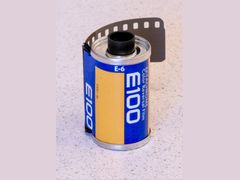 Ektachrome E100 | Provia 100F | |
|---|---|---|
| Type | ISO 100 color slide film, E-6 | Fujichrome color transparency film (RDP III) |
| 35mm, 36 exp (Oct 28, 2026) | $22.99-28.63, sold out or backordered | $37.95 at Nelson (stock not shown) |
| Color | Natural, fairly neutral; cool in shade | Cooler than E100, per James Madison and Mr Leica |
| Grain | Very fine | Smoother still, per Alex Burke |
| Underexposure | Hurts more than on Provia, per Tahusa | More tolerant, per the same reviewer |
| Pushed to EI 800 | Handled it exceptionally well versus Provia 100F, per Emulsive | Rated behind E100 at EI 800 by the same reviewer |
| Scanning | Dries flat with no curl (Beyond the Aperture) | Curls more, per the same reviewer |
Pick the Ektachrome E100 if
- You want warmer, natural color and may push it (Emulsive rated E100 ahead of Provia at EI 800)
- You scan at home and want film that lies flat in the holder
- Price matters: E100 was the cheaper 35mm roll on October 28, 2026, when you could find it
Pick the Provia 100F if
- You prefer cooler color and the smoothest grain
- You tend to underexpose a little and want more shadow tolerance
- E100 is out of stock where you shop
Sources: beyondtheaperture.com, nelsonphotoandvideo.com, jamesmadisonphotography.wordpress.com, mrleica.com, alexburkephoto.com, tahusa.co, emulsive.org
Ektachrome E100 formats, storage, developing and scanning
Kodak Professional lists E100 in 35mm (single rolls; retailers list them at 36 exposures), 120 Pro Packs and 4x5, 5x7 and 8x10 sheets, in 10-sheet boxes for 4x5 and 8x10 and 50-sheet boxes for 5x7. The Film Photography Project also hand-rolls it onto 620 spools for $20.99 and asks for at least ten days before shipping. Reviewers find the grain nearly invisible in 120 and 4x5, one reason to consider 120 over 35mm.
Kodak says to keep unexposed film sealed in a refrigerator at 13°C (55°F) or lower and let it warm to room temperature before opening; CineStill's listing calls that recommended but not required. Kodak's data sheet claims dark-storage image stability of at least 80 years at 10°C (50°F) and 15-20% relative humidity. For flights, TSA suggests packing film in your carry-on or asking for a hand inspection at the checkpoint.
Any E-6 lab can process it, and The Darkroom lists E-6 processing from $20. Home E-6 kits exist, including the Film Photography Project's at $36.99, but Tim Layton says the process needs 38°C plus or minus 0.3°C and recommends a lab for consistent results. See what developing costs for lab prices.
Kodak's FAQ says to use a transmission scanner, not a reflective one, with the slide film setting. Because the slide itself is the color reference, Analog.Cafe turns off automatic color correction, and Beyond the Aperture found E100 dries flat in Epson V800 holders. Our guide to scanning film at home covers DSLR and flatbed setups.
Sources: kodakprofessional.com, filmphotographystore.com, camerawest.com, cinestillfilm.com, kodakprofessional.com, tsa.gov, thedarkroom.com, filmphotographystore.com, timlaytonfineart.com, kodakprofessional.com, analog.cafe, beyondtheaperture.com
What a roll of Ektachrome E100 costs
On October 28, 2026, a 36-exposure 35mm roll of Ektachrome E100 was listed at $22.99 to $28.63, but none of the three US shops below had it in stock. 120 was easier to find: the Film Photography Project had single rolls at $16.99 and five-packs at $84.99, and CineStill's five-pack at $91.99 showed an add-to-cart button, though another tile on the same page listed an E100 five-pack as out of stock. B&H, Adorama, Freestyle, KEH and Walmart could not be checked, so they are not listed.
Film Photography Project Store
New, sold out, 35mm, 36 exposures, single roll
$22.99
See listingNelson Photo & Video (San Diego, CA)
New, backordered, 35mm, 36 exposures, single roll
$23.95
See listingCamera West
New, out of stock (waitlist), 35mm, 36 exposures, single roll
$28.63
See listingFilm Photography Project Store
New, in stock, 120, single roll (ships sealed in foil, no box)
$16.99
See listingNelson Photo & Video (San Diego, CA)
New, backordered, 120, single roll (Kodak Professional listing)
$18.95
See listingNelson Photo & Video (San Diego, CA)
New, backordered, 120, single roll (Eastman Kodak listing)
$18.99
See listingFilm Photography Project Store
New, in stock, 120, five-roll pro pack
$84.99
See listingCineStill Film
New, add to cart shown, 120, five-roll pro pack (limit 10 per customer)
$91.99
See listingArts Cameras
New, sold out, 120, five-roll box
$99.95
See listingFilm Photography Project Store
New, hand-rolled, in stock, 620, single roll (at least ten days to ship)
$20.99
See listingNelson Photo & Video (San Diego, CA)
New, backordered, 4x5 sheet film, 10 sheets
$79.95
See listingNelson Photo & Video (San Diego, CA)
New, backordered, 8x10 sheet film, 10 sheets
$239.95
See listing
Prices checked on October 28, 2026. They move every week, so treat them as a range, not a quote. Per frame, a $22.99 roll of 35mm works out to about $0.64 a shot ($22.99 / 36). The Darkroom lists E-6 processing from $20 without saying whether that is per roll, so if it is, development brings the total to about $1.19 a shot (($22.99 + $20) / 36). The Film Photography Project's 120 five-pack is about $17.00 a roll ($84.99 / 5), no cheaper than its $16.99 single. CineStill limits its 120 five-pack to 10 per customer. For other places to look, see [where to buy 35mm film](/film/where-to-buy-35mm-film/).
Technical data
Film
- Speed
- ISO 100/21°
- Process
- E-6
- Light source
- Daylight or electronic flash (data sheet)
Formats
- 35mm roll
- 36 exposures, sold singly
- DX code (35mm)
- 903824
- Edge print
- KODAK E100 531
Exposure, processing and storage
- Exposure range
- About plus or minus half a stop (Kodak FAQ)
- Tungsten (3200 K)
- 80A filter, EI 25 (data sheet)
- Unexposed storage
- Sealed, in a refrigerator at 13°C (55°F) or lower
- Dark storage stability
- At least 80 years at 10°C (50°F), 15-20% RH (data sheet)
Video reviews worth your time

Testing the exposure limits of Kodak's Ektachrome E100 120 Slide Film
Kodak Ektachrome E100 produces vibrant and clean results at normal exposure, offering a workable exposure range of roughly one stop over or under before highlights or shadow details deteriorate significantly.

Kodak Ektachrome E100 Review
The Kodak Ektachrome E100 is a versatile, high-performing slide film featuring fine grain, pleasant skin tones, and solid dynamic range, though it tends to render a cool color cast in shaded or overcast light.

Kodak Ektachrome E100 35mm | ROLL REVIEW
Kodak Ektachrome E100 is a classic daylight-balanced slide film that delivers bright, saturated colors with cooler blue tones when precisely exposed.

This is your sign to shoot Kodak Ektachrome E100
The reviewer highly recommends Kodak Ektachrome E100 as an outstanding slide film with excellent sharpness, latitude, and color rendition despite its higher cost.

Kodak Ektachrome E100 - Does It Live Up To The Hype?
The reviewer highly praises Kodak Ektachrome E100 for its extremely fine grain, incredible detail, and exceptionally true-to-life color rendering.
Questions people ask about the Ektachrome E100
Is Kodak Ektachrome E100 discontinued?
No. Kodak discontinued its Ektachrome films in 2012 and 2013, then announced on September 25, 2018 that 35mm Ektachrome was available again; 120 and sheet film followed by early 2020, and Kodak Professional still lists all three. Supply is the problem: on October 28, 2026 the 35mm roll was sold out or backordered at every US shop listed on this page.
Sources: en.wikipedia.org, beyondtheaperture.com, kodakprofessional.com
How much does Ektachrome E100 cost to buy and develop?
A 36-exposure 35mm roll was listed at $22.99 to $28.63 on October 28, 2026, a 120 roll at $16.99 to $18.99, and a 10-sheet box of 4x5 at $79.95. The Darkroom lists E-6 processing from $20 but does not say whether that is per roll; if it is, a $22.99 roll of 35mm comes to about $1.19 a frame developed (($22.99 + $20) / 36).
Sources: filmphotographystore.com, camerawest.com, filmphotographystore.com, nelsonphotoandvideo.com, thedarkroom.com
What ISO should I rate Ektachrome E100 at?
Kodak rates it ISO 100 for daylight and flash, and that is the place to start. Some shooters give it a little more light: Tim Layton rates it at EI 80 or 64, Alex Burke thinks his sheet film behaves closer to ISO 64 to 80, and Hamish Gill tried EI 80, a third of a stop over. The Phoblographer says the general rule among photographers has been to go the other way and underexpose Ektachrome by about a stop, so test with your own lab and scanner.
Sources: kodakprofessional.com, timlaytonfineart.com, alexburkephoto.com, 35mmc.com, thephoblographer.com
How does the new E100 compare with E100G, E100VS and Ektachrome 100D?
E100G and E100VS are older Kodak Ektachromes, and E100VS was discontinued early in 2012. Tahusa still prefers the old E100G and E100VS for punchier color, while the Phoblographer thinks the new E100 has better colors overall. Ektachrome 100D is a separate film for motion picture formats such as 16mm, not the still film.
Sources: shop.stearmanpress.com, tahusa.co, thephoblographer.com, en.wikipedia.org, bluemooncameracodex.com
Where can I get Ektachrome E100 developed?
Any lab that runs E-6 chemistry. Not every lab does, so Analog.Cafe suggests checking before you send rolls. Mail-in labs such as The Darkroom process 35mm, 120, 4x5 and 8x10 E-6 from $20. Home E-6 kits exist if you can hold the temperature tightly.
Sources: analog.cafe, thedarkroom.com, timlaytonfineart.com
Is Ektachrome E100 hard to scan?
Mostly no. Alex Luyckx found it very easy to scan, Beyond the Aperture says it dries flat with no curl, and Kodak's FAQ says the slide itself is a color reference, which makes scanning easier. Use a transmission scanner with the slide film setting; the hard cases are underexposed frames, where lifting shadows brings out grain and color shifts.
Sources: alexluyckx.com, beyondtheaperture.com, kodakprofessional.com, 35mmc.com
Is it worth shooting E100 in a point-and-shoot?
It can work. Hamish Gill at 35mmc shot a roll in a basic point-and-shoot and was pleasantly surprised by the exposures, with any variation easy to correct in Lightroom, though he prefers the look of E100 behind sharper, higher-contrast lenses. Keep to bright, even light, since the camera's meter has to land within a narrow window.
Sources: 35mmc.com
Does airport X-ray damage Ektachrome E100?
TSA's film page suggests carrying undeveloped film in your carry-on or asking for a hand inspection at the checkpoint. In one photographer's account, a roll that went through about a dozen X-ray machines picked up a magenta cast across the roll, concentrated along the top and bottom edges, but still gave usable slides; treat that as one anecdote, not a safe limit.
What people compare it with
Fujifilm Provia 100F
Beyond the Aperture calls it E100's main direct competitor; reviewers describe cooler color and smoother grain, and Nelson listed a 35mm roll at $37.95 on October 28, 2026.
Fujifilm Velvia 50
Far more saturated slide film for landscapes; Alex Burke shoots both and finds E100 more neutral, with better shadow detail.
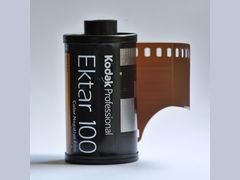
ISO 100 color negative film. Kodak's FAQ says negative films have a much wider exposure range than slide film, and Jake Horn found E100's roll price 62% higher than Ektar's in 2019.
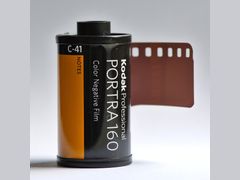
Color negative film that Tim Layton calls soft, forgiving and ideal for natural skin tones; Decaf Journal suggests it may render skin a little better than E100.
Every source behind this page
Read them yourself. How we pick and count them is in our methodology.
Show all 52 sources
Manuals and references 21
- artscameras.com: Kodak Ektachrome E100 Color Transparency 120 Film
- en.wikipedia.org: Ektachrome
- kodakprofessional.com: KODAK PROFESSIONAL EKTACHROME Film E100
- kodakprofessional.com: E100%20FAQs%20PDF%202024.pdf
- kodakprofessional.com: e4000 ektachrome 100.pdf
- nelsonphotoandvideo.com: Eastman Kodak Ektachrome E100 Color Transparency Film - ISO 100 (120)
- nelsonphotoandvideo.com: Kodak Professional EKTACHROME E100 Color Reversal Film 120 FILM
- nelsonphotoandvideo.com: Kodak Professional Ektachrome E100 Color Transparency Film (35mm Roll
- nelsonphotoandvideo.com: Kodak Professional Ektachrome E100 Color Transparency Film (4 x 5", 10
- nelsonphotoandvideo.com: Kodak Professional Ektachrome E100 Color Transparency Film (8 x 10", 1
- nelsonphotoandvideo.com: Search: 16 results found for "provia"
- shop.stearmanpress.com: SHOOTING EXPIRED FILM: KODAK E100 VS
- thedarkroom.com: E-6 Processing by mail | The Darkroom specializes in transparency film
- camerawest.com: Kodak Ektachrome E100
- cinestillfilm.com: KODAK EKTACHROME E100 Color Reversal Slide Film, 120 5-Pack 120 Medium Format, EI 100
- filmphotographystore.com: 120 Color Slide Film - Kodak Ektachrome E100 (1 Roll)
- filmphotographystore.com: 120 Color Slide Film - Kodak Ektachrome E100 (5-Pack)
- filmphotographystore.com: 35mm Chrome - Kodak Ektachrome E100 (1 Roll)
- filmphotographystore.com: 620 Color Slide Film - Kodak Ektachrome E100 (1 Roll)
- filmphotographystore.com: Search: 15 results found for "ektachrome e100"
- tsa.gov: Film
Independent blogs 20
- Matej Sefcik blog: Kodak Ektachrome
- Decaf Journal: A Review Of Kodak Ektachrome E100 Film
- KeithWee Photography: A day with the 135mm Kodak Ektachrome E100 Film
- Alex Luyckx blog: Film Review Blog No. 40
- Tahusa Analog Film Review: Kodak Professional Ektachrome E100
- Tales from the Magic Box: Ektachrome E100
- Jake Horn Photography: Kodak E100 Review (New Ektachrome)
- James Madison Photography: Review: Kodak Ektachrome E100
- Ryan Seabrook Photography: X-ray Damaged Ektachrome
- Tim Layton Fine Art: A Field Guide to Kodak Ektachrome E100
- Tim Layton Fine Art: Kodak Ektachrome E100 Film Guide
- Beyond the Aperture: Review: Kodak Ektachrome E100 Color Reversal Film (135 ...
- randomphoto blog: Review of Kodak's NEW Ektachrome E100
- Mr Leica: New Kodak Ektachrome vs Fuji Provia 100F, Ektar, Velvia
- My Favourite Lens: Kodak Ektachrome E100 35mm Film Review
- Alex Burke Photography: Kodak E100
- 35mmc: Kodak Ektachrome E100 - First Rolls Review
- 35mmc: Kodak Ektachrome E100 - First Rolls Review
- 35mmc: Kodak Ektachrome E100 - First Rolls Review
- 35mmc: Kodak Ektachrome E100 - First Rolls Review
Editorial reviews 5
- Analog.Cafe: Kodak Ektachrome E100 Film Review
- The Phoblographer: Film Emulsion Review
- Blue Moon Camera Codex: A Film Friday film review of Kodak Ektachrome E100 with ...
- EMULSIVE: Film stock review: Kodak EKTACHROME E100 - shot at EI 100, 200, 400 + 800 first impressions
- EMULSIVE: a comparative test of Kodak EKTACHROME E100 and ...
Video reviews 5
- Kyle McDougall: Testing the exposure limits of Kodak's Ektachrome E100 120 Slide Film
- Pushing Film: Kodak Ektachrome E100 Review
- Analog Resurgence: Kodak Ektachrome E100 35mm | ROLL REVIEW
- Michael Bennett: This is your sign to shoot Kodak Ektachrome E100
- Scott Graham: Kodak Ektachrome E100 - Does It Live Up To The Hype?
Retailer customer reviews 1
Keep reading
Film stocks
Kodak Ektar 100 is an ISO 100 color film with very fine grain, $13.99 to $19.00 a 35mm roll. What 141 opinions say about color, skin tones and exposure.
Film stocks
Kodak Portra 160 is a fine-grain ISO 160 color film, $13.99 to $17.99 a 35mm roll in Oct 2026. What 148 opinions say about skin tones, latitude and low light.
Film stocks
How to push film: what a stop means, what to set on your camera, how to tell the lab, one-stop fees from $0 to $4, home development times and how to pull film.
Developing and scanning
The best US labs for mail-in film developing, with October 2026 prices, shipping costs, turnaround times and scan sizes for The Darkroom, Dwayne's and more.
Developing and scanning
Scanning film with a DSLR, step by step: gear and October 2026 prices, exact camera settings, how it compares with a flatbed and fixes for common scan problems.
Film stocks
35mm vs 120 film: common 120 frames are 2.7 to 5.4 times bigger than 35mm but give 8 to 16 shots a roll. Cost per frame, lab prices and which to pick.