Kentmere 400: what it looks like and how to shoot and develop it
The short answer
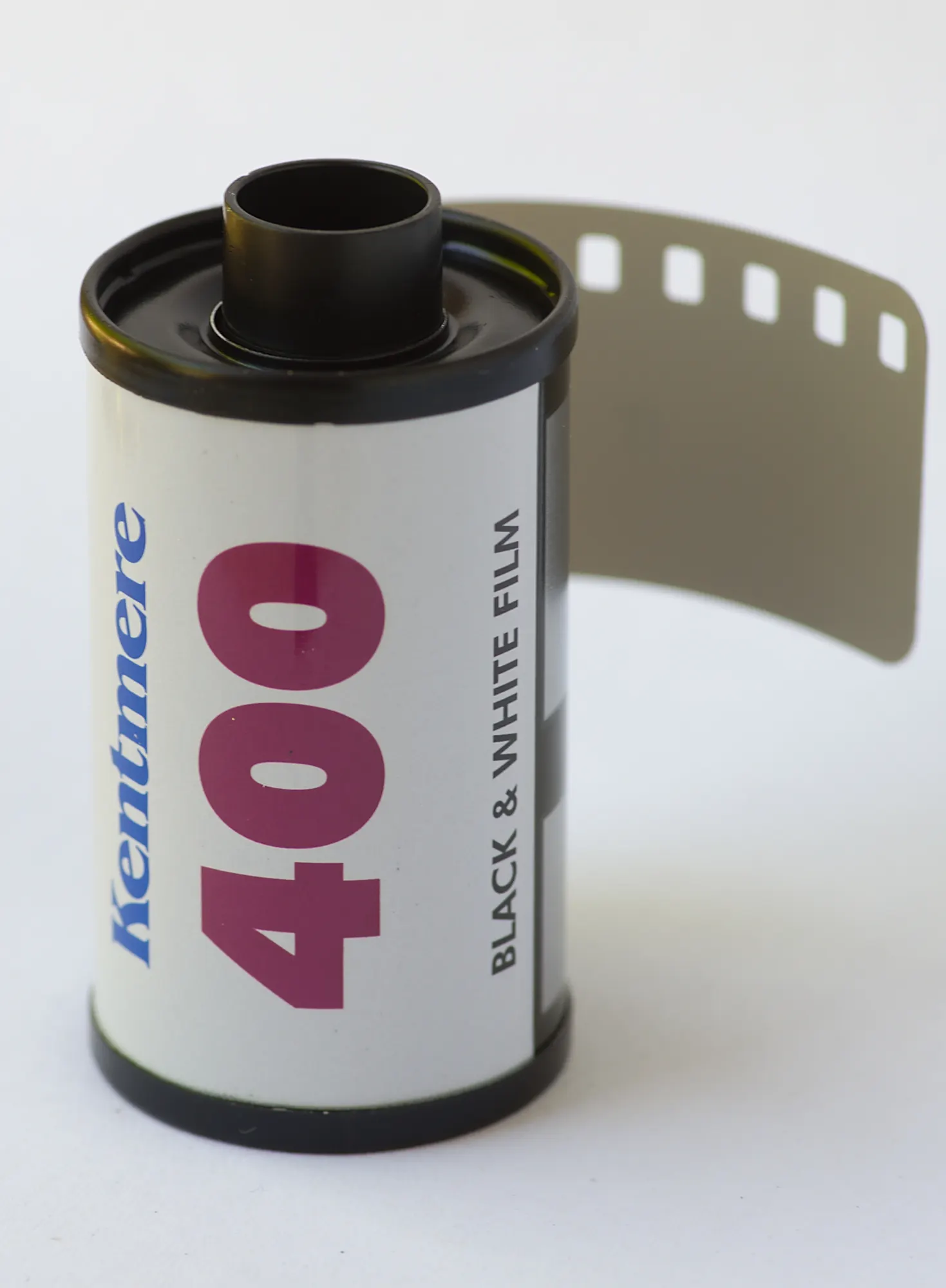
Kentmere 400 (sold as Kentmere Pan 400 since late 2018) is Harman Technology's budget ISO 400 black-and-white negative film, made in the same English factory as Ilford films, and a 36-exposure 35mm roll costs $8.39 to $10.99 at US shops (October 28, 2026).
Reviewers and owners call it a solid all-rounder for the money, with wide latitude, a classic grainy look and easy pushes to EI 800 or 1600. The trade-offs are flat contrast in dull light, grain some find coarse in 35mm, and less forgiveness than Ilford HP5 Plus.
- Speed
- ISO 400
- Process
- Black and white (not C-41)
- Formats
- 35mm, 100 ft bulk, 120
- 35mm, 36 exp
- $8.39-10.99 (Oct 2026)
Built from 135 opinions from 31 pages and videos. Not yet tested by Camera Dojo. Updated .
The short version
Harman launched the Kentmere films in 2009 as a lower-priced brand for the US market, and Kentmere 400 is still the cheap black-and-white roll many people load to learn, test a camera or shoot street pictures. A 24-exposure roll is $6.99 at the Film Photography Project Store, about $0.29 a frame ($6.99 / 24). Reviewers keep measuring it against Kodak Tri-X and Ilford HP5 Plus: 35mmc's Simon King calls it Tri-X with less dynamic range, and Aly's Vintage Camera Alley found pushed Kentmere looks very similar to pushed HP5.
Owners split on two things. Grain looks classic to some and coarse to others, and the developer seems to matter a lot. Contrast is low, which helps when scanning but can look muddy on overcast days unless you add a yellow filter, a push or more contrast in editing.
Good fit if
- You want a cheap ISO 400 black-and-white film for everyday shooting, street work or test rolls
- You are learning to shoot or develop black and white
- You push film to EI 800 or 1600
- You scan your negatives and like room to add contrast later
Think twice if
- You want punchy contrast straight from the negative, especially on gray days
- You print large and want the finest grain at ISO 400
- You need as much room for exposure mistakes as HP5 Plus gives
- You shoot sheet film: Harman lists Kentmere Pan 400 only in 35mm, 35mm bulk and 120
Photos shot on Kentmere Pan 400
Photos shot on Kentmere 400 in 35mm, shared under free licenses on Wikimedia Commons.
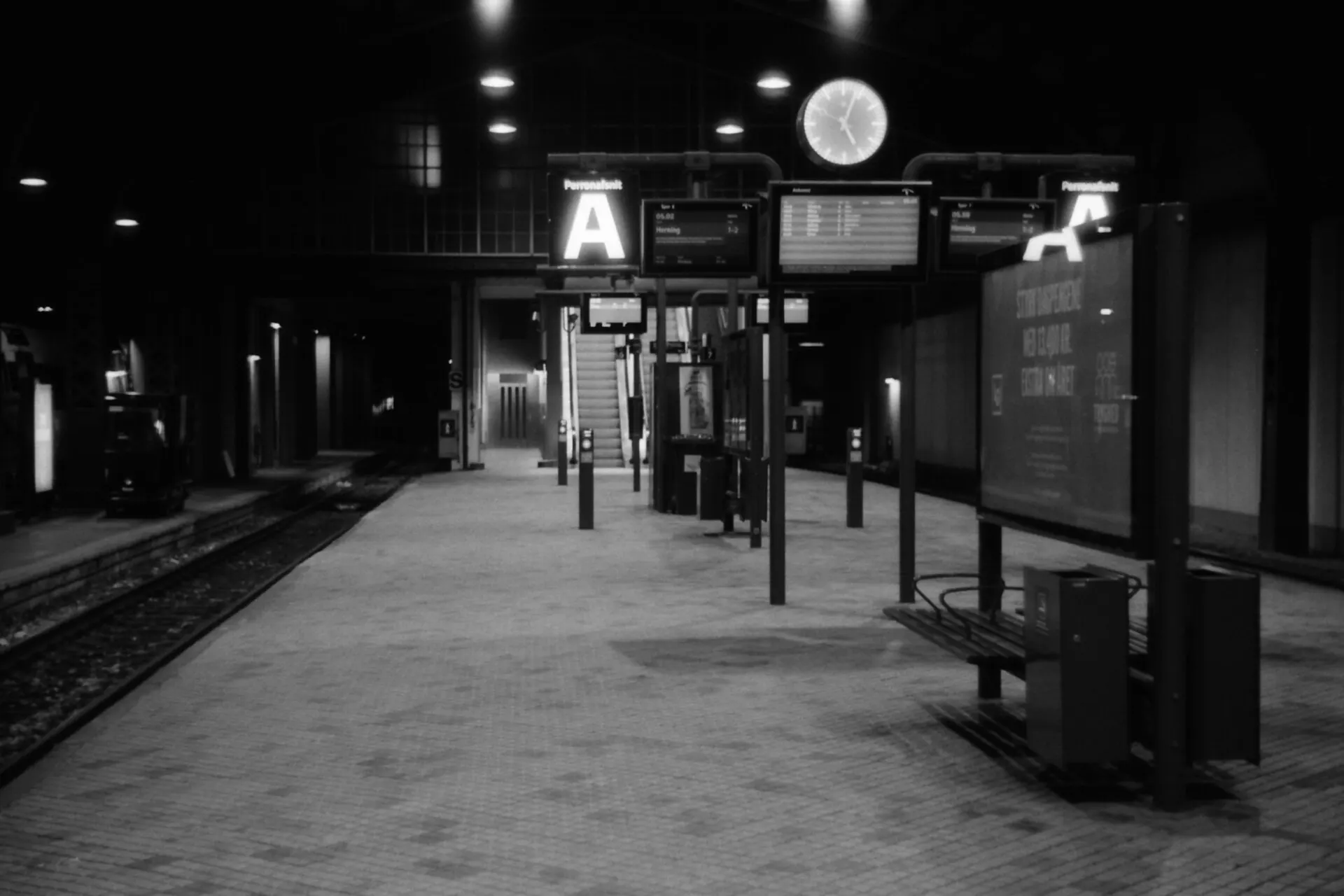
Aarhus H station platform at night, Leica M3, 2018Photo: NAC, CC BY-SA 4.0 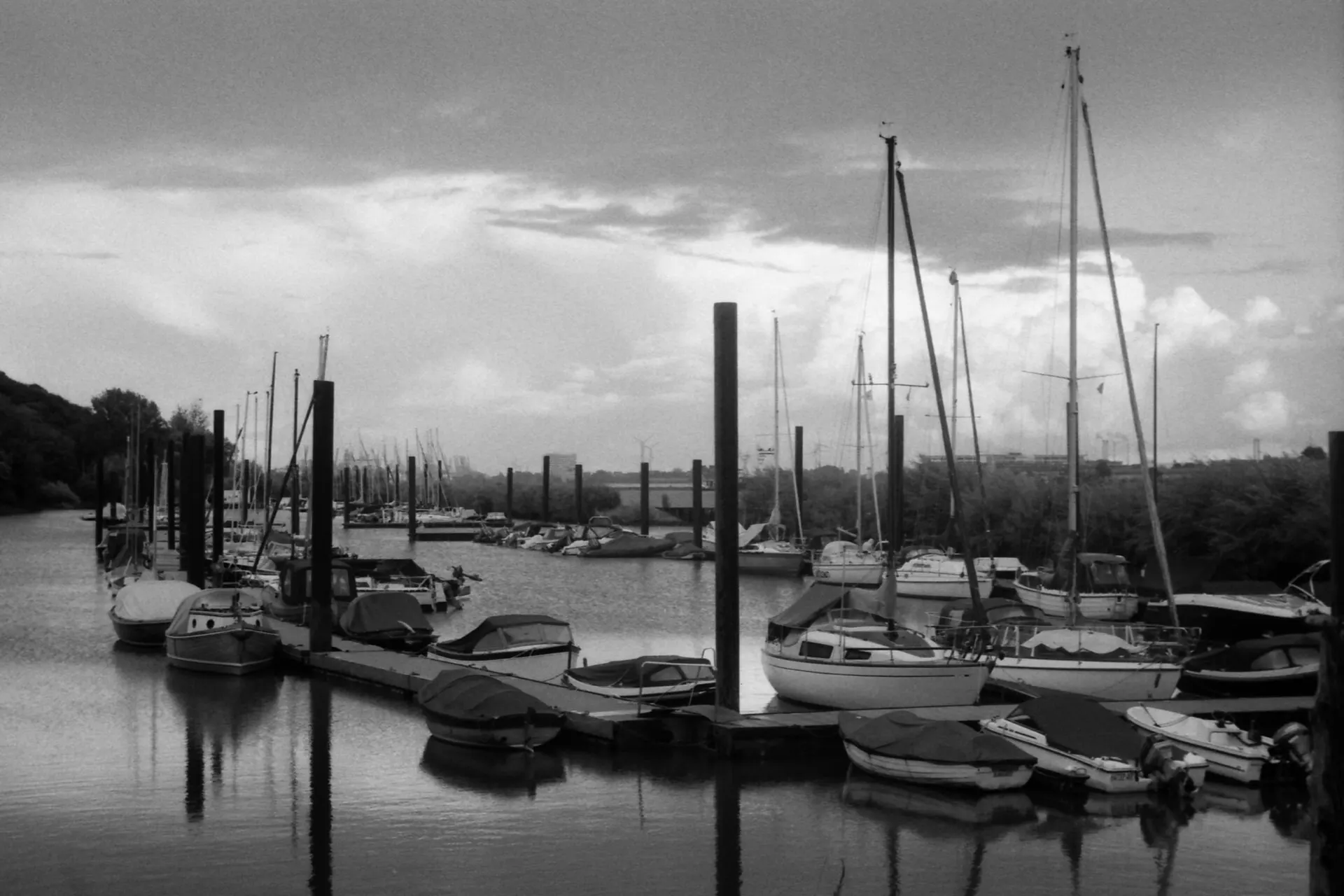
Jollenhafen Mühlenberg, Leica M3, 2018Photo: NAC, CC BY-SA 4.0 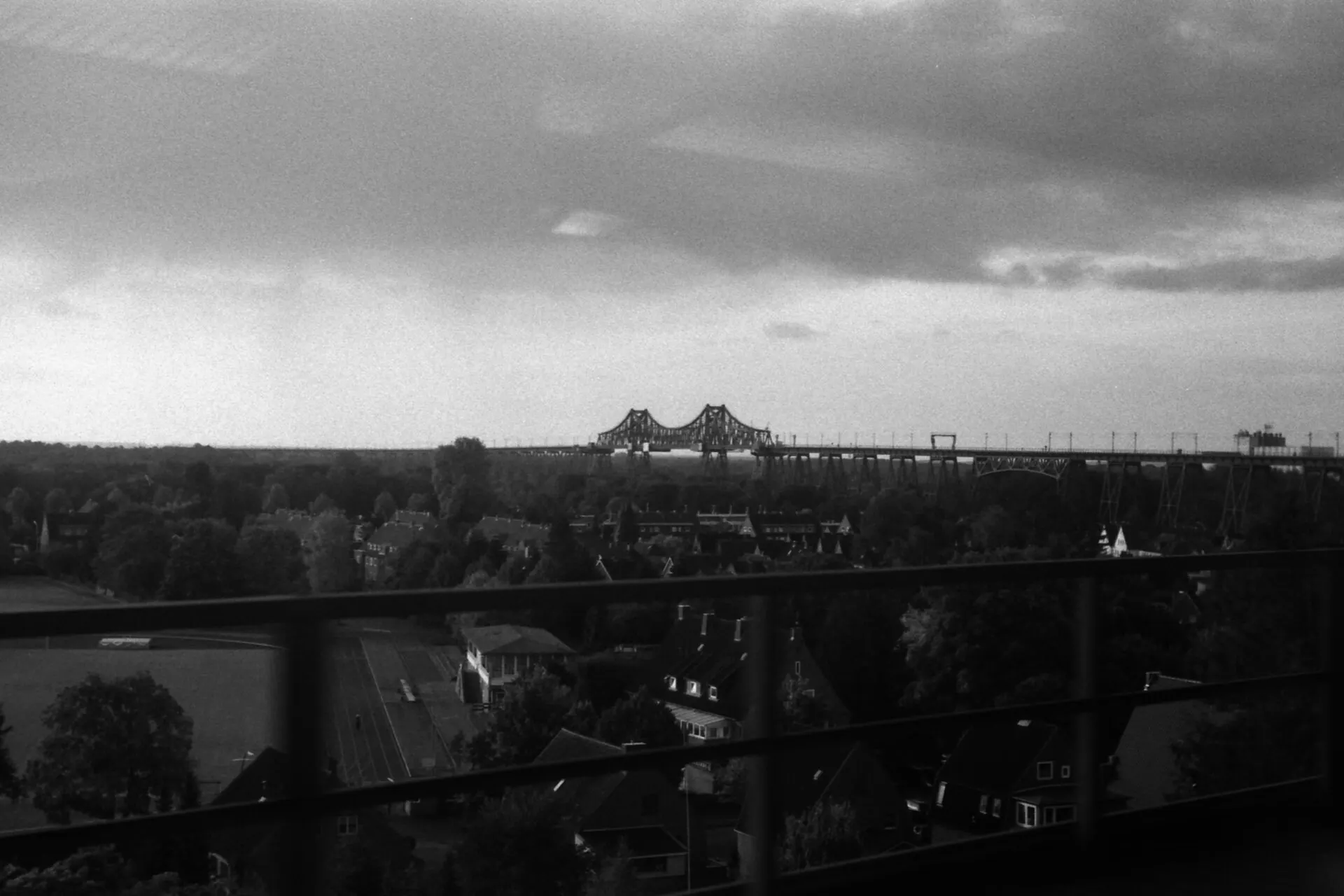
Rendsburger Hochbrücke seen from a train, Leica M3, 2018Photo: NAC, CC BY-SA 4.0 
Antiga Casa Orlando, Cuiabá, Brazil, Nikon F401s, 2018Photo: paulisson miura from Cuiabá, Brasil, CC BY 2.0 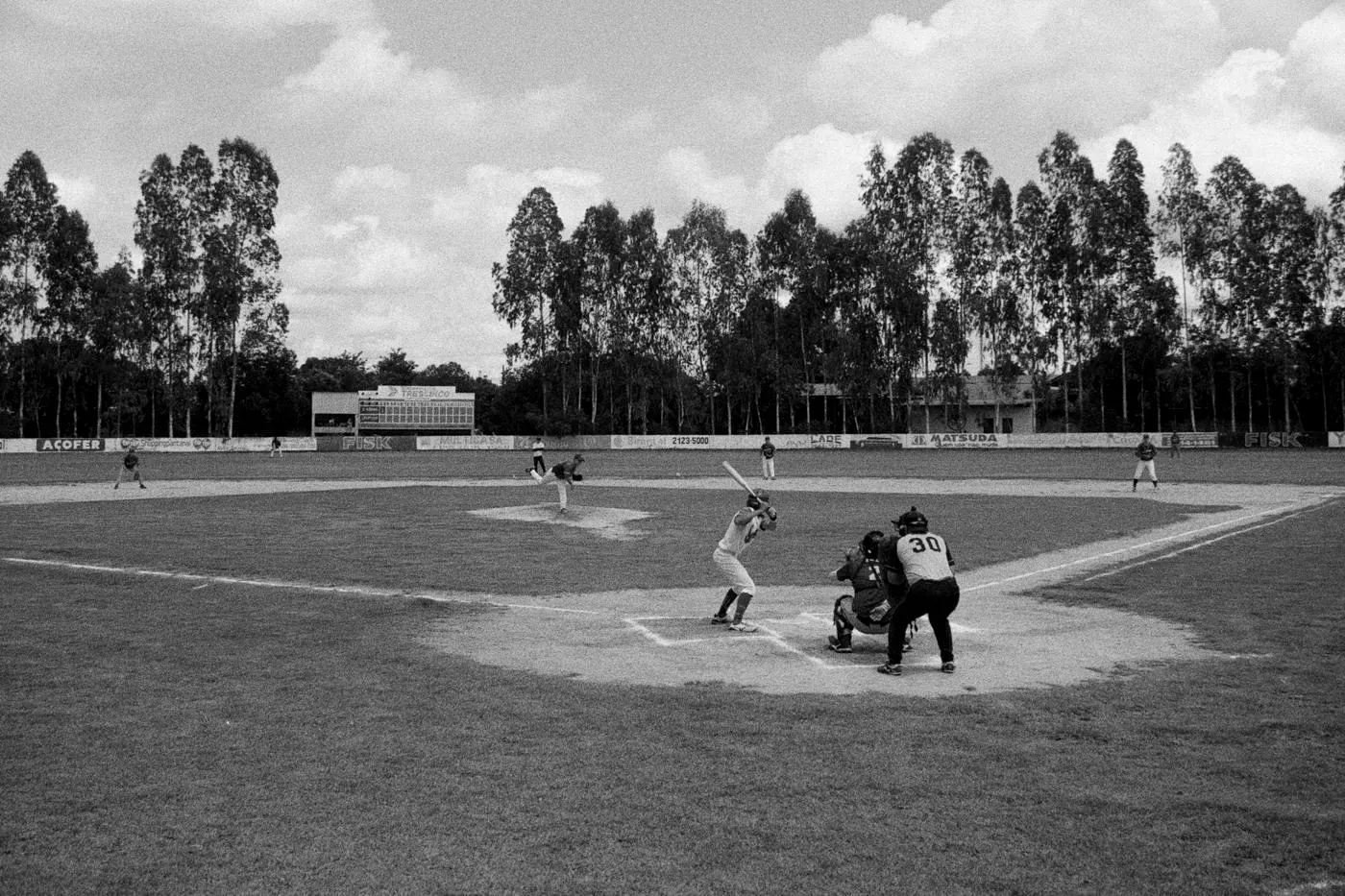
Associação Nipo, Várzea Grande, Brazil, Nikon F401s, 2018Photo: paulisson miura from Cuiabá, Brasil, CC BY 2.0 
Cuiabá, Brazil, Nikon F401s, 2018Photo: paulisson miura from Cuiabá, Brasil, CC BY 2.0
What owners and reviewers say, topic by topic
We sorted 135 opinions about the Kentmere 400 from 31 pages and videos on 23 websites and channels. Each row shows how many people raised a topic and how many of them were positive. Open a row to read short quotes, each linked to its source.
Most of these 135 opinions come from photographers' blogs, editorial reviews and five YouTube reviews. Owner voices come from blog comments, The Darkroom customer reviews, a Flickr group and Talk Photography; Reddit, Photrio and big-retailer reviews could not be read. Color here means tonality, since this is black-and-white film, and halation has only three comments.
Grain55% positiveof 22
The most divided topic. Twelve voices call the grain fine for ISO 400, classic or controlled even when pushed, while six found it coarse or huge, two of them after D-76; dilute or stand development in HC-110 or Rodinal gets the kindest reports.
“The grain is huge with this film, far bigger than even HP5+.”
Flickr, Kentmere Film and Paper group: Kentmere 400 = Grain factoryOwner
“When comparing HP5 400 at 1600 to Pushing Kentmere, the grain looks pretty equal.”
Aly's Vintage Camera Alley, Pushing Kentmere Pan 400 to 1600 2021-01Owner
“it still gave us an even, fine grain for a 400 ISO film”
Parallax Photographic Coop, Kentmere Pan 400 Film ReviewHands-on review
“This film is noticeably higher grain and a bit lower quality than its Ilford counterparts, but I personally really enjoy the look it creates.”
Kyle Wright, The Darkroom customer review, Kentmere Pan 400 2022-06Owner
Overall look57% positiveof 21
Positive or mixed, never negative: people like the classic, Tri-X-like look, and the mixed comments are almost all about low contrast that can look flat or muddy.
“I like it in 35mm so will be trying it in 120.”
Talk Photography forum, Kentmere 100 and 400 2022-12Owner
“I think it also looks a lot like Kodak Tri-X as you can see below in the comparison.”
Aly's Vintage Camera Alley, Pushing Kentmere Pan 400 to 1600 2021-01Owner
“The first Kentmere 400 film looked sharp, but contrast looked as if it was low.”
Flickr, Kentmere Film and Paper group: Kentmere 400 = Grain factoryOwner
“Jim, I've tried Kentmere 400 twice so far, and I did not like it. However, both outings were on dark, dreary days”
Down the Road, First roll impressions: Kentmere 400 2022-08Owner
Exposure latitude76% positiveof 17
Strongly positive: reviewers praise shadow and highlight detail and clean overexposure. The two negative voices find HP5 Plus more forgiving and say Kentmere wants accurate exposure and development.
“The bottom line? Kentmere films demand accurate exposure and development.”
Dan Castelli, 35mmc, 5 Frames with Kentmere 400 2019-08Owner
“This is a nice film with gobs of useful latitude.”
Photo-analogue, Kentmere Pan 400 2019-11
“Plenty of detail in the shadows. And, it handled the highlights well.”
Parallax Photographic Coop, Kentmere Pan 400 Film ReviewHands-on review
“you can afford to miss the 'perfect' exposure while still getting a great shot!”
Price and availability100% positiveof 16
Every one of the 16 comments is positive about price. The prices quoted in reviews ($3.49 in 2017, $5.19 in 2021) are older and lower than October 2026 prices.
“A roll of Kentmere 400 is only $5.19 while Delta 400 is $7.99.”
Aly's Vintage Camera Alley, Pushing Kentmere Pan 400 to 1600 2021-01Owner
“Kentmere 400 is the cheapest B&W film I can buy over the counter in my town”
David, 35mmc, 5 Frames with Kentmere 400 2019-08Owner
“Kentmere 400 is a go-to stock for me, partially because of the price, partially because of the results.”
My Camera Cabinet, Kentmere Pan 400 2021-12Owner
“Love this film. Good price.”
Tamara Bot, The Darkroom customer review, Kentmere Pan 400 2021-04Owner
Pushing and pulling80% positiveof 15
One of its best-liked traits: owners push it to 800 and 1600 in HC-110, DD-X, Microphen and LC29, and Aly found the results very similar to pushed HP5. The one negative voice is about 3200; the two mixed ones say a push would have helped flat winter light and that push latitude is narrower than on Ilford's pricier films.
“the look is very similar to pushing HP5.”
Aly's Vintage Camera Alley, Pushing Kentmere Pan 400 to 1600 2021-01Owner
“Kentmere 400 exposed at EI 1600 is magic to me as well.”
35mmc, 5 Frames with a Holga 120GN and Kentmere 400 in North Jutland 2026-07Owner
“I actually did take Kentmere 400 up to 1600 earlier this month, developed it in Microphen, and it looks amazing!”
Alex Luyckx, Film Review Blog No. 32: Kentmere 400 (Refreshed) 2026Owner
“with overcast winter weather, a one-stop push might have improved the contrast of the negatives”
Nicholas Middleton, Photo-analogue, Kentmere Pan 400 part 2 2023-01Hands-on review
Sharpness and detail50% positiveof 14
Mostly positive but mixed: The Darkroom puts its sharpness close to HP5 Plus and a Flickr member finds it sharper than Tri-X, while Mr. Leica found Kodak T-Max 400 clearly sharper, Jim Grey found a T-Max roll a bit sharper and Gregory Couch saw some soft frames.
“The image doesn't feel sharp, although I know my focusing was spot on.”
Gregory Couch, Kentmere 400 | Budget B&W Film 2017-09Hands-on review
“I get sharper negatives then I get from Tri-x.”
Flickr, Kentmere Film and Paper group: Kentmere 400 = Grain factoryOwner
“Kentmere 400 yields medium contrast but sharp images when developed with ddx @ 1600”
Tenmuter, The Darkroom customer review, Kentmere Pan 400 2021-11Owner
“While it may not be as sharp as Ilford HP5 in 120 strength”
Eric L. Woods, Analog Therapy/Film Test: Kentmere Pan 400 120 2022-12Hands-on review
Scanning and printing67% positiveof 9
Negatives dry flat and scan easily, and the low contrast leaves room to edit. The warnings: scanner sharpening makes grain look chunky, and large enlargements show heavy grain.
“The film dried fairly flat and scanned easily.”
Jim Grey, Down the Road, First roll impressions: Kentmere 400 2022-08Hands-on review
“I do find the flatness of K400 to be a boon when scanning.”
35mmc, One Third Keepers with a Minolta Dynax 7 and Kentmere Pan 400 2025-08Hands-on review
“The contrast is good, with room to increase it in printing or on screen.”
Parallax Photographic Coop, Kentmere Pan 400 120 Film ReviewHands-on review
“I think it's too aggressive for Kentmere and leaves the grain looking chunky”
Gregory Couch, Review | Kentmere 400 vs. Tri-X vs. HP5 Plus 2021-10Hands-on review
Low light and night67% positiveof 6
ISO 400 is enough for handheld indoor work, and a pushed roll can handle a dark train ride, but reviewers say it may fall short at night and loses shadow detail when rated at 3200.
“in dark areas it records details”
“this film is ideal for lower light”
The Darkroom, The Best Budget 120 Film: New Kentmere Pan 100 & 400 2022Hands-on review
“ISO 400 buys you enough speed to work handheld in reasonable indoor light”
“It might not be enough for night shooting”
My Favourite Lens, Kentmere Pan 400 35mm Film ReviewHands-on review
Consistency83% positiveof 6
Five voices call it reliable or consistent: Simon King finds it accurately rated at 400, Gregory Couch found his rolls predictably similar, and a Down the Road commenter finds it more predictable than Fomapan 400. One Darkroom customer reports scratches on the film.
“there may be scratches on the film already or it scratches extremely easily”
Tenmuter, The Darkroom customer review, Kentmere Pan 400 2021-11Owner
“unlike Fomapan, the other budget stock, it produces more predictable results”
Down the Road, First roll impressions: Kentmere 400 2022-08Owner
“The few rolls of Kentmere I've shot have been predictably similar in performance”
Gregory Couch, Kentmere 400 | Budget B&W Film 2017-09Hands-on review
“It is a reliable film at a low cost and makes a great starting point for beginners.”
Parallax Photographic Coop, Kentmere Pan 400 Film ReviewHands-on review
Color25% positiveof 4
Only four comments, about tonality since this is black-and-white film: two say mid-tones can look flat or murky, one says pushing to 3200 loses tonal range, and Alex Luyckx says a yellow filter brings the tones to life.
“When this film is pushed, it seems to lose its tonal range.”
Aly's Vintage Camera Alley, Pushing Kentmere Pan 400 to 3200 2021-03Owner
“keep a yellow filter on hand at all times and you'll see this film come to life”
Alex Luyckx, Film Review Blog No. 32: Kentmere 400 (Refreshed) 2026Hands-on review
“some of the mid-tones can be a little murky”
“In pretty much every other situation, the results were much flatter.”
My Favourite Lens, Kentmere Pan 400 35mm Film ReviewHands-on review
Halation and glow0% positiveof 3
Only three comments, all mixed: 35mmc saw a little halation around very concentrated light, and two YouTube reviewers saw blooming around bright highlights.
“The Kentmere also shows a little halation, but only when the light is very concentrated”
Simon King, 35mmc, Fomapan 400 & Kentmere 400 Review - Battle of the Budgets 2020-03Hands-on review
PositiveMixedNegative
How to shoot Kentmere 400
Kentmere 400 loads and meters like any other black-and-white film. Most of the craft is in exposure and contrast.
- 1
Set ISO 400, or 200 for less grain
The 35mm cassettes are DX coded and Harman's data sheet says they suit all 35mm cameras, so load it and set ISO 400 like any other 400-speed roll. Simon King at 35mmc finds it accurately rated at 400. Alex Luyckx liked it best at EI 200 in dilute HC-110, which gave a serious reduction in visible grain without losing sharpness.
- 2
Meter for the shadows
The Darkroom recommends erring toward overexposure by metering for the shadows. Blurry Frames says overexposure is handled cleanly and underexposure is where the film shows its limits.
- 3
Add a yellow filter in flat light
On overcast days the film can look soft or low-energy, according to Blurry Frames, and Alex Luyckx says to keep a yellow filter on hand. Harman's data sheet warns that some auto-exposure cameras underexpose by as much as 1.5 stops with deep red and orange filters, so check those frames.
- 4
Push to 800 or 1600 when the light drops
Blurry Frames says many photographers shoot it at ISO 800 and develop to match, and owners regularly push it to 1600. Rate the whole roll at the same speed and tell your lab, or adjust your own development.
- 5
Add time for exposures longer than 1 second
Harman's data sheet says nothing needs correcting between 1 second and 1/10,000 second. Past 1 second it gives adjusted time = metered time to the power 1.30, so a metered 10 seconds becomes about 20 seconds (10 to the power 1.30 is 19.95).
- 6
Develop it as black-and-white film
It is not a C-41 film, so send it to a lab that handles black and white or develop it at home. Harman says to handle it in total darkness.
Sources: dodofilmlab.co.uk, 35mmc.com, alexluyckx.com, thedarkroom.com, blurryframes.com, legacy-photolab.com
How long to develop Kentmere 400
At box speed, Harman's data sheet (July 2022) gives 9:30 in Ilford ID-11 stock or Kodak D-76 stock and 11:30 in Ilfotec DD-X 1+4, at 20C/68F in a spiral tank with intermittent agitation. The table lists the times for EI 400 and for a one-stop push to EI 800.
For agitation, Harman says to invert the tank four times in the first 10 seconds, then four times in the first 10 seconds of each further minute. With continuous agitation, as in a tray, cut the times by up to 15%. Harman advises against a pre-rinse because it can cause uneven processing.
Owners often go a little longer. Jim Grey's friends get their best results developing a bit past the Massive Dev Chart time, and he gave about an extra minute in HC-110 dilution B. The developer also changes the grain: an Analogue Wonderland customer found it extremely grainy in D-76, while a Flickr group member who stand develops in Rodinal or HC-110 has never had a grain problem.
For other temperatures, the data sheet's example is a 4-minute time at 20C/68F becoming 3 minutes at 23C/73F and 6 minutes at 16C/61F.
| Developer | Dilution | EI 400 | EI 800 |
|---|---|---|---|
| Ilford ID-11 | stock | 9:30 | 13:00 |
| Ilford ID-11 | 1+1 | 16:30 | 20:30 |
| Kodak D-76 | stock | 9:30 | 12:30 |
| Kodak D-76 | 1+1 | 14:00 | 17:00 |
| Ilfotec DD-X | 1+4 | 11:30 | 13:00 |
| Ilfotec HC | 1+31 | 8:00 | 12:30 |
| Ilfotec LC29 | 1+19 | 8:00 | 12:30 |
| Microphen | stock | 8:00 | 10:00 |
| Ilfosol 3 | 1+9 | 6:30 | 15:00 |
Harman calls these times a guide and says to adjust them until you get the contrast you want.
Sources: dodofilmlab.co.uk, blog.jimgrey.net, analoguewonderland.co.uk, flickr.com
Pushing and pulling Kentmere 400
Kentmere 400 pushes well to EI 800 and 1600, and The Darkroom says it can go as far as +3 stops. Harman's data sheet only prints push times for EI 800, so for 1600 and 3200 owners work out their own; the general method is in how to push and pull film.
At 1600, Aly's Vintage Camera Alley found the grain about equal to HP5 Plus pushed the same amount, and a Darkroom customer who pushed several rolls to 1600 in DD-X was blown away by the results. At 3200 opinions split: Aly says it holds up worse than HP5 and Nicholas Middleton saw shadow detail clearly lost, while grainydays found the grain cleaner than native high-speed films like Ilford Delta 3200.
Pulling works too. The data sheet's one slower time is EI 320 in Perceptol 1+1, and Bob Janes at 35mmc shot it at ISO 200 in stock Perceptol with results he found comparable to Kentmere Pan 200.
| Rating | Developer | Time and temperature | Source |
|---|---|---|---|
| EI 200 | Kodak HC-110 dilution F (1+79) | 9:45 at 20C, constant rotation | Alex Luyckx |
| EI 320 | Ilford Perceptol 1+1 | 23:00 at 20C/68F | Harman data sheet |
| EI 800 | Ilford ID-11 stock | 13:00 at 20C/68F | Harman data sheet |
| EI 1600 | Kodak HC-110 dilution B | 11:03 at 21C (she called the temperature adjustment a mistake) | Aly's Vintage Camera Alley |
| EI 1600 | Ilfotec LC29 1+19 | 18:00 at 20C | Nicholas Middleton, Photo-analogue |
Pushing raises contrast as well as speed: grainydays found a two-stop push cut the flat look, and Middleton thinks a one-stop push would have helped his gray winter negatives.
Sources: thedarkroom.com, dodofilmlab.co.uk, alysvintagecameraalley.com, alysvintagecameraalley.com, thedarkroom.com, photo-analogue.blogspot.com, photo-analogue.blogspot.com, alexluyckx.com, 35mmc.com, youtube.com
Kentmere 400 vs Ilford HP5 Plus
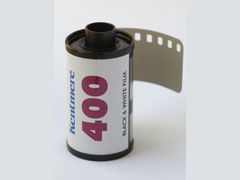 Kentmere 400 | 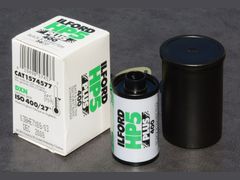 Ilford HP5 Plus | |
|---|---|---|
| Maker | Harman Technology, Mobberley, England | Harman Technology, same factory and production line |
| Price | $8.39 to $10.99 for 36 exp (October 2026) | Not price-checked here; The Darkroom put it $1 to $2 a roll above Kentmere in 2022 |
| Look | Classic grain and lower contrast; Nick Carver found his 120 results very similar to HP5 | Similar all-round look |
| Grain | Visible; Blurry Frames says not as tight as HP5 Plus | Tighter, per Blurry Frames |
| Sharpness | Comparable to HP5 Plus, says The Darkroom | Eric L. Woods thinks HP5 may be sharper in 120 |
| Exposure latitude | Wide, but John Grzinich and Nick Carver find it less forgiving | More forgiving |
| Pushed to 1600 | Grain about equal to HP5 (Aly's Vintage Camera Alley) | About equal |
| Pushed to 3200 | Holds up worse, with more contrast and grain (Aly) | Holds up better |
Pick the Kentmere 400 if
- You want the cheapest good ISO 400 black-and-white film for everyday shooting, test rolls or learning to develop
- You shoot at box speed or push to 800 or 1600
- You scan and like flatter negatives with room to add contrast
Pick the Ilford HP5 Plus if
- You want more room for exposure mistakes
- You push to 3200 often
- You want tighter grain and will pay a little more per roll; see our Ilford HP5 Plus guide and HP5 vs Tri-X
Sources: blurryframes.com, thedarkroom.com, 35mmc.com, alysvintagecameraalley.com, alysvintagecameraalley.com, ewoodsphoto.com, youtube.com, dodofilmlab.co.uk, en.wikipedia.org
Kentmere 400 in 35mm, 120 and bulk rolls
Kentmere 400 comes in 24- and 36-exposure 35mm cassettes, 30.5 m (100 ft) bulk rolls and 120 roll film, according to Harman's data sheet; no sheet film is listed. The 120 version arrived in 2022, and The Darkroom announced it on December 1, 2022.
Product copy at the Film Photography Project Store describes the formats a little differently: the 35mm text promises fine grain and good contrast, the 120 text classic-looking grain and medium contrast. Reviewers like the bigger negative. Parallax Photographic Coop saw even grays with a smoother look than 35mm, and Eric L. Woods calls the 120 film mellow, smooth and relatively free of grain.
A single 120 roll cost $6.99 to $7.99 at US shops in October 2026, and a 100 ft bulk roll $87.99 at the Film Photography Project Store. For what the larger negative changes in practice, see 35mm vs 120 film.
Sources: dodofilmlab.co.uk, thedarkroom.com, filmphotographystore.com, filmphotographystore.com, parallaxphotographic.coop, ewoodsphoto.com, filmphotographystore.com
Scanning and storing Kentmere 400
Kentmere 400 negatives are easy to scan. Jim Grey found they dried fairly flat and scanned easily, though he still boosted contrast in Photoshop, and Bob Janes at 35mmc calls the flatness of K400 a boon when scanning.
Watch the scanner's sharpening. Gregory Couch says the Unsharp Mask on flatbeds like the Epson V600 or V800 is too aggressive for Kentmere and leaves the grain looking chunky, so he leaves sharpening to Photoshop. Digital ICE dust removal does not work on silver black-and-white film, so clean up dust by hand. The full process is in how to scan film at home.
Harman says to store unexposed film in a cool, dry place, 10-20C (50-68F), in its original packaging; a fridge or freezer is fine if you let the film warm up before use. Keep processed negatives cool, dry and dark in triacetate, Mylar, paper or polyester sleeves.
Sources: blog.jimgrey.net, 35mmc.com, gregorycouch.com, en.wikipedia.org, dodofilmlab.co.uk
What a roll of Kentmere 400 costs
On October 28, 2026, a 36-exposure 35mm roll of Kentmere 400 cost $8.39 to $10.99 at US camera shops and labs, a 24-exposure roll $6.99, and 120 ran $6.99 to $7.99 a roll. B&H, Adorama, Freestyle, KEH and Walmart could not be checked, so they are not listed.
Film Developing Co
new, 35mm, 36 exposures
$8.39
See listingVictory Camera
new, 35mm, 36 exposures
$8.95
See listingLegacy Photo Lab
new, 35mm, 36 exposures
$10.99
See listingFilm Photography Project Store
new, 35mm, 24 exposures
$6.99
See listingFilm Photography Project Store
new, 120, single roll
$6.99
See listingFilm Developing Co
new (sold out Oct 28), 120, single roll
$7.29
See listingVictory Camera
new, 120, single roll
$7.95
See listingLegacy Photo Lab
new, 120, single roll
$7.99
See listingFilm Photography Project Store
new, 35mm bulk, 100 ft
$87.99
See listingUnique Photo
new, 35mm bulk, 100 ft ($89.95 each for 2 or more)
$99.00
See listing
Prices checked on October 28, 2026. They move every week, so treat them as a range, not a quote. Per frame, the $6.99 24-exposure roll works out to about $0.29 a shot ($6.99 / 24) and the $8.39 36-exposure roll to about $0.23 ($8.39 / 36). Prices quoted in older reviews ($3.49 a roll at B&H in 2017, $5.19 in 2021) are out of date. Film Developing Co showed its 120 roll as sold out on October 28, 2026.
Technical data
Film
- Speed
- ISO 400/27°
- Latitude (one reviewer's figure)
- EI 200 to 800, per Alex Luyckx
Formats
- 35mm bulk
- 30.5 m (100 ft)
- Sheet film
- None listed by Harman
Exposure and processing (Harman data sheet)
- Development at box speed
- 9:30 in ID-11 or D-76 stock, 20C/68F
- Safelight
- None: handle in total darkness
History
- Kentmere bought by Harman
- 2007
- Kentmere 100 and 400 launched
- 2009, as a lower-priced brand for the US market
- Renamed Kentmere Pan 400
- Late 2018; Kentmere packaging was refreshed in September 2018
Video reviews worth your time
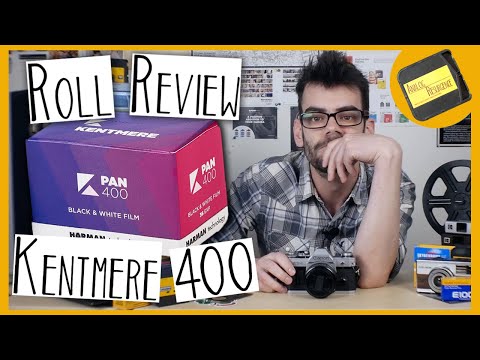
Kentmere 400 - CHEAP CHEAP CHEAP Black & White | ROLL REVIEW & OPENING MAIL
Kentmere 400 is an affordable, entry-level black-and-white film that delivers decent classic results, making it ideal for beginners despite its flatter contrast and coarser grain.

Pushing Kentmere 400 +3 Stops
Kentmere 400 pushed three stops to ISO 3200 yields surprisingly clean, high-contrast, and viable black-and-white images at a lower cost than native high-speed films.

Kentmere Pan 400 ISO Black and White Film Review | All About Film
The reviewer highly praises Kentmere 400 as an exceptionally versatile and affordable 35mm black-and-white film that performs remarkably well across various developers and exposure speeds.

Photography On Location: The Pallet Yard + Kentmere 400 Film
The Kentmere 400 120 film is a great budget-friendly black-and-white option that delivers solid image quality comparable to higher-end film stocks like HP5.

How Good is Kentmere 400? | Review
Kentmere Pan 400 is a reliable and budget-friendly black and white film that delivers solid versatility, though its contrast and tonal range are relatively flat.
Questions people ask about the Kentmere 400
Is Kentmere 400 good?
Yes, for the price. Reviewers and owners mostly call it a solid all-round ISO 400 black-and-white film with wide latitude, a classic grainy look and easy pushes to 1600. Jim Grey's verdict after one roll was "Perfectly Fine," and Gregory Couch doubts any B&W film in its price range performs as well. The usual complaints are flat contrast in dull light and visible grain in 35mm.
Sources: blog.jimgrey.net, gregorycouch.com, 35mmc.com
How long does it take to develop Kentmere 400?
At box speed, Harman's data sheet gives 9:30 in Ilford ID-11 stock or Kodak D-76 stock, 11:30 in Ilfotec DD-X 1+4 and 8:00 in Ilfotec HC 1+31, all at 20C/68F with intermittent agitation. For a one-stop push to EI 800 it gives 13:00 in ID-11 stock. Several owners develop a little longer than the Massive Dev Chart suggests; Jim Grey added about a minute in HC-110 dilution B.
Sources: dodofilmlab.co.uk, blog.jimgrey.net
Is Kentmere 400 the same film as Ilford HP5 Plus or Ilford Pan 400?
Not according to Harman for HP5 Plus. Both come from Harman Technology, made on the same line in the same factory according to Blurry Frames, but Harman's Simon Galley said Kentmere is "not a 'rebadged' Ilford film," while The Darkroom calls Kentmere essentially Ilford film in every way other than name. In use they look alike, though owners find HP5 Plus more forgiving and better at 3200. Ilford PAN 400 is a separate consumer-grade film sold in selected markets, and Matt Osborne of Mr. Leica found it different from Kentmere in his own comparison.
Sources: myfavouritelens.com, blurryframes.com, thedarkroom.com, alysvintagecameraalley.com, en.wikipedia.org, mrleica.com
What are the differences between Kentmere Pan 200 and 400? Is Pan 200 good?
Pan 200 is the slower, newer sibling, and Victory Camera charged the same for both in October 2026: $8.95 for 36 exposures of 35mm and $7.95 for 120. Owner comparisons are scarce. Bob Janes at 35mmc shot Pan 400 at ISO 200 in Perceptol and found the results comparable to Pan 200 in the same developer; he quite likes Pan 200 but finds Pan 400's flatter negatives easier to scan.
Sources: victorycamera.com, 35mmc.com
Which Kentmere film is considered the best?
There is no consensus. Gregory Couch says Kentmere is the best choice if you need a budget film and also highly recommends Kentmere 100, while Matt Osborne of Mr. Leica calls Kentmere 100 fine to use. Choose by speed: Pan 400 for dim light and pushing, Pan 100 or Pan 200 when there is plenty of light.
Sources: gregorycouch.com, mrleica.com
Is Kentmere 400 good for beginners?
Yes. The Darkroom calls it an ideal film for beginners because it is affordable and has broad exposure latitude, and Parallax Photographic Coop calls it a great starting point. Alex Luyckx recommends it as a cheap film for learning both shooting and home developing. At $6.99 for 24 exposures, about $0.29 a frame ($6.99 / 24), mistakes stay cheap.
Sources: thedarkroom.com, parallaxphotographic.coop, alexluyckx.com, filmphotographystore.com
Is Kentmere 400 hard to find?
Not in October 2026. The Film Photography Project Store, Victory Camera, Film Developing Co and Legacy Photo Lab all sold it new, and Legacy Photo Lab listed 18 rolls of 35mm and 28 rolls of 120 in stock on October 28, 2026. Single formats do sell out: Film Developing Co showed its 120 roll as sold out that day. No discontinuation notice was found.
Sources: legacy-photolab.com, legacy-photolab.com, filmdeveloping.co, filmphotographystore.com, victorycamera.com
Why is my film camera not winding up?
None of the Kentmere 400 reviews gathered here blame the film for a stuck lever, so check the camera first. If you have shot the whole roll and the lever will not move, do not force it; rewind instead. On an electronic body, a weak or dead battery can stop the shutter from firing, and a Talk Photography reply named the batteries as the most likely problem for a Minolta X-300s whose lever would not wind. Our guide to [loading film in any camera](/cameras/how-to-load-film/) has a troubleshooting table.
Sources: oldcamsbyjens.com, talkphotography.co.uk
What people compare it with
Same maker and a similar look, with more exposure latitude and better results at 3200; The Darkroom put it $1 to $2 a roll above Kentmere in 2022.
The reference reviewers use: Simon King calls Kentmere 400 Tri-X with less dynamic range, and Aly found pushed Kentmere looks a lot like Tri-X.
Fomapan 400
The other budget ISO 400 film. 35mmc found Fomapan hits pure white far more often, and a Down the Road commenter finds Kentmere more predictable.
Kodak T-Max 400
Finer grain and more sharpness: Mr. Leica calls T-Max the clear winner on sharpness and resolution, while Kentmere has the more classic look at about half the price in his market.
Every source behind this page
Read them yourself. How we pick and count them is in our methodology.
Show all 47 sources
Independent blogs 17
- 35mmc, Fomapan 400 & Kentmere 400 Review - Battle of the Budgets: Fomapan 400 & Kentmere 400 Review
- 35mmc, 5 Frames with Kentmere 400: 5 Frames with Kentmere 400 - by Simon King
- 35mmc, One Third Keepers with a Minolta Dynax 7 and Kentmere Pan 400: 'One Third Keepers' with a Minolta Dynax 7 and Kentmere Pan 400 exposed at ISO 200
- 35mmc, 5 Frames with a Holga 120GN and Kentmere 400 in North Jutland: 5 Frames with a Holga 120GN and Kentmere 400 in North Jutland
- My Camera Cabinet, Kentmere Pan 400: Kentmere Pan 400
- Alex Luyckx, Film Review Blog No. 32: Kentmere 400: Film Review Blog No. 32
- Aly's Vintage Camera Alley, Pushing Kentmere Pan 400 to 1600: Developing Adventures
- Aly's Vintage Camera Alley, Pushing Kentmere Pan 400 to 3200: Developing Adventures - Pushing Kentmere Pan 400 to 3200
- Mr. Leica, Kentmere 400 Review + Photos: Kentmere 400 Review + Photos (Best Budget Ilford Film?
- Down the Road, First roll impressions: Kentmere 400: First roll impressions: Kentmere 400
- Eric L. Woods, Analog Therapy/Film Test: Kentmere Pan 400 120: Analog Therapy/Film Test
- My Favourite Lens, Kentmere Pan 400 35mm Film Review: Kentmere Pan 400 35mm Film Review
- Gregory Couch, Kentmere 400 | Budget B&W Film: Kentmere 400 | Budget B&W Film
- Gregory Couch, Review | Kentmere 400 vs. Tri-X vs. HP5 Plus: Review | Kentmere 400 vs. Tri-X vs. HP5 Plus
- Photo-analogue, Kentmere Pan 400: Photo-Analogue
- Photo-analogue, Kentmere Pan 400 part 2: Kentmere Pan 400
- Island in the Net, Palmer Square: Kentmere Pan 400 at Palmer Square
Manuals and references 16
- dodofilmlab.co.uk: KENTMERE PAN400.pdf
- en.wikipedia.org: Digital ICE
- en.wikipedia.org: Ilford Photo
- filmdeveloping.co: Kentmere Pan 400 B&W Film (35mm Roll)
- filmdeveloping.co: Kentmere Pan 400 B&W Film (120 Roll)
- filmphotographystore.com: 120 BW Film Kentmere 400 (Single Roll)
- filmphotographystore.com: 35mm BW Bulk Roll (100 ft) - Kentmere 400
- filmphotographystore.com: 35mm BW Film Kentmere Pan 400 (1 Roll)
- legacy-photolab.com: Kentmere 400 ISO 400 120 B&W Film - Medium Format
- legacy-photolab.com: Kentmere 400 35mm B&W Film - 36 Exposures
- oldcamsbyjens.com: How to Load and Shoot Your First Roll of 35mm Film
- talkphotography.co.uk: please help a novice
- uniquephoto.com: Kentmere Pan 400 Black and White Negative Film (35mm Roll Film, 100ft Roll)
- victorycamera.com: Kentmere PAN 400 Black & White Negative Film (120)
- victorycamera.com: Kentmere PAN 400 Black & White Negative Film (35mm, 36 Exposures)
- victorycamera.com: Search
Editorial reviews 6
- PHOTONews Canada, Kentmere 100 and 400 120 Film Review: Kentmere 100 and 400 120 Film Review
- Parallax Photographic Coop, Kentmere Pan 400 Film Review: Kentmere Pan 400 Film Review
- Parallax Photographic Coop, Kentmere Pan 400 120 Film Review: Kentmere Pan 400 120 Film Review
- Blurry Frames, Kentmere PAN 400 Review: Kentmere PAN 400 Review
- The Darkroom, The Best Budget 120 Film: New Kentmere Pan 100 & 400: The Best Budget 120 Film
- Analogue Wonderland, Kentmere 400 Review: Kentmere 400 Review | Film Review
Video reviews 5
- Analog Resurgence: Kentmere 400 - CHEAP CHEAP CHEAP Black & White | ROLL REVIEW & OPENING MAIL
- grainydays: Pushing Kentmere 400 +3 Stops
- David Hancock: Kentmere Pan 400 ISO Black and White Film Review | All About Film
- Nick Carver: Photography On Location: The Pallet Yard + Kentmere 400 Film
- Aperture Dundee: How Good is Kentmere 400? | Review
Forums 2
Retailer customer reviews 1
Keep reading
Film stocks
Ilford HP5 Plus is an ISO 400 black-and-white film known for latitude and easy pushing. What 112 opinions say, how to shoot it, and US prices from $9.99.
Film stocks
Kodak Tri-X 400 is an ISO 400 black-and-white film with classic grain and wide latitude, $8.99 to $10.41 a roll. What 116 opinions say about grain and pushing.
Film stocks
Ilford HP5 Plus is the best black and white film for most people. Compare Tri-X, Kentmere 400, Ektapan (T-Max), XP2 Super and Delta 3200, with US prices.
Film stocks
How to push film: what a stop means, what to set on your camera, how to tell the lab, one-stop fees from $0 to $4, home development times and how to pull film.
Developing and scanning
How to develop film at home: the gear and chemistry you need with October 2026 prices, black and white and C-41 steps with times, and fixes for bad negatives.
Film stocks
35mm vs 120 film: common 120 frames are 2.7 to 5.4 times bigger than 35mm but give 8 to 16 shots a roll. Cost per frame, lab prices and which to pick.