Sony RX100 VII: is the 24-200mm pocket camera still worth it?
The short answer
The Sony RX100 VII (DSC-RX100M7) is Sony's 2019 pocket camera with a 1-inch, 20.1 MP stacked sensor, a 24-200mm f/2.8-4.5 Zeiss zoom, a pop-up viewfinder and 4K video, and reviewers call it one of the best compacts you can still buy, mostly for its tracking autofocus and its reach.
The trade-offs are price and stamina: Sony rates the battery at about 260 shots, B&H and Adorama listed it at $1,498.00 new on November 2, 2026, and used and open-box copies with a warranty ran $1,087 to $1,440.
- Sensor
- 1-inch, 20.1 MP stacked CMOS
- Lens
- 24-200mm, f/2.8-4.5
- Battery
- About 260 shots (CIPA)
- New price
- $1,498 (Oct 2026)
Built from 147 opinions from 29 pages and videos. Not yet tested by Camera Dojo. Updated .
The short version
The praise is consistent across launch reviews, long-term write-ups and owner reviews: real-time tracking and Eye AF that stay locked on moving subjects, 20 fps bursts with no blackout, a viewfinder that saves you in bright sun, sharp 4K video and the first microphone jack in the RX100 line. The lens and body carry over from the 2018 RX100 VI, which the RX100 series guide covers, so the VII's case rests on autofocus, video and that mic input.
The complaints repeat just as often. Every battery opinion in the research is negative, the smooth body and small flush buttons are easy to fumble, the touchscreen cannot run the menus, there is no ND filter or hot shoe, 4K stops after about 5 minutes on the default heat setting, and noise shows from about ISO 800 to 1600. Then there is the price: Sony raised it in the US from $1,299 to $1,699 in July 2025, according to No Film School.
Good fit if
- You want 24-200mm of zoom in a camera that fits a jacket pocket
- You shoot kids, pets or street scenes and want autofocus that tracks moving subjects
- You often shoot in bright sun and want an eye-level viewfinder
- You film short clips or vlogs and will add a mic on a bracket or Sony's grip
- You want one small camera instead of a mirrorless body and lenses on trips
Think twice if
- You shoot mostly at night or indoors: reviewers see noise from about ISO 800 to 1600, and the lens is f/4.5 at 200mm
- You want the Y2K CCD digicam look: this is a CMOS camera, so see the vintage Cyber-shot guide instead
- You record long 4K takes handheld: the heat limit and Sony's tripod warning get in the way
- You have large hands or want a deep grip and lots of dials
- You need weather sealing for rain, spray or sand
Sony RX100 series: which model to look for
Every RX100 since 2012 has a 1-inch, 20 MP sensor and a control ring around the lens, so the differences are the lens, the viewfinder, video and price. Used ranges are MPB asking prices on November 2, 2026. The Sony RX100 series guide covers the whole line.
| Model | Year | Sensor | Why look for it |
|---|---|---|---|
| RX100 | 2012 | 1-inch Exmor CMOS, 20.2 MP | The original: a 28-100mm f/1.8-4.9 Zeiss zoom and no viewfinder. |
| RX100 II | 2013 | 1-inch back-illuminated Exmor R, 20.2 MP | Adds a tilting screen, a multi-interface shoe, Wi-Fi and NFC. MPB: $394 to $704. |
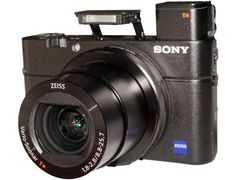 RX100 III | 2014 | 1-inch, 20 MP | First with a pop-up OLED viewfinder and a brighter 24-70mm f/1.8-2.8 lens, but the hot shoe is gone. MPB: $299 to $879. See the RX100 III page. |
| RX100 IV | 2015 | 1-inch, 20.2 MP | First RX100 with 4K XAVC S video at 24, 25 and 30 fps. MPB: $294 to $999. |
| RX100 V and VA | 2016 (V) | 1-inch, 20 MP | The V was announced October 6, 2016; the VA update came out after the VI. The VA has a built-in ND filter and focuses as close as 5 cm. MPB: V $359 to $1,179, VA $639 to $1,209. |
| RX100 VI | 2018 | 1-inch, 20 MP | Announced June 5, 2018, it brought the 24-200mm f/2.8-4.5 zoom the VII keeps, with a 30-minute video cap and no mic jack. MPB: $439 to $1,129. |
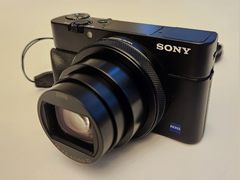 RX100 VII | 2019 | 1-inch stacked Exmor RS CMOS, 20.1 MP | This camera, announced July 25, 2019: same lens and body as the VI, plus a 3.5 mm mic jack, no 30-minute video cap and Sony's newer autofocus. MPB: $479 to $1,279, with working units from $1,129. |
Sources: en.wikipedia.org, mpb.com, sonyalphalab.com, cameralabs.com, alphauniverse.com
What owners and reviewers say, topic by topic
We sorted 147 opinions about the RX100 VII from 29 pages and videos on 26 websites and channels. Each row shows how many people raised a topic and how many of them were positive. Open a row to read short quotes, each linked to its source.
Owner voices are thinner than reviewer voices here. Owners come mainly from CDW and eBay buyer reviews, English reviews on a Finnish retailer, one long-term blog post and a few forum posters. Reddit, DPReview forums and the B&H, Adorama and Best Buy customer reviews could not be read, so the page leans on editorial and video reviews.
Ease of use48% positiveof 25
An even split: tracking autofocus draws nearly all the praise, while the slippery body, small flush buttons, sensitive shutter and long menus draw the complaints.
“I really disliked using this camera. The buttons were a bit vague in general, the flush shutter release I didn't like at all.”
Duncan Martin (blog) 2024-08Owner
“the menu has sprouted at least 20 extra pages of non-essential features”
zorroandjet, eBay customer review 2020-12Owner
“the more I experimented, the more I fell in love with photography”
wirr01, Alpha Shooters forum 2025-11Owner
“The autofocus is fast and accurate. Real time eye AF. Real time tracking.”
Henry Turner PhotographyHands-on review
Video70% positiveof 20
The strongest topic: reviewers praise the 4K detail, stabilization, tracking autofocus and the new mic jack; the gaps are no ND filter, no hot shoe, no 10-bit and no 4K at 60p.
“make no mistake, the RX100 VII is a video powerhouse.”
Compact Shooter 2022-09Hands-on review
“its video performance is what makes it such a superb little unit”
Dave Stevenson, Expert Reviews 2019-12Hands-on review
“you won't really find better video in a point and shoot at this pricepoint”
Myles Katherine Photography 2026-03Hands-on review
“sure there's no accessory shoe for mounting, but you can easily use a bracket or a lavalier mic”
Gordon Laing, Cameralabs 2019-07Hands-on review
Image look29% positiveof 17
Mostly mixed: in good light some reviewers put the files close to full-frame results at normal sizes, but pixel-peepers see less dynamic range and more noise than larger sensors, and one long-term owner found the long end soft.
“the lens, although impressive in terms of range vs physical size isn't that great in terms of quality, particularly at the long end”
Duncan Martin (blog) 2024-08Owner
“I am blown away by the image quality, especially at 200mm”
usjav-2zv47lyb, eBay customer review 2021-05Owner
“boy, this is a sharp knife compared to the RX100VII”
wirr01, Alpha Shooters forum 2025-11Owner
“the noise in the shadows is a characteristic of the sensor. selective noise reduction in post sorts that out.”
John 2, The Photography Forum 2022-08Owner
Screen and viewfinder65% positiveof 17
The pop-up viewfinder is the most praised part, especially in bright sun; the touchscreen is the most criticized because it cannot run the menus or swipe through photos.
“the only drawback for this camera is that the lcd screen is too small”
iytv9600, eBay customer review 2021-07Owner
“the EVF on this little beauty has given me my love of photography back”
ormina, CDW customer review 2026-03Owner
“the viewfinder is excellent and I was relieved to find that it is possible to adjust its focus to suit one's eye prescription”
alternativecarpark, Verkkokauppa.com customer review 2026-06Owner
“I didn't expect to love the viewfinder this much. But I did.”
Henry Turner PhotographyHands-on review
Size and weight73% positiveof 15
Nearly everyone praises how a 24-200mm zoom fits a pocket; people with large hands find it too small, and one owner says it needs a coat pocket where his Canon G9 X II fits jeans.
“it is small enough to fit into your pocket.”
John 2, The Photography Forum 2022-08Owner
“for a lot what shoot i can now get away with the rx100.”
steveb, Talk Photography forum 2020-06Owner
“an excellent camera that slips easily in your pocket”
itsb9, eBay customer review 2021-08Owner
“I have to use the wrist strap, so for my taste, it might be a bit too small”
Ryan Longnecker, Lensrentals Blog 2019-10Hands-on review
Price and value8% positiveof 13
Mixed to negative: even fans call it expensive and TechRadar still listed price as the main drawback in 2024, while a few owners say it was worth the money.
“A good (but expensive) concert camera”
harrypalmer425, eBay customer review 2020-04Owner
“great small camera, bad price”
Stefano Allari, Lensrentals Blog 2019-11
“I thought the price was high until I researched a little more”
ab88, Verkkokauppa.com customer review 2026-06Owner
“pricey as i;m sure you know but worth it.”
alanklein, The Photography Forum 2022-02
Low light and flash30% positiveof 10
Split: reviewers put the practical ceiling around ISO 800 to 1600 and the lens dims to f/4.5 at 200mm, while others find high ISOs usable and like having the small pop-up flash for dinners and parties.
“the sensor is very noisy, even for it's type - roughly a stop worse than the G9X II sensor which is the same size”
Duncan Martin (blog) 2024-08Owner
“at ISOs higher than 800 we started to see some fuzziness in fine details”
Dave Stevenson, Expert Reviews 2019-12Hands-on review
“I love a tiny camera with a pop-up flash.”
Myles Katherine Photography 2026-03Hands-on review
“It copes surprisingly well in lower light situations.”
Henry Turner PhotographyHands-on review
Batteries and charging0% positiveof 10
Every opinion is negative: reviewers and owners say the small NP-BX1 runs down within hours, or 40 to 45 minutes of 4K, and two reviewers wanted USB-C instead of micro USB.
“the battery dies really fast”
jilljohnson, eBay customer review 2021-10Owner
“the small batteries require replacing or recharging fairly frequently”
nickitson, CDW customer review 2024-01Owner
“Micro USB is such an old and dead format.”
Chris Gampat, The Phoblographer 2020-06Hands-on review
“It's simply not enough for a whole day of shooting.”
Compact Shooter 2022-09Hands-on review
Build quality57% positiveof 7
Most call the metal body solid and premium-feeling; the complaints are about the missing weather sealing.
“The Sony RX100 VII doesn't have weather resistance or sealing.”
Chris Gampat, The Phoblographer 2020-06Hands-on review
“the camera seems to be well built”
ca-552920, eBay customer review 2023-05Owner
“build quality is second to none and it oozes quality in the hand”
rdon, Verkkokauppa.com customer review 2026-07Owner
“The metal-shelled body feels robust but still has some handling flaws”
Wedio 2025
Reliability today0% positiveof 7
Few reports, all negative or mixed: 4K heat shutdowns on the default setting, plus single owner reports of cameras that stopped powering on and one screen with blotches. They show what can fail, not how often.
“I bought this 3 weeks ago and after 2 it wouldn't turn on”
alsoangry, Verkkokauppa.com customer review 2026-06Owner
“for a product that is expensive not impressed, as it appears that it's failure to boot up is not uncommon”
came man, CDW customer review 2023-10Owner
“I've had my RX100 into repair 3 times in as many years”
roger, Lensrentals Blog 2019-10
“the adhesive that holds the digital screen fails after a couple of years and those blotches appear on the LCD screen”
aggie95, CDW customer review 2024-08Owner
Memory cards and transfer17% positiveof 6
Mostly small complaints: a UHS-I slot that slows buffer clearing, video files tucked in a separate folder, a card door blocked by tripod plates and one owner's Wi-Fi trouble; phone transfer gets one thumbs-up.
“sony save the video files in a completely different location to pictures, buried under a directory called private”
Duncan Martin (blog) 2024-08Owner
“serious wifi sync issues. took a week to remove sdcard n copy over files manually.”
tony777tony, CDW customer review 2024-06Owner
“I really enjoy the ability to take high-quality shots and have it transferred to my phone with the easy to use app.”
vecuroniums, eBay customer review 2021-07Owner
“That means you can still use the faster UHS-II cards, although you won't see any performance advantage in doing so.”
TechRadar 2024-05Hands-on review
PositiveMixedNegative
Sony RX100 VII vs RX100 VI: is the upgrade worth it?
| RX100 VII (2019) | RX100 VI (2018) | |
|---|---|---|
| Lens and body | 24-200mm f/2.8-4.5 Zeiss, essentially the VI's body | Same lens, same body |
| Microphone input | 3.5 mm jack, the first on an RX100 | None |
| Video length cap | No 30-minute cap, though heat still limits 4K | 30 minutes |
| Autofocus | Real-time Tracking and Eye AF, including animal Eye AF for stills only | Without the latest AF modes |
| Used at MPB, Oct 28, 2026 | $479 to $1,279 (working units from $1,129) | $439 to $1,129 |
Pick the RX100 VII (2019) if
- You will plug in a microphone for vlogs or interviews
- You shoot kids, pets or sports and want Sony's newer tracking autofocus
- You want the improved 4K stabilization Cameralabs mentions
Pick the RX100 VI (2018) if
- You mostly shoot static scenes, where Compact Shooter says the Sony autofocus advantages do not come into play
- You want the same 24-200mm lens for less money used
- You rarely record video longer than a few minutes
Sources: cameralabs.com, en.wikipedia.org, compactshooter.com, mpb.com
Best settings for the Sony RX100 VII
These come from Sony's Help Guide plus what reviewers ran into. None of them need anything you have to buy.
- 1
Pick the shutter type for flash
With flash, the electronic shutter tops out at 1/100 s, while Auto or Mechanical allows up to 1/2000 s, according to Sony. Set Shutter Type to Auto or Mechanical before you shoot flash in daylight.
- 2
Fire the flash on every shot for the direct-flash look
The flash does not pop up by itself: slide the flash pop-up switch, then set Flash Mode to Fill-flash. At the wide end the lens can cast a shadow, so Sony suggests zooming in a little. The direct-flash digicam look guide covers the style.
- 3
Choose a Creative Style for JPEG color
Creative Style offers presets such as Standard, Vivid, Neutral, Deep, Light, Sunset, Black & White and Sepia, each with its own contrast, saturation and sharpness. It falls back to Standard in Intelligent Auto, Superior Auto and Scene Selection.
- 4
Use Picture Effects only on JPEG
Filters like Toy Camera, Retro Photo, Pop Color and Miniature switch off when the file format is RAW or RAW & JPEG. Some, including Soft Focus and Miniature, cannot be previewed while you shoot.
- 5
Watch the electronic shutter under artificial light
The electronic shutter is silent and reaches 1/32000 s, but Sony warns of light and dark bands under fluorescent or flickering light and distortion on fast subjects. Switch to Mechanical indoors if you see banding.
- 6
Raise the heat limit before a long 4K take
On the default Standard setting, 4K stops after about 5 minutes. Set Auto Power OFF Temp. to High for about 30 minutes at 20 C or 30 C (68 F or 86 F), or about 20 at 40 C (104 F). Put the camera on a tripod: Sony says not to shoot handheld on High, because holding it for a long time can cause low-temperature burns.
- 7
Use Single Burst for the decisive moment
Single Burst takes seven frames at up to 90 fps, with focus and exposure fixed on the first frame and no flash. Half-press to focus, then press just before the moment.
- 8
Mind the control ring and the video button
The Phoblographer found the control ring so sensitive it changed exposure by accident, and long-term owner Duncan Martin says the video button near the thumb grip is easy to press by mistake.
Sources: helpguide.sony.net, helpguide.sony.net, helpguide.sony.net, helpguide.sony.net, helpguide.sony.net, helpguide.sony.net, helpguide.sony.net, helpguide.sony.net, helpguide.sony.net, thephoblographer.com, duncanmartin.com
Sony RX100 VII battery, charging and memory cards
The RX100 VII runs on Sony's small NP-BX1 battery, rated at about 260 shots on the screen and 240 with the viewfinder. Real use can be shorter: Expert Reviews killed one in perhaps two and a half hours, and The Film Alliance expects 40 to 45 minutes of 4K. On November 2, 2026, B&H sold Sony's NP-BX1 for $58.00, a Watson NP-BX1 for $19.99 and Sony's charger kit with a battery for $65.00. Sony says to use only genuine batteries, and some used cameras arrive with a third-party one.
Charging happens in the camera over the supplied micro USB cable, with the camera turned off: about 150 minutes from empty, with an orange lamp that goes out when it is full. With USB Power Supply on, the camera can run from USB power, but a battery must be inside and it does not charge while you shoot. Sony recommends charging between 10 C and 30 C (50 F to 86 F). Expert Reviews' review says the port is USB type-C, but Sony's own spec sheet lists micro USB, as do The Phoblographer and Ubergizmo.
The single card slot takes SD, SDHC and SDXC, plus Memory Stick PRO Duo. 4K at 100 Mbps needs a U3 card; 60 Mbps needs Class 10 or U1. The slot is UHS-I, so a UHS-II card works but brings no speed gain, and Photography Blog says the buffer is slow to clear after long bursts. Format cards in the camera, not on a computer, and since the USB port is only Hi-Speed USB 2.0, a card reader is the faster way to copy 4K files. Long-term owner Duncan Martin points out that video lands in a separate folder called PRIVATE, away from the photos.
| Setting | About |
|---|---|
| RAW, 20 MP 3:2 | 2,850 shots |
| JPEG Fine | 5,500 shots |
| JPEG Standard | 9,600 shots |
| 4K at 100 Mbps | 1 hour 15 minutes |
| 4K at 60 Mbps | 2 hours |
Reviewers who mention battery life keep recommending a spare; in cold weather, keep it in a pocket close to your body.
Sources: helpguide.sony.net, helpguide.sony.net, helpguide.sony.net, helpguide.sony.net, helpguide.sony.net, helpguide.sony.net, helpguide.sony.net, helpguide.sony.net, helpguide.sony.net, bhphotovideo.com, expertreviews.co.uk, thefilmalliance.com, techradar.com, photographyblog.com, duncanmartin.com
Is the Sony RX100 VII good for vlogging and video?
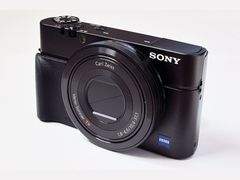 Sony RX100
Yes, with a few add-ons. It records 4K UHD at 24, 25 or 30p in XAVC S at about 100 or 60 Mbps, the screen flips up to face you, and it is the first RX100 with a 3.5 mm microphone jack. Reviewers single out the 4K detail, the stabilization and the tracking autofocus. What it lacks: 10-bit recording, 4K at 60p, a headphone jack and an accessory shoe, so an external mic needs a bracket, a lavalier mic or Sony's shooting grip kit, announced in 2019 at about $1,300 with the camera, a grip, a bracket with a shoe and two batteries.
Heat and light are the two limits. On the default heat setting, 4K stops after about 5 minutes; set Auto Power OFF Temp. to High and Sony's table gives about 30 minutes at 20 C (68 F), but Sony says not to shoot handheld on High and to use a tripod. There is no built-in ND filter, which the RX100 VA has, and a Photography Forum owner says that can be a problem for video on bright days. Cameralabs says the VII adds a much more effective Active SteadyShot option in 4K, though iJustine's video review notes it crops the frame slightly. If you want 4K, a mic input and a built-in ND filter in one pocket camera, Cameralabs points to the Canon G7 X Mark III.
Sources: cameralabs.com, helpguide.sony.net, helpguide.sony.net, helpguide.sony.net, helpguide.sony.net, alphauniverse.com, photographyblog.com, sonyalphalab.com, coolblue.de, thephotoforum.com
What to check before buying a used RX100 VII
The VII and VI essentially share a body, and the faults in owner reports and a US repair shop's list are mostly mechanical (lens, viewfinder, ports and dials), so a short check of each can catch many of them.
- 1
Make sure it is a VII
Look for model DSC-RX100M7 (or DSC-RX100M7A, which ships with a battery charger instead of an AC adapter) and a 3.5 mm mic jack. The VI has no mic jack.
- 2
Power on and zoom
The lens should extend and retract smoothly with no error code. Codes such as C:32, E:61, E:62, E:91 or E:94 point to a malfunction, according to Sony.
- 3
Test the viewfinder and screen
Pop the viewfinder up and down, check it switches between the eyepiece and the screen, and look for cracked eyepiece glass. Tilt the screen and check it on a plain bright frame for blotches.
- 4
Check the ports and dials
Push a plug into the mic jack, click an SD card in and out several times, and turn every dial and the control ring. Video One Repair lists loose mic jacks, card slots that will not hold a card and flaky dials among its common RX100 VII repairs.
- 5
Read what is in the box
MPB listings say whether the battery is Sony or third-party and whether the battery door and charger are included.
- 6
Buy with a warranty
On November 2, 2026, used units came with 90 days at B&H, a free 180 days at Adorama and 6 months at MPB. A non-working unit sold as spares at MPB had no warranty.
Sources: kunkoku.jp, en.wikipedia.org, helpguide.sony.net, videoonerepair.com, cdw.com, mpb.com, bhphotovideo.com, adorama.com
Known problems and what fixing them costs
No Sony recall or service notice for the RX100 VII turned up in the research; these come from Sony's Help Guide, a US repair shop's list and owner reports, so they show what can go wrong rather than how often.
Camera will not power on, or the lens stops with an error code
Raised in 2 opinions
- How you notice
- Owners on CDW and a Finnish retailer describe cameras that stopped booting after weeks or months. MPB sells one that does not power on as spares. Sony's codes C:32, E:61, E:62, E:91 and E:94 point to hardware faults.
- Fix
- Follow Sony's order: remove the battery, wait about a minute, reinsert it and power on, then initialize the settings, then go to a dealer or authorized service. Never force the lens; Sony warns that sand or dust inside can cause damage that sometimes cannot be repaired.
- Typical cost
- No published US price. Video One Repair diagnoses for free and gives a 6-month guarantee. MPB sold a non-working unit for $479 while working ones cost $1,129 to $1,279, which hints at what a dead one sells for.
Sources: helpguide.sony.net, helpguide.sony.net, helpguide.sony.net, mpb.com, videoonerepair.com
4K recording stops after about 5 minutes
Raised in 3 opinions
- How you notice
- On the default Standard heat setting, Sony's table gives about 5 minutes of 4K before the camera stops, and reviewers report thermal shutdowns in direct sun.
- Fix
- Set Auto Power OFF Temp. to High for about 30 minutes at 20 C or 30 C (68 F or 86 F), shoot from a tripod as Sony advises, and drop to 1080p when you can.
- Typical cost
- $0, a menu setting. Sony publishes the 5-minute figure for the Standard setting in its specifications.
Sources: helpguide.sony.net, helpguide.sony.net, thefilmalliance.com
Battery drains fast or will not charge
Raised in 8 opinions
- How you notice
- Sony rates the NP-BX1 at about 260 shots; owners and reviewers say it runs out in a few hours. The charge lamp flashes when charging stops because of temperature or a new or long-unused battery.
- Fix
- Carry spares, charge with the camera off between 10 C and 30 C (50 F to 86 F), and if the lamp flashes before the battery is full, unplug the USB cable and reconnect it.
- Typical cost
- $19.99 for a Watson NP-BX1, $58.00 for Sony's and $65.00 for Sony's charger kit with a battery at B&H (November 2, 2026).
Sources: helpguide.sony.net, helpguide.sony.net, helpguide.sony.net, bhphotovideo.com
Viewfinder will not switch, or its glass cracks
- How you notice
- Video One Repair lists cameras that will not switch between the screen and the eyepiece, a broken auto switch and shattered viewfinder glass among its common RX100 VII repairs.
- Fix
- First check that Finder/Monitor is on Auto and the screen is not tilted out, since Sony says the eye sensor stops working then. Never push hard on the pop-up viewfinder. If it still fails, get a repair estimate.
- Typical cost
- No published US price; Video One Repair quotes after a free diagnosis.
Sources: videoonerepair.com, helpguide.sony.net, helpguide.sony.net, helpguide.sony.net
Blotches on the rear screen
Raised in 1 opinion
- How you notice
- One CDW owner reports blotches across the screen after about two years and says online research points to failing screen adhesive. It is a single owner report, not a Sony notice.
- Fix
- Check the screen on a plain bright frame before buying used, and get a repair estimate if blotches appear.
- Typical cost
- No published US price found.
Sources: cdw.com
Memory card errors
- How you notice
- A card formatted on a computer can trigger 'Unable to use memory card. Format?', an incompatible card or a failed format shows 'Memory card error', and code C:13 means the camera cannot read or write the card.
- Fix
- Copy your files off, then format the card in the camera or swap it. Use a U3 card for 4K at 100 Mbps.
- Typical cost
- $0 to reformat; otherwise the price of a new card.
Sources: helpguide.sony.net, helpguide.sony.net, helpguide.sony.net, helpguide.sony.net
Loose mic jack, card slot or dials
- How you notice
- Video One Repair lists a microphone jack that is loose or intermittent, a card slot where the card will not lock in, bent card reader pins, and dials that work only some of the time.
- Fix
- Test every port and dial before buying used, and get a repair estimate before replacing the camera.
- Typical cost
- No published US price; Video One Repair's diagnosis and estimate are free.
Sources: videoonerepair.com
Damage from sand, moisture or condensation
Raised in 2 opinions
- How you notice
- The camera has no weather sealing. Sony warns that sand or dust inside can cause damage that sometimes cannot be repaired, and that moving from cold to warm air can fog it inside.
- Fix
- Keep it away from sand and spray. Before going from cold to warm, seal it in a plastic bag and wait about an hour, as Sony advises.
- Typical cost
- Prevention is free; water or sand damage means a repair-shop quote.
Sources: helpguide.sony.net, thephoblographer.com
What a Sony RX100 VII costs today, new and used
The RX100 VII is still sold new. Sony raised its US price from $1,299 to $1,699 in July 2025, according to No Film School, but on November 2, 2026 B&H and Adorama both listed it at $1,498.00. Used and open-box copies with a warranty ran $1,087 to $1,440.00. That means buying used saves a few hundred dollars at most.
B&H Photo
New, Body only, in stock
$1,498.00
See listingAdorama
New, Body only
$1,498.00
See listingCDW
New, List price shown before sign-in
$1,997.99
See listingB&H Photo
Used, grade 10 (good as new), Body, 90-day B&H warranty
$1,317.95
See listingB&H Photo
Used, grade 9 (minor surface marks), Body, 90-day B&H warranty
$1,227.95
See listingAdorama
Open box, Free 180-day warranty
$1,440.00
See listingAdorama
Used, Excellent Plus, Free 180-day warranty
$1,425.00
See listingAdorama
Used, Excellent, Free 180-day warranty
$1,418.00
See listingAdorama
Used, Average, Free 180-day warranty
$1,220.00
See listingAdorama
Used, Well Used, Lowest Adorama grade, free 180-day warranty
$1,087.00
See listingMPB
Used, Good to Like New, 6-month warranty; listings say whether the battery is Sony or third-party
$1,129 to $1,279
See listingMPB
Spares and repairs (does not power on), Sold as seen, no warranty
$479
See listing
Prices checked on November 2, 2026. They move every week, so treat them as a range, not a quote. B&H, Adorama and MPB block automated checks, so these prices were read in a browser. CDW's figure is the list price it shows before you sign in. eBay sold listings could not be read, so eBay is left out.
Video reviews worth your time

DPReview TV: Sony RX100 VII Review
The Sony RX100 VII is an extremely capable compact camera with market-leading autofocus and valuable video upgrades, though it suffers from high pricing, limited touch controls, and short battery life.

Vlogging Camera - RX100 VII Review!
The reviewer considers the Sony RX100 VII an exceptional, highly portable vlogging camera due to its newly added microphone jack, advanced autofocus, and powerful features.

Sony RX100 VII review - the BEST pocket camera, at a price
The Sony RX100 VII is a highly capable pocket camera featuring advanced autofocus, extended zoom, and a microphone input, though it carries a premium price tag and a dimmer lens than some competitors.

The BEST Compact Camera EVER Made? | Sony RX100vii in 2026
The Sony RX100 VII is an exceptionally portable compact camera with a versatile zoom range and great vlogging video features, though its 1-inch sensor image quality and lack of weather sealing present minor drawbacks for landscape photography.

OFFICIAL Sony RX100 VII Hands On PREVIEW | A MINI a9?! (vs RX100 VI vs a9)
The Sony RX100 VII offers flagship-level autofocus, unlimited 4K video recording, and a microphone jack in a compact form factor, though its high price tag and lack of an accessory shoe may deter some buyers.
Questions people ask about the RX100 VII
Is the Sony RX100 VII still worth it in 2026?
For travel and fast subjects, most sources say yes: Henry Turner's 2025 review calls it absolutely still worth considering and suggests checking MPB for a used deal, and TechRadar's 2024 update says it remains one of the best compact cameras you can buy. The case against is price and noise: long-term owner Duncan Martin sold his in 2024 after a couple of years, citing high-ISO noise, a soft long end and fiddly controls. At $1,498.00 new on November 2, 2026, it makes most sense if you will use the 200mm reach and the autofocus.
Sources: henryturnerphotography.co.uk, techradar.com, duncanmartin.com, bhphotovideo.com
When was the Sony RX100 VII released, and what did it cost?
Sony announced it on July 25, 2019, with shipping set for August 2019 at about $1,200, body only. TechRadar listed the official US price at $1,299 in May 2024, and No Film School reported a rise to $1,699 in July 2025. On November 2, 2026, B&H and Adorama listed it at $1,498.00.
Sources: alphauniverse.com, techradar.com, nofilmschool.com
Is the Sony RX100 VII good in low light?
Only up to a point. Expert Reviews saw fine detail turn fuzzy above ISO 800 and The Phoblographer calls ISO 1600 the practical top, while Compact Shooter is happy up to ISO 6400. The lens also narrows to f/4.5 at 200mm. It does have a small built-in pop-up flash, which some reviewers like for dinners and parties.
Sources: expertreviews.co.uk, thephoblographer.com, compactshooter.com, myleskatherine.com
Is the Sony RX100 VII better than an iPhone camera?
For zoom and control, yes; for casual phone-screen viewing, not always. Compact Shooter says that if you do not crop heavily and only view on screens, its photos and a latest phone's can look indistinguishable. Ubergizmo says it renders more naturally than the best phones, and the 24-200mm zoom and viewfinder are things a phone cannot match.
Sources: compactshooter.com, ubergizmo.com
How long does the Sony RX100 VII battery last, and does it charge over USB-C?
Sony rates the NP-BX1 at about 260 shots using the screen and 240 with the viewfinder, and Expert Reviews killed one in perhaps two and a half hours. The Film Alliance expects 40 to 45 minutes of 4K, and several reviewers say to carry at least one spare. Charging is in the camera over micro USB, not USB-C: Sony's spec sheet lists a Hi-Speed USB 2.0 micro port, even though Expert Reviews calls it USB Type-C.
Sources: helpguide.sony.net, helpguide.sony.net, expertreviews.co.uk, thefilmalliance.com
Which camera is better than the Sony RX100 VII?
It depends on what you value. Compact Shooter says the Ricoh GR III has a bigger sensor and better image quality but far less versatility. Myles Katherine preferred the color of the [Canon G7 X Mark II](/cameras/canon-powershot-g7-x-mark-ii/), and Cameralabs notes Canon's G7 X III adds an ND filter and a brighter lens for less money. None of them match its 24-200mm zoom.
Sources: compactshooter.com, myleskatherine.com, cameralabs.com
Why is my Sony RX100 VII not turning on?
Start with Sony's steps: remove the battery, wait about a minute, reinsert it and turn the camera on, then initialize the settings. Also try a charged spare, since a flat NP-BX1 is the simplest cause. If it still will not start or shows a code such as C:32 or E:61, Sony says it needs a dealer or authorized service; a few owners on CDW and a Finnish retailer report exactly that failure.
Sources: helpguide.sony.net, helpguide.sony.net, cdw.com
Does the Sony RX100 VII have a built-in flash?
Yes, a small pop-up flash. It does not pop up by itself: slide the flash pop-up switch, then set Flash Mode to Fill-flash if you want it to fire on every shot. Sony lists its range at about 1.31 to 19.35 ft at the wide end with ISO on Auto. You cannot use it while recording movies or in Single Burst mode, and with no accessory shoe there is nowhere to mount a bigger flash.
Sources: helpguide.sony.net, helpguide.sony.net, helpguide.sony.net, cameralabs.com
What people compare it with
Sony RX100 VI
Same body and 24-200mm f/2.8-4.5 lens without the mic jack and the newest autofocus; Cameralabs says much of what makes the VII compelling is in the VI. MPB asked $439 to $1,129 on November 2, 2026. More in the RX100 series guide.
Cameralabs set it against the Sony in 2019: 4K, a brighter lens with an ND filter, a flip screen, a mic input and a lower price, but the Sony zooms much longer and has phase-detect AF and quicker bursts.
The 2014 model with a pop-up viewfinder and a brighter 24-70mm f/1.8-2.8 lens, at $299 to $879 used at MPB, but no 4K and a much shorter zoom.
Canon PowerShot G9 X Mark II
What long-term owner Duncan Martin kept while selling his RX100 VII: it fits a jeans pocket, has a simpler menu and, in his view, a less noisy sensor, but its video is weaker and it has no 4K.
Every source behind this page
Read them yourself. How we pick and count them is in our methodology.
Show all 61 sources
Manuals and references 32
- alphauniverse.com: Sony Announces New RX100 VII | Sony
- en.wikipedia.org: Sony Cyber-shot DSC-RX100 series
- helpguide.sony.net: DSC-RX100M7 | Help Guide
- helpguide.sony.net: DSC-RX100M7 | Help Guide
- helpguide.sony.net: DSC-RX100M7 | Help Guide
- helpguide.sony.net: DSC-RX100M7 | Help Guide
- helpguide.sony.net: DSC-RX100M7 | Help Guide | Self
- helpguide.sony.net: DSC-RX100M7 | Help Guide
- helpguide.sony.net: DSC-RX100M7 | Help Guide | Charging the battery pack while it is inserted in the camera
- helpguide.sony.net: DSC-RX100M7 | Help Guide | Battery life and number of recordable images
- helpguide.sony.net: DSC-RX100M7 | Help Guide
- helpguide.sony.net: DSC-RX100M7 | Help Guide
- helpguide.sony.net: DSC-RX100M7 | Help Guide
- helpguide.sony.net: DSC-RX100M7 | Help Guide
- helpguide.sony.net: DSC-RX100M7 | Help Guide
- helpguide.sony.net: DSC-RX100M7 | Help Guide
- helpguide.sony.net: DSC-RX100M7 | Help Guide
- helpguide.sony.net: DSC-RX100M7 | Help Guide
- helpguide.sony.net: DSC-RX100M7 | Help Guide
- helpguide.sony.net: DSC-RX100M7 | Help Guide
- helpguide.sony.net: DSC-RX100M7 | Help Guide
- helpguide.sony.net: DSC-RX100M7 | Help Guide
- helpguide.sony.net: DSC-RX100M7 | Help Guide
- helpguide.sony.net: DSC-RX100M7 | Help Guide
- helpguide.sony.net: DSC-RX100M7 | Help Guide
- helpguide.sony.net: DSC-RX100M7 | Help Guide
- kunkoku.jp: RX100VIIの新型番「DSC-RX100M7A」が海外ソニーストアに登場。EU USB Type-C充電義務化対策用と思われるバッテリー充電器を付属。 - ソニーが基本的に好き。
- nofilmschool.com: Sony Cameras and Lenses Are Reportedly Seeing Price Hikes of Up to 35% Due to US Tariffs
- adorama.com: adorama.com
- dxomark.com: Sony Cyber-shot DSC-RX100 VII sensor review
- sonyalphalab.com: Sony RX100 VII Review
- videoonerepair.com: Sony RX100 VII Repair | Sony DSC
Editorial reviews 9
- The Phoblographer: The Camera I Almost Threw in the Ocean
- TechRadar: Sony Cyber-shot RX100 VII review
- Lensrentals Blog: Review of the Sony RX100 VII
- Expert Reviews: Sony RX100 VII review: The saviour of the compact camera?
- Wedio: Sony RX100 VII Review | the Ideal On-the-Go Camera
- Coolblue: Expert review of the Sony CyberShot DSC-RX100 VII
- Photography Blog: Sony Cyber-shot RX100 VII Review
- Cameralabs: Sony RX100 VII review
- Ubergizmo: Sony RX100 VII Review
Independent blogs 6
- Henry Turner Photography: Sony RX100 VII Review
- Compact Shooter: Sony RX100 VII Review - 200mm in your pocket!
- The Film Alliance: Sony RX100 VII Review
- Duncan Martin: Sony RX100 VII: Exit Review
- Myles Katherine Photography: Sony RX100 VII Full Review with Sample Photos | How Does it Compare to the Ricoh GR IIIx and Canon G7X Mark II?
- Bluewater Photo: Sony RX100 VII Review
Retailer customer reviews 6
- CDW customer review: Sony Cyber-shot DSC-RX100 VII - digital camera - ZEISS - DSC-RX100M7 - Cameras
- eBay customer review: Reviews: Sony-Cyber-shot-DSC-RX100-VII-20-1MP-Point-Shoot-Digital-Camera-Black
- eBay customer review: Reviews: Sony-Cyber-shot-DSC-RX100-VII-20-1MP-Point-Shoot-Digital-Camera-Black
- eBay customer review: Reviews: Sony-Cyber-shot-DSC-RX100-VII-20-1MP-Point-Shoot-Digital-Camera-Black
- eBay customer review: Reviews: Sony-Cyber-shot-DSC-RX100-VII-20-1MP-Point-Shoot-Digital-Camera-Black
- Verkkokauppa.com customer review: Kokemukset ja arvostelut: Sony RX100 VII -digikamera
Video reviews 5
- DPReview TV: DPReview TV: Sony RX100 VII Review
- iJustine: Vlogging Camera - RX100 VII Review!
- Gordon Laing: Sony RX100 VII review - the BEST pocket camera, at a price
- Henry Turner: The BEST Compact Camera EVER Made? | Sony RX100vii in 2026
- Jared Polin: OFFICIAL Sony RX100 VII Hands On PREVIEW | A MINI a9?! (vs RX100 VI vs a9)
Forums 3
Keep reading
Digicams
Sony RX100 I to VII: what owners and reviewers say, which model to buy, lens errors to check, battery tips, and prices from $455 certified used to $1,498 new.
Digicams
Sony RX100 III: what reviewers and owners say, the lens and battery problems to check, best settings, and used prices from $399 at US dealers in October 2026.
Digicams
Canon PowerShot G7 X Mark III: what reviewers and owners say, overheating and autofocus problems, best settings, and why used ones topped $1,500 in 2026.
Digicams
Canon G7X alternatives you can buy: Sony ZV-1 II ($998), ZV-1F ($598) and RX100 VII ($1,498, on order). Eight picks by use, US prices checked October 2026.
Digicams
Sony RX10 IV: what owners and reviewers say about its 24-600mm lens and autofocus, problems to check, best settings, and used prices from $959 in Nov 2026.
Digicams
A digicam is a digital camera, but today the word means a 2000s compact point-and-shoot. Why they're back, US prices and how a digicam compares with an iPhone.